| GTM-8.19 |
Gas Tanker Manual GTM Personal Safety and Health |
Form No.: GTM-8.19
Revision: 01 Date: 15 Oct 2024 Issued by: DPA Approved by: MD |
19. PERSONAL SAFETY AND HEALTH
Gas tankers are designed such that in normal operation, personnel need at no time be exposed to hazard from the products being transported, provided that the ship and its equipment are properly maintained and operating instructions are observed.
Hazard avoidance depends on:
- Hazard removal
- Hazard control
- Reliance on personal protection
- Training
Liquefied gas relates to the following hazards: asphyxia, toxicity, low temperature, and flammability.
See Health Data Liquids and Vapour/Gases
19.1 ASPHYXIA
Normal breathing requires air with an oxygen content of 20.8%. At 19.5% there is in general a rapid onset of impairment of activity and reasoning power. At levels below 16% oxygen, the onset of unconsciousness may be rapid. At lower levels, exposure time for ultimate survival shortens rapidly. A victim removed from this situation before death may suffer permanent brain damage.
19.2 TOXICITY
Toxicity is the ability of a substance to cause damage to living tissue, the nervous system, illness, and in extreme cases death when ingested, inhaled, or absorbed through the skin.
19.3 THRESHOLD LIMIT VALUES
Given as a guide to vapour concentrations for prolonged exposure, such as might occur in plant operation and usually given in PPM (parts of vapour per million parts of contaminated air by volume).
*HEALTH DATA - LIQUIDS| Substance | Irritant | Cold Burn | Chemical Burn | Skin Absorption |
|---|---|---|---|---|
| LNG | - | X | - | - |
| LPG | - | X | - | - |
| Methane | - | X | - | - |
| Ethane | - | X | - | - |
| Propane | - | X | - | - |
| Butane | - | X | - | - |
| Ethylene | - | X | - | - |
| Propylene | - | X | - | - |
| Butylene | - | X | - | - |
| Substance | Irritant | Cold Burn | Chemical Burn | Skin Absorption |
|---|---|---|---|---|
| Butadiene | X | X | - | - |
| VCM | - | X | - | X |
| Ammonia | X | X | X | - |
| Chlorine | X | X | X | X |
| Ethylene Oxide | X | X | X | - |
| Propylene Oxide | X | - | X | - |
| Nitrogen | - | X | - | - |
| Substance | Asphyxiant | Narcotic | Toxic System | Irritant | Typical TLV TWA (STEL) ppm by vol |
|---|---|---|---|---|---|
| LNG | X | - | - | - | - |
| LPG | X | - | - | - | 1000(1250) |
| Methane | X | - | - | - | - |
| Ethane | X | - | - | - | - |
| Propane | X | - | - | - | - |
| Butane | X | - | - | - | 800 |
| Ethylene | X | X | - | - | - |
| Propylene | X | X | - | - | - |
| Butylene | X | X | - | - | - |
| Butadiene | X | X | - | - | - |
| VCM | X | XX | X | - | 5 |
| Ammonia | X | - | X | X | 25(35) |
| Chlorine | X | - | X | X | 1(3) |
| Ethylene Oxide | X | XX | X | X | 1 |
| Propylene Oxide | X | XX | X | X | 20 |
| Nitrogen | X | - | - | - | - |
| Flue Gas | X | - | X | X | - |
XX Strong
(i) TLV-TWA Time weighted average concentration for an 8-hour day or 40-hour week throughout working life.
(ii) TLV-STEL Short term exposure limit in terms of the maximum concentration allowable for a period of up to 15 minutes duration provided there are no more than 4 such excursions per day and at least 60 minutes between excursions.
(iii) TLV-C The ceiling concentration which should not be exceeded even instantaneously.
While most substances that are quoted are allocated a TLV-TWA and a TLV-STEL, only those which are predominantly fast-acting are given a TLV-C.
19.4 COLD AND CHEMICAL BURNS
Skin contact with materials that are very cold compared with human temperature will cause damage similar to that when contact is made with hot materials of similar temperature difference. Some cargoes will cause chemical burning in addition to cold burning. Gases that cause chemical burning are especially dangerous to the eyes!
19.5 ATMOSPHERE EVALUATION
Vapour detection equipment is required by IMO codes for a number of reasons.
- Cargo vapour in air, inert gas or the vapour of another cargo.
- Concentrations of gas in or near the flammable range.
- Concentrations of oxygen in inert gas, cargo vapour or enclosed spaces.
19.6 OXYGEN ANALYSER/INDICATORS
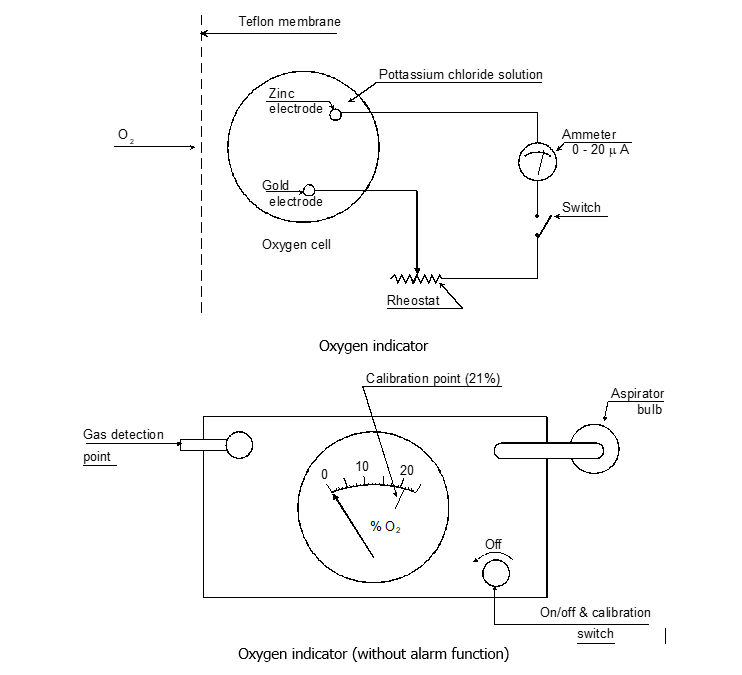
A typical indicator draws the sample through a teflon membrane into a potassium chloride solution and activates a chemical cell. When the switch is closed, current flows round the circuit and deflects the ammeter needle. The more oxygen absorbed by the solution, the greater the current and needle deflection, indicating the percentage oxygen in the sample.
19.7 COMBUSTIBLE GAS INDICATORS
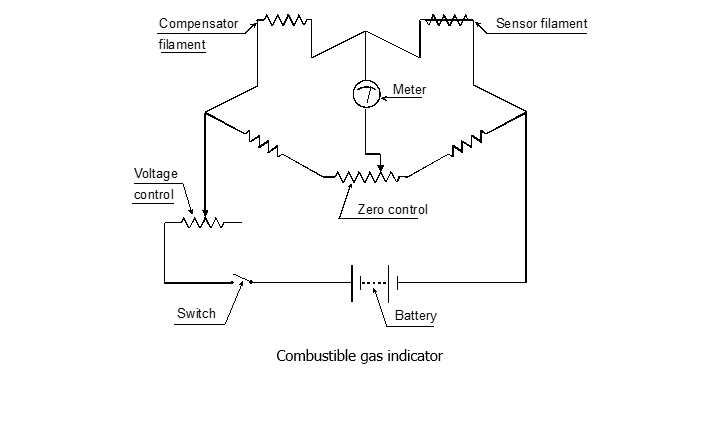
The basic electric circuit (Wheatstone Bridge) of the combustible gas indicator is shown. Sample gas to be measured is aspirated over the specially treated sensor filament which is heated by the bridge current. Although the gas sample may be below the lower flammable limit, it will burn catalytically on the filament surface. In so doing, it will raise the temperature of the filament and thereby increase its electrical resistance, which unbalances the bridge. The resultant imbalance current is shown on the meter and is related to the hydrocarbon content of the sample gas.
19.8 TOXICITY DETECTORS
Toxic gas detectors commonly operate on the principle of absorption of the toxic gas in a chemical tube which results in a colour change. A common type of toxic gas detector is illustrated. Immediately prior to use, the ends are broken from a sealed glass tube. This is inserted into the bellows unit, and a sample is aspirated through it. The reaction between the gases being sampled and the chemicals contained in the tube causes a colour change. Usually, readings are taken from the length of the colour stain against scale indicators marked on the tube and are expressed as parts per million (ppm). Some tubes, however, require the colour change to be matched against a control provided in the instructions. As tubes may have a specific shelf life, they are date stamped and also accompanied by an instruction leaflet which lists any different gases which, being present, may interfere with the accuracy of the indication.
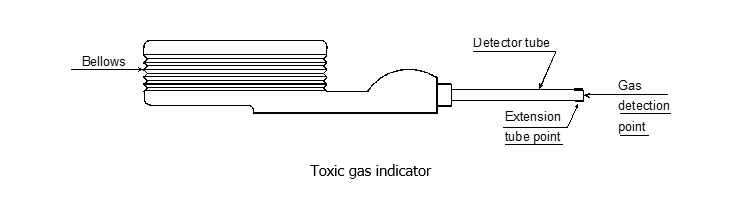
It is important to aspirate the bulb correctly if reliable results are to be obtained. Normally, the bellows are compressed and the unbroken tube inserted. The instrument is then checked for leaks prior to breaking the tube; if found to be faulty, it must be replaced at once.
19.9 VOID SPACES / DUCT KEELS AND PIPE TUNNELS
Because of restricted natural ventilation, these spaces may be oxygen deficient. In addition, they are adjacent to cargo holds and ballast tanks, so both hydrocarbon vapour and inert gas may leak into them. It must be recognised that the rescue of an unconscious or injured person may be very difficult.
Hydrocarbon vapours may also be released from adjacent cargo tanks due to leaks in pipelines or hairline cracks in the tank structure. It is therefore essential that checks are made of these spaces for the presence of hydrocarbons. Some ships will be equipped with automatic detectors and recording devices for this purpose. Ships that do not have such equipment must carry out manual checks at least weekly, and the results should be recorded in the table within the deck log book.
Where the Classification Society rules do not require the permanent lighting systems in these spaces to be isolated during gas trading, the following procedures are to be complied with in order to eliminate the hazards that could result from damaged flameproof fittings:
- The space must be tested and proven gas-free, before the lights are switched on.
- The mechanical ventilation system is to be in operation before the lights are switched on, and must remain in operation until after the lights are switched off.