| CTM 9.3 A3 |
Chemical Tanker Manual CTM USCG Cargo Compatibility Table |
Doc No.: CTM 9.3 A3
Revision: 01 Date: 15 Oct 2024 Issued by: DPA Approved by: MD |
1. INTRODUCTION
- USCG compatibility guide, defines the criteria for incompatibility between two groups as
A mixture of two chemicals is considered hazardous, when, under specified test conditions, the temperature rise of the mixture exceeds 25°C or a gas is evolved
. - The purpose of the Compatibility Chart is to show chemical combinations known or believed to be dangerously reactive in the case of unintentional mixing, to indicate whether bulk chemicals can be shipped in adjacent cargo tanker holds.
- The compatibility guide assigns each bulk chemical cargo to one of the: 22 Reactive groups (Most reactive chemicals) and 14 Cargo groups (Less reactive chemicals).
- Whether cargoes within a pair of groups are incompatible is indicated in the table (Compatibility Chart).
- Although one group can be considered dangerously reactive with another group under normal (ambient) conditions where an "X" appears on the chart, there are wide variations in the reaction rates of individual chemicals within the broad groupings.
- Some individual materials in one group will react violently with some of the materials in another group; others will react slowly, or not at all.
2. USE OF THE TABLE
To check compatibility of two cargoes, follow the following procedure:
- Determine the chemical group of a particular chemical. Example: Cyclohexanone belongs to Group 18, ketones.
- Enter the chart with the chemical group. Proceed across the page.
- "X" indicates a reactivity group that forms an unsafe combination with the chemical in question.
- Example: Caustic and Alcohol, Acetone and EDA (ethylene diamine).
- "E" indicates that the two groups are Compatible but Incompatible Exception Exist.
- "Ⓧ" indicates that the two groups are Incompatible but Compatible Exception Exist.
- If two cargoes are categorized in group numbers between 30 throughout 43, then both cargoes are compatible; therefore the chart need not be referred.
- Example: Toluene (Group 32, aromatic hydrocarbons) is compatible with CTC (carbon tetrachloride) (Group 36, halogenated hydrocarbons).
Note:
- Even though two groups are generally compatible, there may be specific chemical combinations (e.g., trichloroethylene [36] and caustics [5] ) that are incompatible, and combinations may be reactive with one another under non-ambient or impure conditions such as at elevated temperatures or with a catalytic contaminant present.
Coution:
- The Chart should, therefore, not be used as an infallible guide. It is only an aid in the safe storage and handling of chemicals, with the recommendation that proper safeguards be taken to avoid unintentional mixing of binary mixtures for which an ‘%” appears on the chart.
Note:
- Please refer to USCG publication 46 CFR Part 150 for the latest information about the compatibility data.
3 USCG CARGO COMPATIBILITY TABLE
See table below
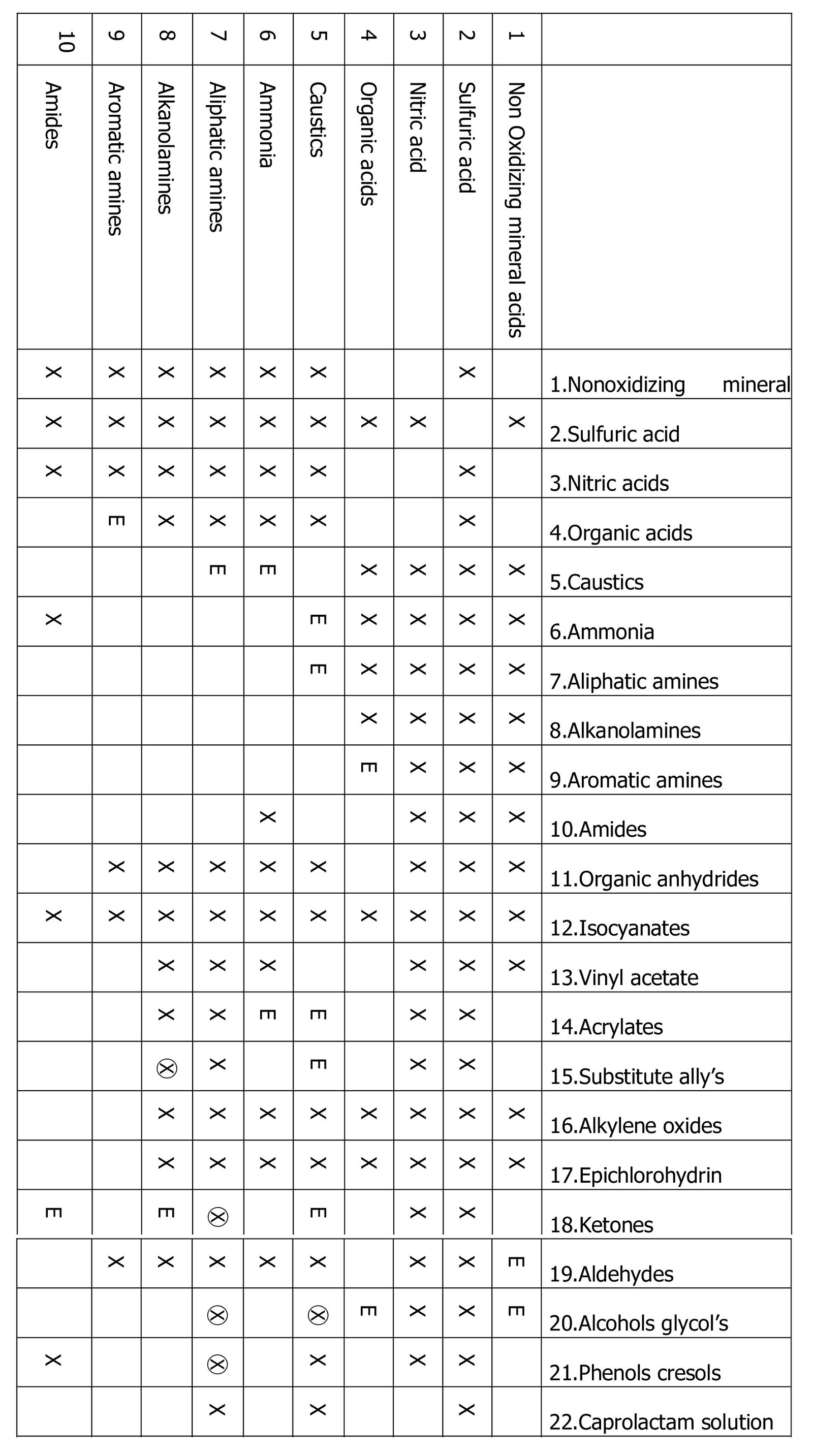
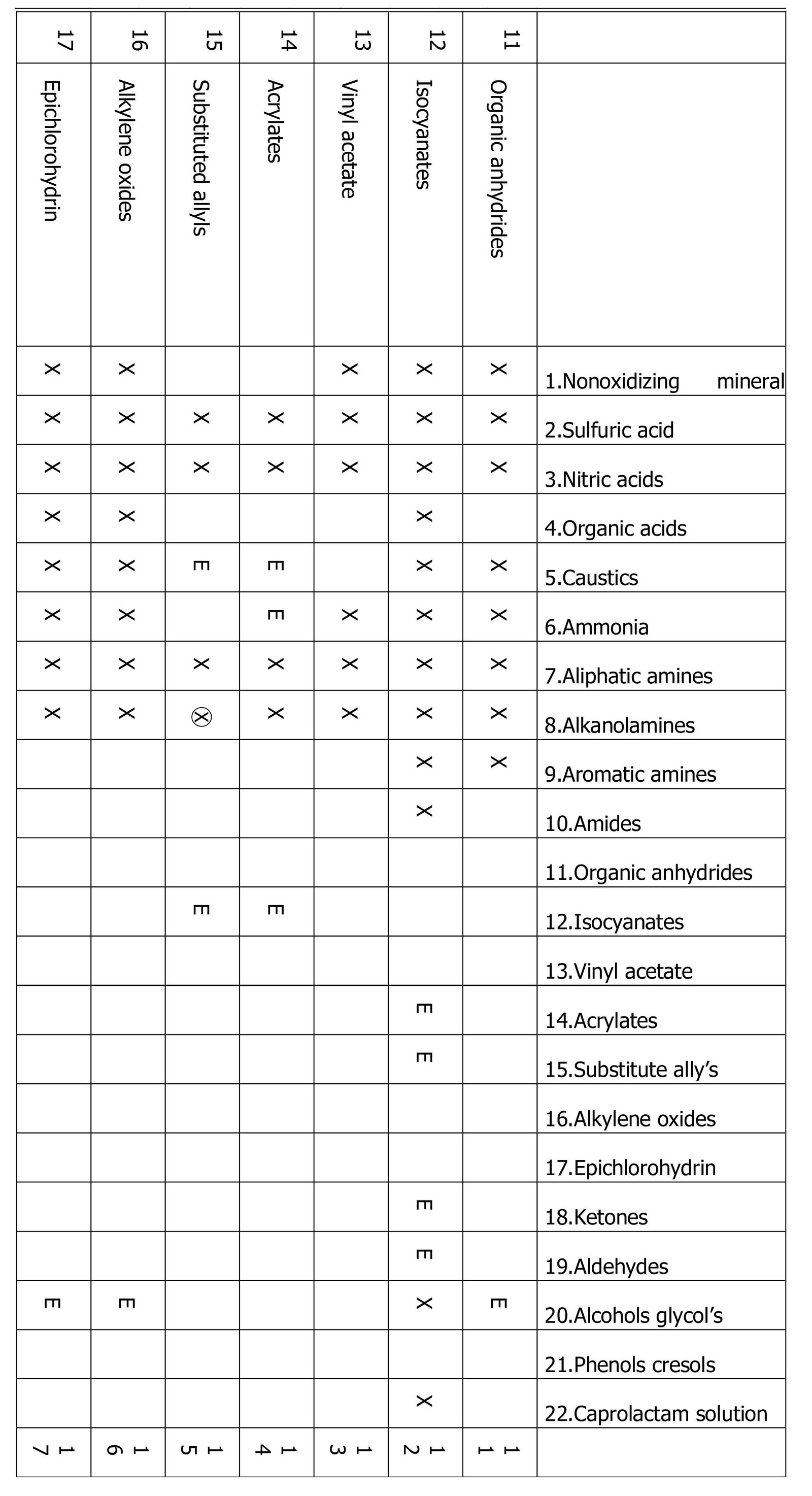
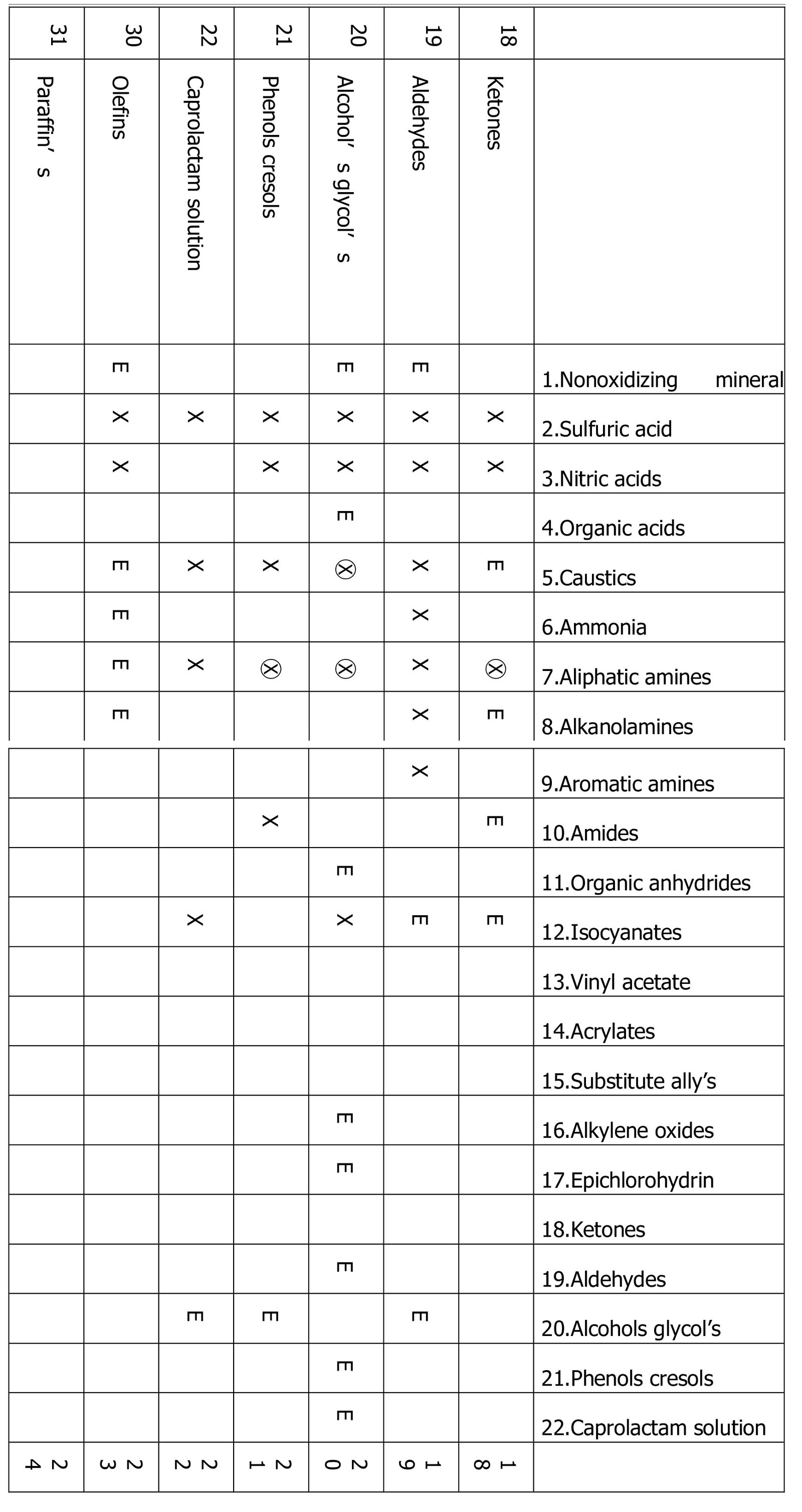
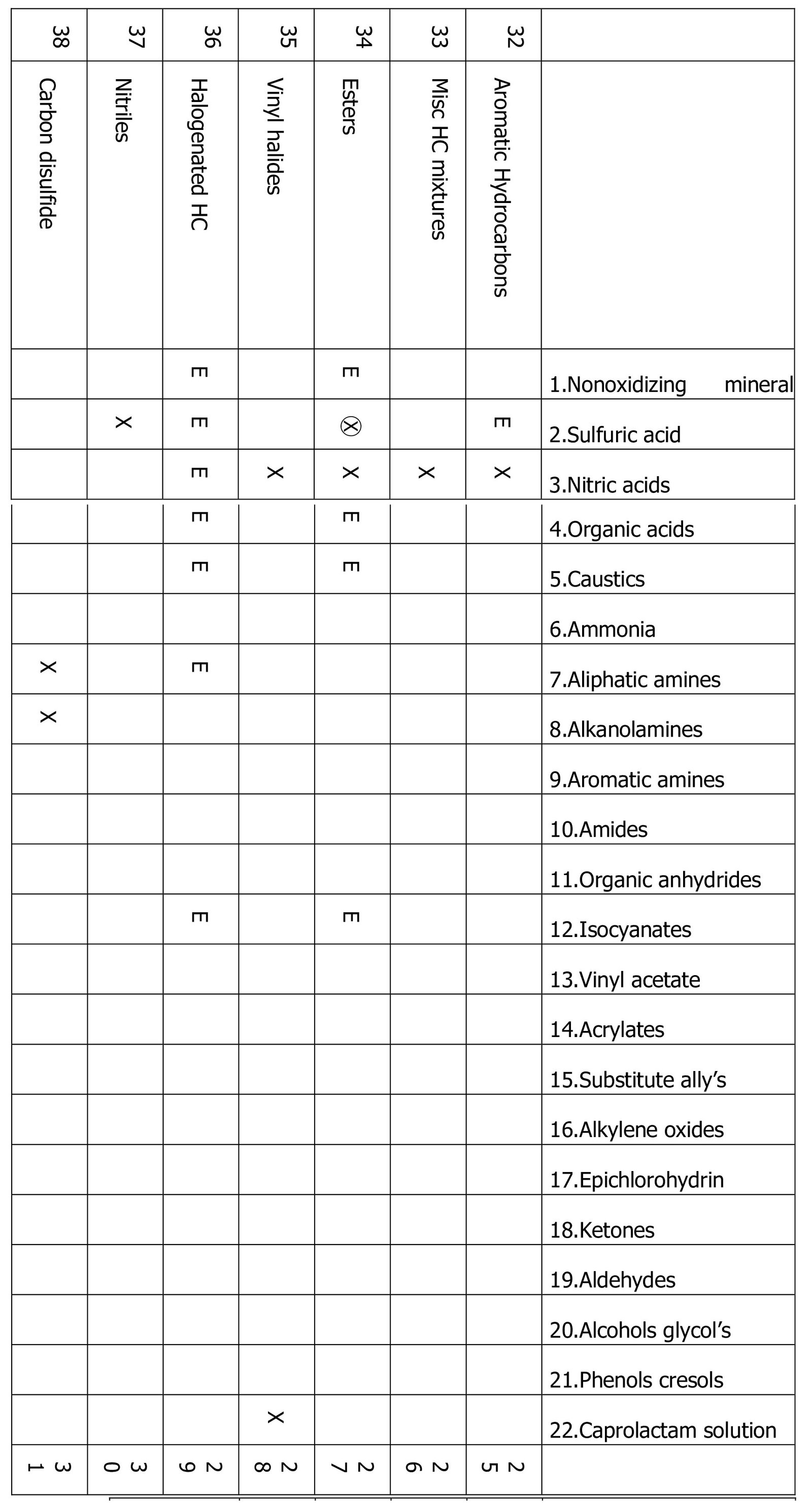
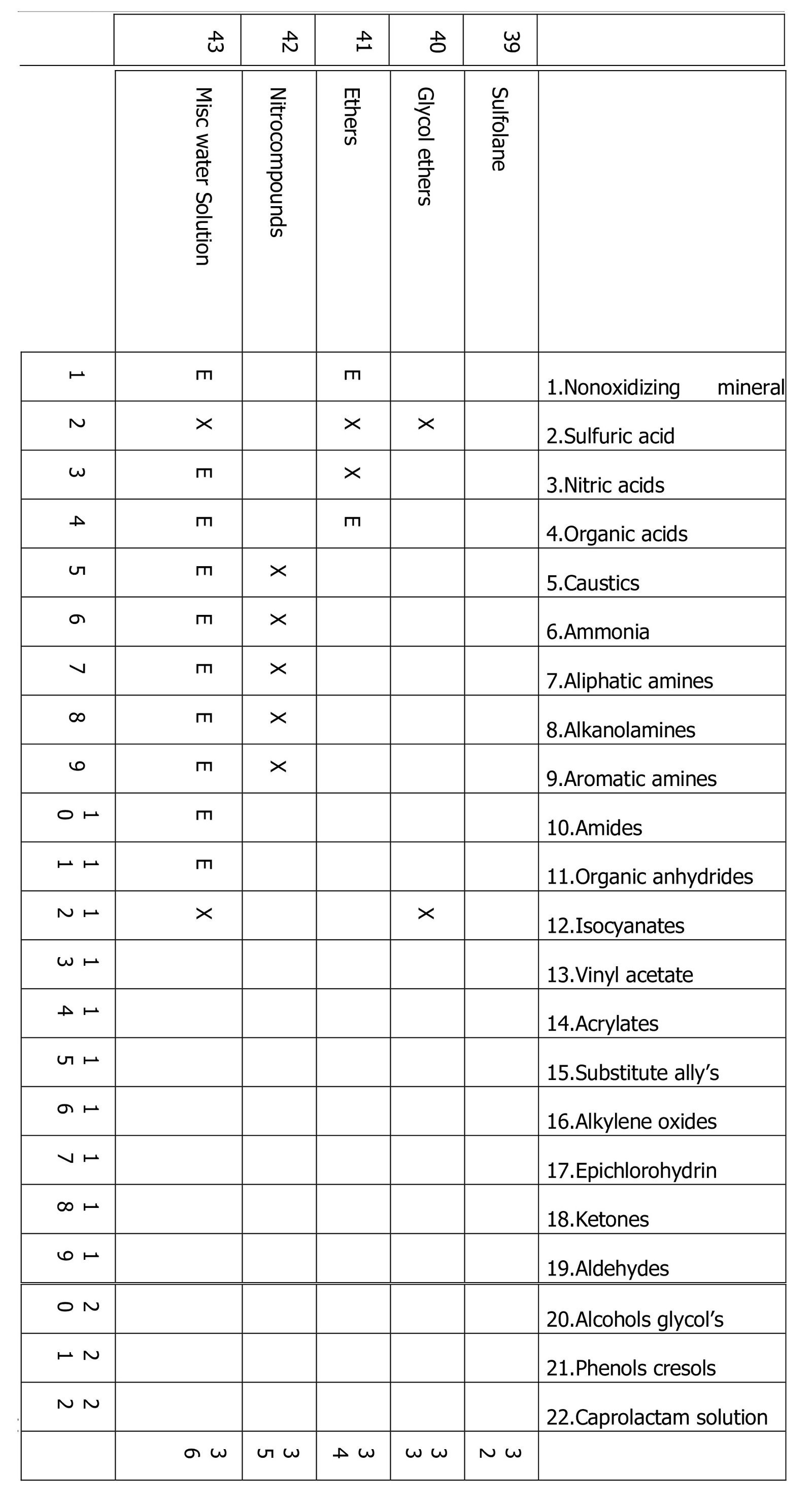
4 EXCEPTIONS TO THE CHART
a) The binary combinations listed below have been tested and found not to be dangerously reactive. These combinations are exceptions to the Compatibility Chart, and may be stowed in adjacent tanks. Please refer to USCG publication 46 CFR Part 150 for the latest information about the below data.
| Member of reactive group | Compatible with |
|---|---|
| Acetone (18) | Diethylenetriamine (7) |
| Acetone cyanohydrin (0) | Acetic acid (4) |
| Acrylonitrile (15) | Triethanolamine (8) |
| 1,3-Butylene glycol (20) | Morpholine (7) |
| 1,4-Butylene glycol (20) | Ethylamine (7) |
| Triethanolamine (8) | gamma-Butyrolactone (0) |
| N-Methyl-2-pyrrolidone (9) | |
| Caustic potash, 50% or less (5) | Isobutyl alcohol (20) |
| Ethyl alcohol (20) | |
| Ethylene glycol (20) | |
| Isopropyl alcohol (20) | |
| Methyl alcohol (20) | |
| iso-Octyl alcohol (20) | |
| Caustic soda, 50% or less (5) | Butyl alcohol (20) |
| tert-Butyl alcohol, Methanol mixtures Decyl alcohol (20) | |
| iso-Decyl alcohol (20) | |
| Diacetone alcohol (20) | |
| Diethylene glycol (40) | |
| Dodecyl alcohol (20) | |
| Ethyl alcohol (20) | |
| Ethyl alcohol (40%, whiskey) (20) | |
| Ethylene glycol (20) | |
| Ethylene glycol, Diethylene glycol mixture (20) | |
| Ethyl hexanol (Octyl alcohol) (20) | |
| Methyl alcohol (20) | |
| Nonyl alcohol (20) | |
| iso-Nonyl alcohol (20) | |
| Propyl alcohol (20) | |
| iso-Propyl alcohol (20) | |
| Propylene glycol (20) | |
| Sodium chlorate solution (0) | |
| iso-Tridecanol (20) | |
| tert-Dodecanethiol (0) | Acrylonitrile (15) |
| Diisodecyl phthalate (34) | |
| Methyl ethyl ketone (18) | |
| iso-Nonyl alcohol (20) | |
| Perchloroethylene (36) | |
| iso-Propyl alcohol (20) | |
| Tall oil, crude | |
| Dodecyl and Tetradecylamine mixture (7) | Tall oil, fatty acid (34) |
| Ethylenediamine (7) | Butyl alcohol (20) |
| tert-Butyl alcohol (20) | |
| Butylene glycol (20) | |
| Creosote (21) | |
| Diethylene glycol (40) | |
| Ethyl alcohol (20) | |
| Ethylene glycol (20) | |
| Ethyl hexanol (20) | |
| Glycerine (20) | |
| Isononyl alcohol (20) | |
| Isophorone (18) | |
| Methyl butyl ketone (18) | |
| Methyl iso-butyl ketone (18) | |
| Methyl ethyl ketone (18) | |
| Propyl alcohol (20) | |
| Propylene glycol (20) | |
| Oleum (0) | Hexane (31) |
| Dichloromethane (36) | |
| Perchloroethylene (36) | |
| 1,2-Propylene glycol (20) | Diethylenetriamine (7) |
| Polyethylene polyamines (7) | |
| Triethylenetetramine (7) | |
| Sodium dichromate, 70% (0) | Methyl alcohol (20) |
| Sodium hydrosulfide solution (5) | Methyl alcohol (20) |
| Iso-Propyl alcohol (20) | |
| Sulfuric acid (2) | Coconut oil (34) |
| Coconut oil acid (34) | |
| Palm oil (34) | |
| Tallow (34) | |
| Sulfuric acid, 98% or less (2) | Choice white grease tallow (34) |
b) The binary combinations listed below have been determined to be dangerously reactive, based on either data obtained in the literature or laboratory testing. These combinations are exceptions to the Compatibility Chart (Figure 1) and may not be stowed in adjacent tanks.
- Acetone cyanohydrin (0): not compatible with Groups 1-12, 16, 17, and 22.
- Acrolein (19): not compatible with Group 1, Non-Oxidizing Mineral Acids.
- Acrylic acid (4): not compatible with Group 9, Aromatic Amines.
- Acrylonitrile (15): not compatible with Group 5 (Caustics).
- Alkylbenzenesulfonic acid (0): not compatible with Groups 1-3, 5-9, 15, 16, 18, 19, 30, 34, 37, and strong oxidizers.
- Allyl alcohol (15): not compatible with Group 12, Isocyanates.
- Alkyl(C7–C9) nitrates (34): not compatible with Group 1, Non-oxidizing Mineral Acids.
- Aluminum sulfate solution (43): not compatible with Groups 5-11.
- Ammonium bisulfite solution (43): not compatible with Groups 1, 3, 4, and 5.
- Benzenesulfonyl chloride (0): not compatible with Groups 5-7, and 43.
- 1,4-Butylene glycol (20): not compatible with Caustic soda solution, 50% or less (5).
- gamma-Butyrolactone (0): not compatible with Groups 1-9.
- C9 Resinfeed (DSM) (32): not compatible with Group 2, Sulfuric acid.
- Carbon tetrachloride (36): not compatible with Tetraethylenepentamine or Triethylenetetramine, both Group 7, Aliphatic amines.
- Catoxid feedstock (36): not compatible with Group 1, 2, 3, 4, 5, or 12.
- Caustic soda solution, 50% or less (5): not compatible with 1,4-Butylene glycol (20).
- 1-(4-Chlorophenyl)-4,4-dimethyl pentan-3-one (18): not compatible with Group 5 (Caustics) or 10 (Amides).
- Crotonaldehyde (19): not compatible with Group 1, Non-Oxidizing Mineral Acids.
- Cyclohexanone, Cyclohexanol mixture (18): not compatible with Group 12, Isocyanates.
- 2,4-Dichlorophenoxyacetic acid, Triisopropanolamine salt solution (43): not compatible with Group 3, Nitric Acid.
- 2,4-Dichlorophenoxyacetic acid, Dimethylamine salt solution (0): not compatible with Groups 1-5, 11, 12, and 16.
- Diethylenetriamine (7): not compatible with 1,2,3-Trichloropropane, Group 36, Halogenated hydrocarbons.
- Dimethyl hydrogen phosphite (34): not compatible with Groups 1 and 4.
- Dimethyl naphthalene sulfonic acid, sodium salt solution (34): not compatible with Group 12, Formaldehyde, and strong oxidizing agents.
- Dodecylbenzenesulfonic acid (0): not compatible with oxidizing agents and Groups 1, 2, 3, 5, 6, 7, 8, 9, 15, 16, 18, 19, 30, 34, and 37.
- Ethylenediamine (7) and Ethyleneamine EA 1302 (7): not compatible with either Ethylene dichloride (36) or 1,2,3-Trichloropropane (36).
- Ethylene dichloride (36): not compatible with Ethylenediamine (7) or Ethyleneamine EA 1302 (7).
- Ethylidene norbornene (30): not compatible with Groups 1-3 and 5-8.
- 2-Ethyl-3-propylacrolein (19): not compatible with Group 1, Non-Oxidizing Mineral Acids.
- Ethyl tert-butyl ether (41): not compatible with Group 1, Non-oxidizing mineral acids.
- Ferric hydroxyethylethylenediamine triacetic acid, Sodium salt solution (43): not compatible with Group 3, Nitric acid.
- Fish oil (34): not compatible with Sulfuric acid (2).
- Formaldehyde (over 50%) in Methyl alcohol (over 30%) (19): not compatible with Group 12, Isocyanates.
- Formic acid (4): not compatible with Furfural alcohol (20).
- Furfuryl alcohol (20): not compatible with Group 1, Non-Oxidizing Mineral Acids and Formic acid (4).
- 2-Hydroxyethyl acrylate (14): not compatible with Group 5, 6, or 12.
- Isophorone (18): not compatible with Group 8, Alkanolamines.
- Magnesium chloride solution (0): not compatible with Groups 2, 3, 5, 6 and 12.
- Mesityl oxide (18): not compatible with Group 8, Alkanolamines.
- Methacrylonitrile (15): not compatible with Group 5 (Caustics).
- Methyl tert-butyl ether (41): not compatible with Group 1, Non-oxidizing Mineral Acids.
- NIAX POLYOL APP 240C (0): not compatible with Group 2, 3, 5, 7, or 12.
- o-Nitrophenol (0): not compatible with Groups 2, 3, and 5-10.
- Octyl nitrates (all isomers): see Alkyl(C7–C9) nitrates.
- Oleum (0): not compatible with Sulfuric acid (2) and 1,1,1-Trichloroethane (36).
- Phthalate based polyester polyol (0): not compatible with Group 2, 3, 5, 7 and 12.
- Polyglycerine, Sodium salts solution (20): not compatible with Groups 1, 4, 11, 16, 17, 19, 21 and 22.
- Propylene, Propane, MAPP gas mixture (containing 12% or less MAPP gas) (30): not compatible with Group 1 (Non-oxidizing mineral acids), Group 36 (Halogenated hydrocarbons), nitrogen dioxide, oxidizing materials, or molten sulfur.
- Sodium acetate, Glycol, Water mixture (1% or less Sodium hydroxide) (34): not compatible with Group 12 (Isocyanates).
- Sodium chlorate solution (50% or less) (0): not compatible with Groups 1-3, 5, 7, 8, 10, 12, 13, 17 and 20.
- Sodium dichromate solution (70% or less) (0): not compatible with Groups 1-3, 5, 7, 8, 10, 12, 13, 17 and 20.
- Sodium dimethyl naphthalene sulfonate solution (34): not compatible with Group 12, Formaldehyde and strong oxidizing agents.
- Sodium hydrogen sulfide, Sodium carbonate solution (0): not compatible with Groups 6 (Ammonia) and 7 (Aliphatic amines).
- Sodium hydrosulfide (5): not compatible with Groups 6 (Ammonia) and 7 (Aliphatic amines).
- Sodium hydrosulfide, Ammonium sulfide solution (5): not compatible with Groups 6 (Ammonia) and 7 (Aliphatic amines).
- Sodium polyacrylate solution (43): not compatible with Group 3, Nitric Acid.
- Sodium silicate solution (43): not compatible with Group 3, Nitric Acid.
- Sodium sulfide, hydrosulfide solution (0): not compatible with Groups 6 (Ammonia) and 7 (Aliphatic amines).
- Sodium thiocyanate (56% or less) (0): not compatible with Groups 1-4.
- Sulfonated polyacrylate solution (43): not compatible with Group 5 (Caustics).
- Sulfuric acid (2): not compatible with Fish oil (34), or Oleum (0).
- Tall oil fatty acid (Resin acids less than 20%) (34): not compatible with Group 5, Caustics.
- Tallow fatty acid (34): not compatible with Group 5, Caustics.
- Tetraethylenepentamine (7): not compatible with Carbon tetrachloride, Group 36, Halogenated hydrocarbons.
- 1,2,3-Trichloropropane (36): not compatible with Diethylenetriamine, Ethylenediamine, Ethyleneamine EA 1302, or Triethylenetetramine, all Group 7, Aliphatic amines.
- 1,1,1-Trichloroethane (36): not compatible with Oleum (0).
- Trichloroethylene (36): not compatible with Group 5, Caustics.
- Triethylenetetramine (7): not compatible with Carbon tetrachloride, or 1,2,3-Trichloropropane, both Group 36, Halogenated hydrocarbons.
- Triethyl phosphite (34): not compatible with Groups 1, and 4.
- Trimethyl phosphite (34): not compatible with Groups 1 and 4.
- 1,3,5-Trioxane (41): not compatible with Group 1 (non-oxidizing mineral acids) and Group 4 (Organic acids).