| CTM 9.3 |
Chemical Tanker Manual CTM Cargo Stowage Planning |
Doc No.: CTM 9.3
Revision: 01 Date: 15 Oct 2024 Issued by: DPA Approved by: MD |
1. APPLICATION
This document applies to all Chemical Tankers managed by Company.
2. PURPOSE
The purpose of this document is to provide guidelines and procedures for cargo stowage planning.
3. CARGO INFORMATION
Master shall ensure following information is available for each cargo prior to loading:
- Physical and chemical properties - full description
- Compatibility with other materials.
- Action to be taken in the event of spills or leaks.
- Accidental personal contact - Countermeasures.
- Fire-fighting procedures and fire extinguishing media.
- Whether chemical is stabilized/inhibited including limitations of the inhibitor.
- Procedures for cargo transfer, tank cleaning, gas freeing and ballasting.
- Requirement of Antidotes as per MSDS or IMDG Code supplement.
- Review of emergency procedures as per IMDG Code supplement.
- Requirement of gas detection equipment applicable for the cargoes.
- Any other special requirements.
See also CTM 9.2 Section 3.3 Cargo Safety information.
Coution:
- Cargo operation should not be started without having on board the applicable antidote and gas detection equipment.
- In case if a crew member is unexpectedly exposed to any toxic cargo, expert medical opinion from a shore-based doctor should be taken and any tests recommended by the doctor for determining the extent of exposure shall be undertaken.
4. VOYAGE ORDERS AND CARGO QUANTITIES
The commercial operator will provide:
- Details of new fixture
- Charterers voyage orders
Upon receipt of Charterer’s voyage orders, master shall:
- Acknowledge on the day of receipt
- Confirm cargo intake and make a stowage plan
- Send preliminary stowage plan to vessel Operators
- Complete required Terminals Questionnaires / checklist as applicable
- Send Notices to Agents/Shippers/Port Terminals as per Charter Party/Charterers voyage orders
- Check and advise Bunkering requirements for the voyage to the operators
Note:
- 1. Voyage order
- Voyage orders may be accompanied with proposed stowage. Master shall thoroughly check the same and propose changes to Operator. Inform Marine Superintendent in case of difficulty in complying operation’s instructions or voyage orders whatsoever. Marine Superintendent should be kept in loop for any communication with charterer or operator.
- 2. Carriage of any cargo new to the company:
- In case if a cargo new to the company, is proposed for carriage on any company vessel, the marine superintendent of the vessel shall carry out a proper evaluation of the cargo in consultation with the Marine Manager. Following shall be reviewed as a minimum during this evaluation:
- - Review of latest MEPC.2/Circular (if applicable).
- - Suitability of the vessel’s equipment and her cargo tank coating for the carriage of the cargo.
- - Review of COF (List of cargoes) of the vessel
- - Hazards of the cargo.
- - Any special handling requirements like special PPE, carriage temperature, tank environment control requirement etc.
- - Any requirement of Antidotes or any other special equipment for safe handling of cargo.
- - Review of IMDG Code supplement
- - Any need of familiarization training of on-board crew.
5. CARGO STOWAGE PLANNING
See the process flow chart - CTM 9.3 A1 Cargo Stowage Process - Flow Charts
Master / Chief Officer shall refer to guidance in the following sections when making the Stowage plan.
6. REFERENCE DOCUMENTS
Consult following documents for Cargo Stowage:
- Certificate of Fitness (COF) - list of chemicals - Nominated cargo must be mentioned herein.
Master should check the following points in connection to change of ship type:
- Vessel should maintain COF for both ship type 2 and type 3 at all times.
- Master to acknowledge receipt of orders from Company, in writing, for change of ship type.
- Master to provide for change of ship type with due regards to all relevant instructions in the approved P&A Manual.
- Master to ensure official entry to be made in the ship’s deck log.
- Master to ensure corresponding Certificate of Fitness to be posted / placed in valid certificates file. At a time only one COF type can be used.
- Master to ensure the other held Certificate of Fitness (not in use) to be placed in sealed envelope and kept in Master’s safe.
- Master to notify the Company and RO, in writing, upon completion of change of ship type (written notification could contain specific information in relation to ship type in use).
- The scope and extent of statutory surveys shall be those applicable to a Type 2 Chemical Tanker regardless of whether the chemical tanker is operating as or downgrading to a Type 3 Chemical Tanker at the time of the surveys.
- Upon satisfactory completion of annual/intermediate statutory surveys, the Surveyor of the Recognized Organization is to endorse both the Certificate of Fitness for Type 2 Chemical Tanker and that for Type 3 Chemical Tanker.
Note:
- IBC Code requirements for:
- Ship Type 1 each tank capacity not more than 1250 m3;
- Ship Type 2 each tank capacity not more than 3000 m3;
- Ship Type 3 each tank capacity not regulated.
In case ship is carrying any ship type 2 parcel, she will be on ship type 2 COF. In this case, she cannot get 2K exemption for loading vegetable oils more than 3000 cu meters per tank.
2K exemption is only available when ship is on ship type 3 COF.
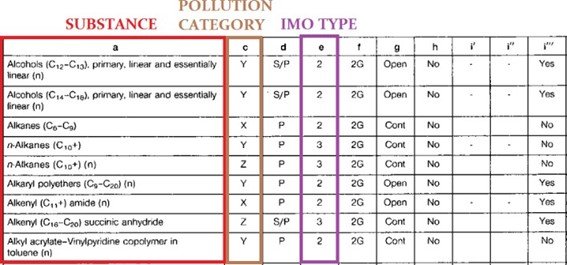
Chapter 15 of the Code contains ‘Special Requirements’ which are cargo specific and which must be complied with only if that specific cargo is to be carried.
Chapter 16 addresses aspects, which are the responsibility of the operator. Chapter 17 lists all chemicals considered being suitable for transportation by sea.
Coution:
- If Nominated Cargo is not mentioned in COF, Master shall advise Operator and Tech Superintendent/ Marine Superintendent.
- Tech Superintendent/ Marine Superintendent shall after consultation with Operator approach the Classification Society to issue addendum to COF, subject to vessel being found fit to carry the said cargo.
- IBC Code chapters 17 or 18 - Nominated Cargo must be classified herein.
- In case, there is a new cargo coming for carriage, which company has never carried before, a risk assessment will be undertaken and actions taken accordingly to ensure safe carriage.
Reference Documents
Coution:
- In case a cargo is not yet classified for bulk shipment, the manufacturer will have to request and obtain a “Tripartite Agreement”.
- For Carriage requirements and other details See CTM 9.3 A2 MEPC.2- Circ- circular relating to Provisional catergorization of liquid substances
- Vessel Manager/ Marine Superintendent shall approach the Classification Society/ Flag State to issue addendum to COF, subject to vessel being found fit to carry the said cargo.
- Loading Manual
- Trim & Stability Booklet
- P&A Manual
- Damage Stability Booklet
- Coating Compatibility Guide (For Vessels with coated cargo tanks)
- Ship specific stainless steel guide (For vessels with Stainless steel tanks)
7. SEGREGATION
7.1 Reactivity with other cargoes (CDI 5.5.3)
- Keep incompatible chemical cargoes strictly separated from each other throughout the entire cargo containment and handling system, to avoid accidental mixing.
- Achieve separation by having two barriers between containment systems of the incompatible chemicals.
For more details regarding the use of the USCG Cargo Compatibility Table, see CTM 9.3 A3 USCG Cargo Compatibility Table.
7.2 Segregation from other tanks loaded with heated cargoes
- Never load heated cargoes adjacent to:
- Cargoes with self-reactivity such as polymerisation, decomposition, thermal instability, etc.
- Excessive heating will shorten the life of the stabilizing inhibitor resulting in progress of self- reaction and finally deterioration in quality.
- If Cargo is subjected to IBC Code 16.6.1, do not stow heated cargo adjacent to it even if the heating temperature to be maintained is not so high as to make the cargo in adjacent tank self-react
- Cargo of low boiling point.
- Excessive evaporation of the cargo will result in cargo loss and possible vapour hazard in cargo area.
- A difference of 10°C between the boiling point of the non-heated cargo and the maximum temperature of the heated cargo stowed in an adjacent tank is normally sufficient as a safe margin in planning adjacent stowage.
- Avoid stowage of heated cargoes adjacent to tanks containing toxic cargo to minimize the possible release of toxic cargo vapour onto cargo area.
Note:
Coution:
Note:
Note:
7.3 Segregation of cargoes reactive with water
- Segregate cargo tanks loaded with such cargoes from the tanks loaded with water such as:
- Fresh water for tank-cleaning
- Clean sea water as gale ballast
- Any leakage of water into the cargoes may cause hydrolysis of the cargoes resulting in increased corrosivity
- Ensure the following are completely cleaned and dried to eliminate any residual water:
- Cargo tanks
- Pipelines and other associated fittings
- Ensure the heating coils are blown dry and blanked.
Coution:
Note:
- Also Refer to Paragraph 15.16.2 of IBC Code or equivalent of BCH Code for carriage of cargoes reactive with water
8. RESTRICTION OF LOADING EDIBLE OILS
Note:
- The shippers / consignees belonging to NIOP (in North America) and FOSFA (in Europe) restrict loading of their edible oils into cargo tanks which have carried certain hazardous cargoes previously by the rules of "NIOP/ FOSFA".
- Edible oils owned by these shippers and/or consignees must be loaded in the tanks which satisfy the rules.
- Check voyage orders to confirm if the shipment falls under NIOP or FOSFA rules.
- If in doubt, clarify with Operators keeping Marine Department in copy.
- Plan the stowage of such edible oils as per the requirements of the rules.
- For lists of restricted or acceptable previous cargoes and further information on FOSFA, see CTM 9.3 A4 – FOSFA Regulations.
9. LOADING LIMITATION OF CARGO
9.1 Filling limits for cargo thermal expansion
- In calculating the ullage to which the tanks are to be loaded, Officer in charge shall:
- Give due allowance for temperature increases either from:
- Changes in climatic conditions, or
- Cargo heating.
- Avoid excessive allowance so that cargo is not shut out unnecessarily.
- Never load a cargo tank beyond 98% of its capacity.
- Consider following when determining the highest temperature which the cargo may reach – the period, season, route, etc. of the voyage and cargo loading condition in each case
- Take into consideration Trim of vessel in expected loaded conditions.
- Do consider an error of measurement of the liquid level
- Consider that cargo tanks can be loaded up to the maximum filling ratio as below:
Note:
Note:
Max. Filling ratio (% full) = 100 (1 - R x T) – S where;
R: Coefficient of cubical expansion per °C (see the data sheet)
T: Expected maximum temperature rise (°C)
S: Safety margin, usually 2% of capacity
Coution:
- Do not accept "shore stop" when the final ullage of a cargo tank is likely to be smaller than the ullage calculated by the above formula.
9.2 Filling limits for cargo tank design specific gravity (CDI 5.5.6)
- Officer in charge shall:
- Consider the correction between the design specific gravity (DSG) of the cargo tanks and the specific gravity (SG) of the cargo loaded.
- Be aware of Max. Filling limit calculated as below:
Max. Filling ratio (% full) = DSG / SG x 100
Example of calculation:
DSG = 1.4
SG = 1.48 (Chloroform)
Then filling ratio is 1.4 / 1.48 x 100 = 94.6%
9.3 Filling limits for sloshing strength of cargo tank
Coution:
- In general, partial loading between 20% and 80% of filling ratio is prohibited. This is to avoid an excessive sloshing load in the tank structure.
- If partial loading, however is involved in the intended plan:
- Cargoes may be loaded to the extent of a safe loading percentage which the officer in charge shall determine after referring to the sloshing calculation shown on Vessel's Loading Operation Manual.
Note:
- The greater the Specific Gravity, the more severe the effect of sloshing on the vessel's structure.
10. STABILITY AND STRESS
- Officer in charge shall:
- Apply weight distributions for various conditions of loading as detailed in the Trim and Stability (Loading) Manual onboard.
- Verify above distribution by the stress and stability indicators.
- All vessels are supplied with an approved P & A Manual, which states all procedure to be followed and arrangements of the equipment and pipelines for the cargo operation.
- File evidence that a stress and stability calculation has been made for the current voyage and cargo operation.
- This may be in either written form or as stored in the computer.
Note:
Note:
11. DAMAGE STABILITY CHARACTERISTICS
- Master shall:
- Verify that the intended stowage plan has a sufficient survival capability in damaged condition as per the requirement of the Code.
- Officer in charge shall make an entry in the Deck Log Book as an evidence that damage stability is evaluated for every voyage.
- Ensure that all deck officers are familiar with the damage stability characteristics of the vessel.
Note:
Note:
- The damage stability calculation is based on Chapter 2 "Ship Survival Capability and Location of Cargo Tanks" of the IBC Code or equivalent of BCH Code. For detailed method of calculation, refer to Damage Stability Manual
12. APPENDICES
- CTM 9.3 A1 Cargo Stowage Process - Flow Charts
- CTM 9.3 A2 MEPC.2- Circ - Provisional categorisation of liquid substances
- CTM 9.3 A3 USCG Cargo Compatibility Table
- CTM 9.3 A4 FOSFA Regulations