| CTM 9.7 A2 |
Chemical Tanker Manual CTM Wall Wash Tests |
Doc No.: CTM 9.7 A2
Revision: 01 Date: 15 Oct 2024 Issued by: DPA Approved by: MD |
1. GENERAL
The wall wash test is done to determine the state of cleanliness of the cargo tanks and is the final stage of tank cleaning operation for verification of results. This involves spraying a highly active solvent (usually Methanol) against a segment of the tank surface cleaned. The liquid is collected and analysed with different methods. The wall wash sample is analysed for the following:
- Colour Test
- Chloride Test
- Hydrocarbon Test
- Permanganate Time Test (P.T.T)
- Non-Volatile Matters Test (NVM Test)
On the basis of the wall wash test result, it is decided whether further cleaning is required and if so, the procedure to be followed. The test is carried out after the tank is cleaned as per the charterers’ instructions and requisite steaming is completed, and tanks drained and dried.
2. WALL WASH TEST KIT
The chemical tankers engaged in carriage of wall wash test cargoes shall carry approximately the following wall wash test equipment at all times. Actual quantity can vary as per the trading pattern of the vessel.
- Wall Wash Test Equipment (Quantities may vary as per vessel's trading pattern)
- Other relevant materials required for testing
| Item | Unit | Quantity |
|---|---|---|
| pH papers in range 0-14 | 1 box/100pcs | 1 box |
| 2% Silver nitrate solution (AGNO3) | 500 Ml | 2 bottles |
| 20% Nitric acid (HNO3) | ||
| Pipette | 5 Ml | 3 |
| Chloride standard solution (10 PPM) | 500 ml | 2 bottles |
| Filter papers, folded | 1 box/100 pcs | 1 |
| Funnel glass | 2 | |
| Half cut funnel | Plastic | 1 |
| Graduated Nessler tubes | 100 ml and 50 ml | 6 each |
| Disposable gloves | 24 | |
| Distilled water | 2.5 liters | 6 |
| 0.02% Potassium Permanganate standard solution | 250 ml | 1 bottle |
| Black board | 12 inches x 6 inches | 1 |
| White board | 12 inches x 6 inches | |
| Nessler tube stand | 1 | |
| Pure wall wash test methanol | 1 liter bottles | 24 |
| Methanol dispenser | 1 liter | 2 |
| Sample bottles | 500 ml | 6 |
| Permanent markers | 2 | |
| Glass chalet for NVM test | 100 ml | 1 |
3. PRECAUTIONS
a) Safety Considerations
Eye protection is required when collecting the samples to prevent the inadvertent contact of methanol with eyes during sample collection. Gloves should be worn to prevent the absorption of methanol through the skin. Disposable plastic gloves are worn to prevent contamination of the sample during the collection process (sufficient amounts of chlorides can be absorbed from the skin to cause the sample to fail the chloride analysis).
Also, all sampling equipment including bottles, funnels, and other apparatus must be thoroughly rinsed with methanol prior to use as chlorides are abundant in the environment. Personnel collecting the samples must be aware that the samples or sampling equipment must not in any way contact bare skin or perspiration.
b) Test Sites
A minimum of four (4) sites, approximately 1 square metre each, must be chosen in each tank. Any area that appears to have crystalline deposits must definitely be tested.
c) Collection Procedure
Dispense methanol on the test sections at the highest practical point (about 1.5 to 2 metres) above the tank bottom in a stream of about 10 cm wide. Allow the methanol to run down the wall approximately 15 cm and begin collecting it with a half-cut funnel pressed against the bulkhead. Collect about 200 ml of sample of wall wash methanol in the sample bottle from four sites. This methanol sample collected is to be used for analysis.
3.1 Colour Test
Certain impurities result in discoloration of the wall wash sample. The color of the wall wash liquid is compared to a standard solution. Mostly, APHA color is measured for this comparison.
3.2 Chloride Test
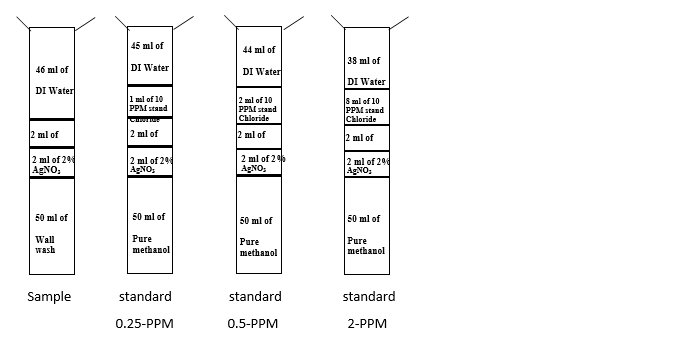
The principle of the test is that chloride, together with silver nitrate solution, forms silver chloride (AgCl), which makes the solution turbid. This solution is compared with various standard solutions to establish the ppm chlorides in the sample.
Prepare the Nessler tubes as indicated in the below diagrams. Insert the stopper and invert the tubes. Compare the turbidity of the sample solution with standard 0.25-PPM, 0.5-PPM, and 2-PPM solutions by looking through the liquid against a black background. Comparison should be done in a dark room by looking through the tube using a beam flashlight.
If the turbidity of the sample is more than 0.25-PPM solution, the sample should be compared with the 0.5-PPM standard solution, and so on until the turbidity of the sample matches the higher standard solution.
4. HYDROCARBON TEST
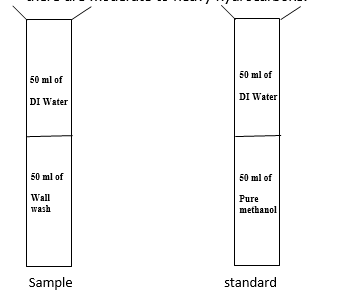
The purpose of this test is the qualitative detection of non-water-soluble contaminants. It works on the basis that many impurities are soluble in the wall wash liquid but not in water. Therefore, this test is also called the Water Miscibility Test. The wall wash sample is poured into clear DI water. The wall wash sample is soluble in water, but the impurities are not, resulting in cloudiness or turbidity of the water.
The water with wall wash liquid is compared with a standard solution of pure methanol and DI water. Prepare the Nessler tubes as indicated in the below diagrams. Insert the stopper and invert the tubes to mix the contents. Allow it to stand for 5 minutes. Compare the cloudiness/turbidity of the sample solution with the standard solution of pure methanol/DI water by looking through the liquid against a black background. Comparison should be done in a dark room using a beam flashlight.
If the sample solution is the same in transparency as the standard, then the wall wash hydrocarbon content is zero. Similarly, if the sample solution is milkier than the standard, there is the presence of hydrocarbons in the wall wash test. If a bluish tint is present, moderate to heavy hydrocarbons are present.
5. PERMANGANATE TIME TEST
Principle: Presence of oxide impurities reduces the presence of Potassium Permanganate.
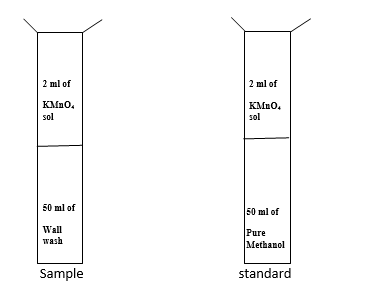
The test is based on the ability of Potassium permanganate (KMnO4) to oxidize hydrocarbon impurities that could be present in the wall wash liquid. If there is a reaction in a neutral solution, the potassium permanganate is reduced and changes its color from purple to yellow-orange. The more the impurities, the faster the change in color.
Prepare the Nessler tubes as indicated in the below diagrams. Keep the Nessler tubes in a constant temperature bath, add KMnO4. Insert the stopper and invert the tube once to mix the contents, noting the time. Note the time it takes for the purple sample solution in the Nessler tube to turn to orange-yellow in color. Compare the time taken for the standard solution to undergo a similar change in color.
If the sample solution takes less time to turn orange-yellow, oxide impurities are present in the wall wash sample.
6. NON-VOLATILE MATTER TEST (NVM TEST)
This test is used to determine the presence of non-volatile impurities on the tank surface. A defined quantity of the wall wash liquid is poured into a glass chalice and evaporated. The weight of the residue, known as NVM (Non-Volatile Matter), is detected by weighing.
The residue weight is then divided by the original weight of the sample. The presence of trace residues on the tank surfaces, where the wall wash test reagent had flowed down, is a clear indication of NVM on the tank surface.