| FOM 1.7A |
Fleet Operations Manual General Port state control inspections |
Doc No.: FOM 1.7A
Revision: 01 Date: 15 Oct 2024 Issued by: DPA Approved by: MD |
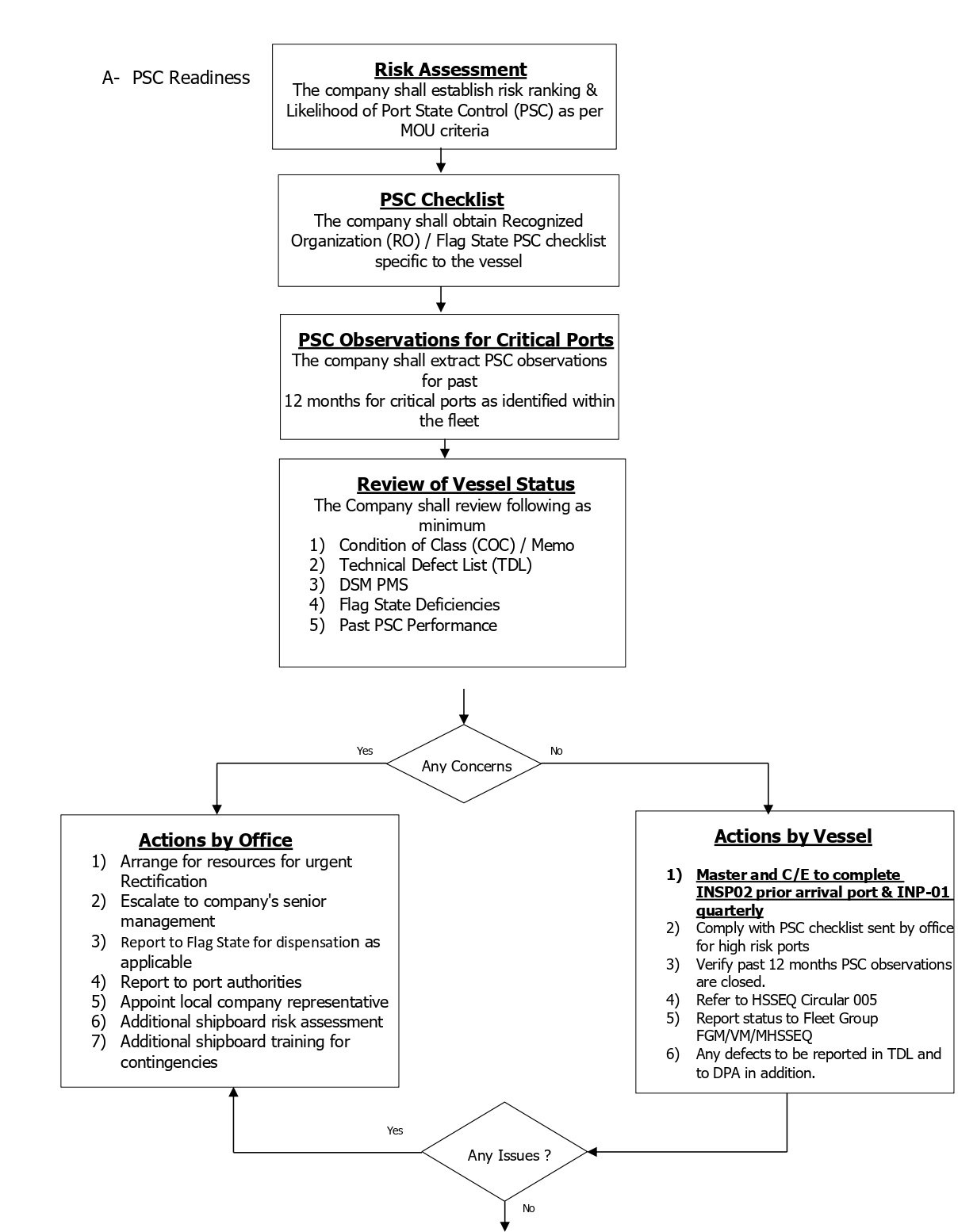
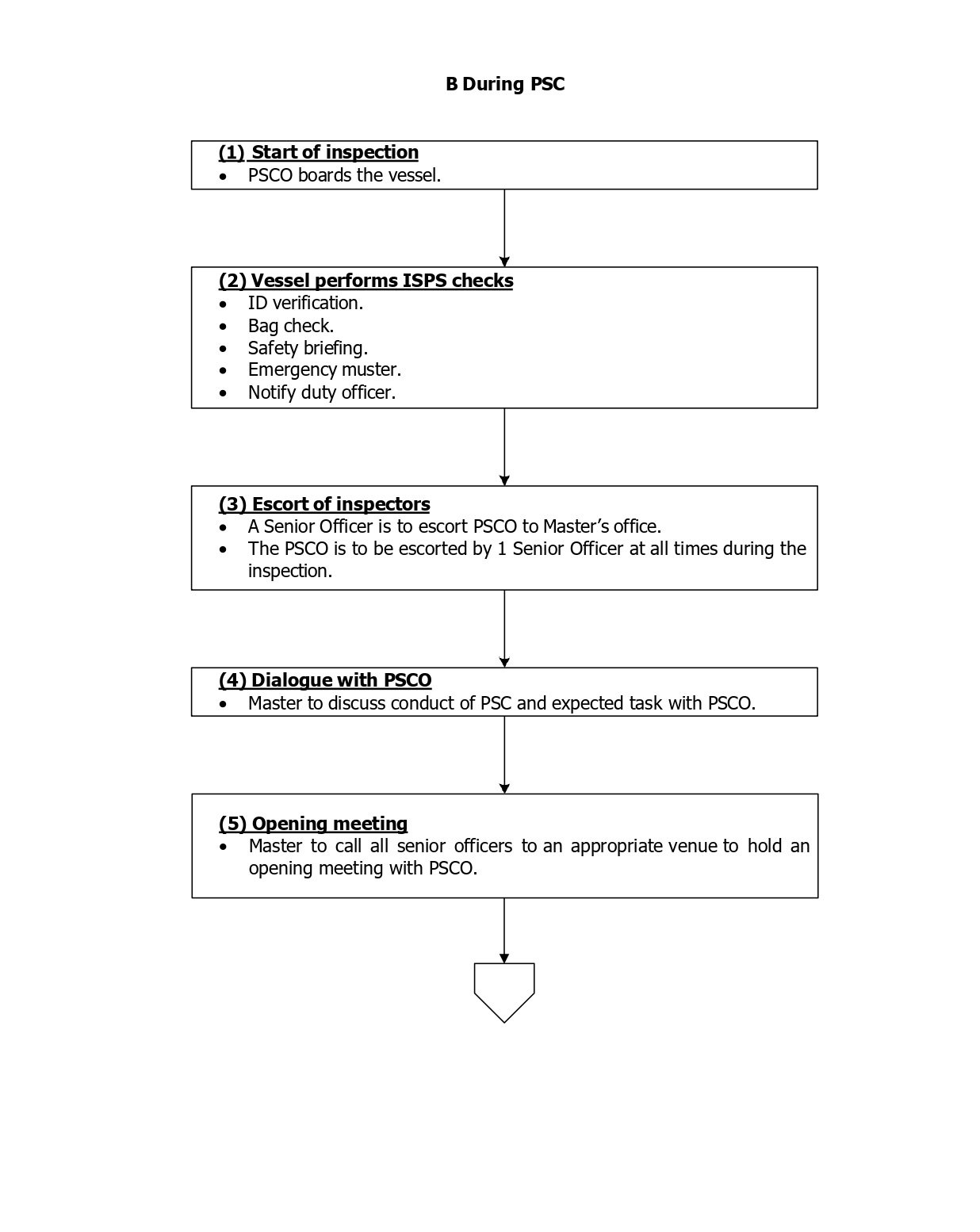
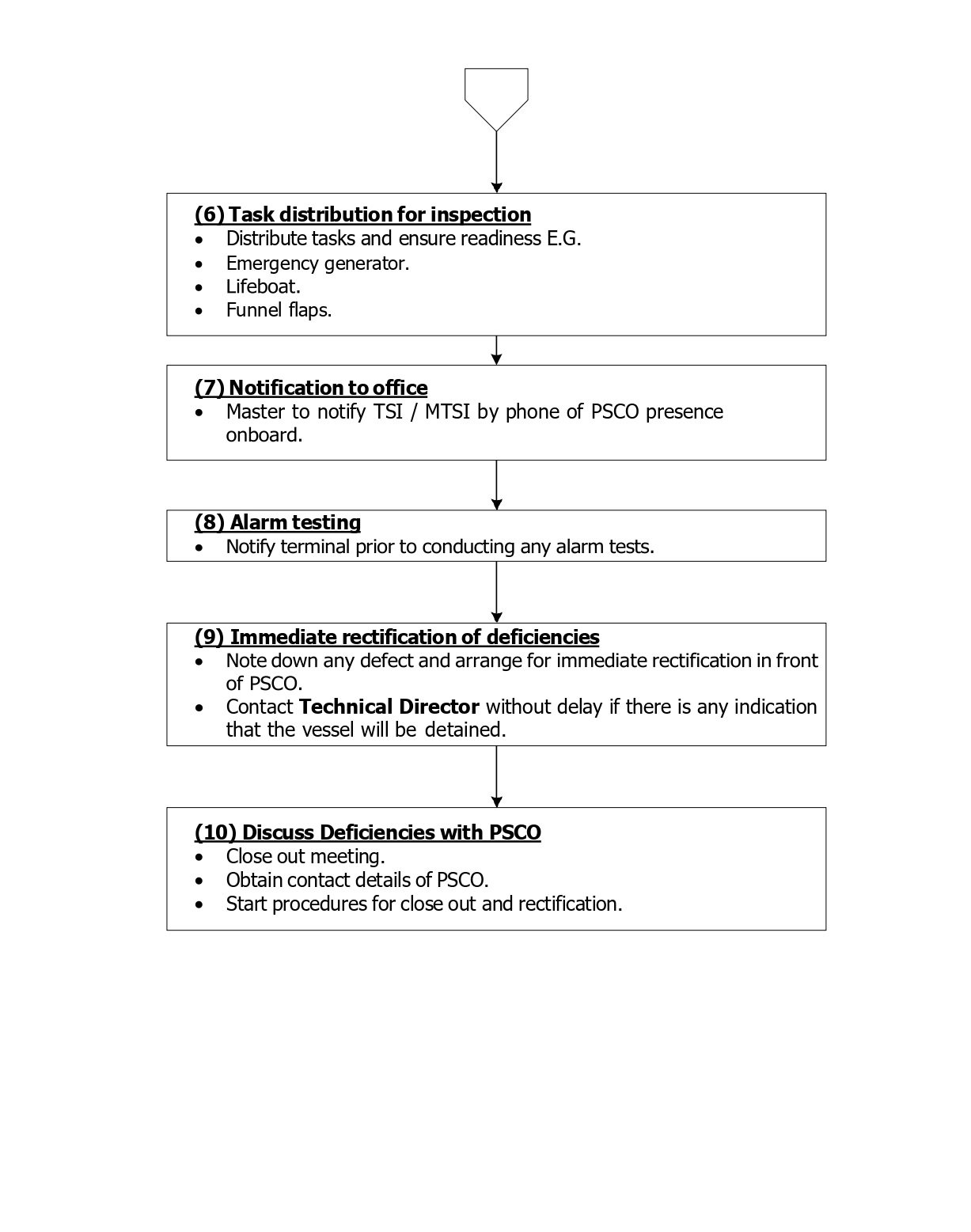
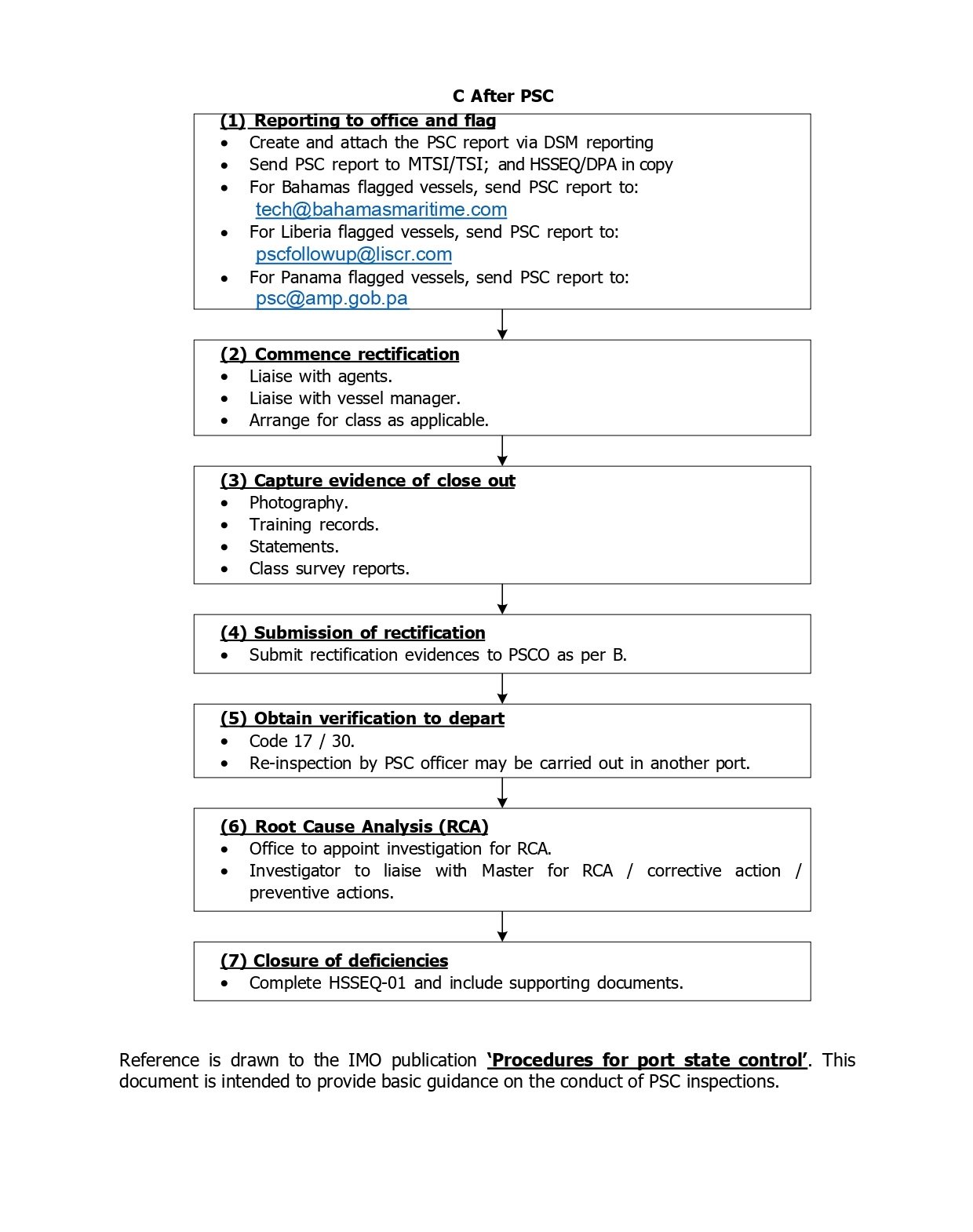
Reference is drawn to the IMO publication ‘Procedures for port state control’
This document is intended to provide basic guidance on the conduct of PSC inspections.
General Inspection Guidelines
A Port State Control Officer (PSCO), prior to boarding, would gain from the vessel’s hull appearance an impression of the standard of maintenance from the hull condition. Upon boarding and introduction, the PSCO would examine the vessel’s relevant certificates and documents. Based on the PSCO’s general impression and visual observations onboard, he would complete his inspection or opt for a detailed inspection.
The PSCO uses his professional judgement in carrying out all his duties. If he has clear grounds for carrying out a detailed inspection, he should immediately inform the Master of the grounds for doing so. If the Master has any reason to believe that the PSCO is unreasonable or the observations raised are incorrect, he should immediately call MTSI/TSI and consult him.
The vessel may have to undergo a mandatory expanded inspection if it falls under the category recognized by the Port State. The vessel’s inspection may also be subject to concentrated campaigns. Information in regards is always made available through Company circulars and/or third-party sources such as P&I Clubs, etc.
Port State Control (PSC) Inspection Report
The Master should confirm whether any deficiencies and/or detention items are specified in the PSC Inspection report provided by the PSCO on the conclusion of an inspection. There are two forms of report as follows:
FORM A
This inspection report is issued for the purpose of informing the Master and other port states that an inspection by the port state has taken place. In this report, the Master can see whether any deficiency and/or detention have occurred or not.
FORM B
This inspection report is issued when any deficiency and/or detention have occurred. In this report, the details of the deficiency and/or detention and actions taken by the PSCO are recorded with the action taken codes.
Notification Requirements
The vessel must diligently report any defects in the vessel’s equipment to the office. The office shall assess the nature of the defect and explore the feasibility of reporting such defect to the flag state, port of arrival, and similar authorities appointed by the government of the state. Examples are mentioned below:
Australia
The Australian Maritime Safety Agency (AMSA) has found that there is an increasing number of vessels that are failing to report defects in ships’ equipment as required by the Navigation Act and SOLAS.
There are requirements under both the Commonwealth Navigation Act [Section 268] and SOLAS [Chapter 1, Reg 11(c)] for ships to report incidents, accidents, breakdowns, and defective equipment. The correct method of reporting to AMSA is by use of the AMSA Form 18 Incident Alert [to be completed within 4 hours] and AMSA Form 19 Incident Report [to be completed within 72 hours]. These forms are available from the AMSA website www.amsa.gov.au and should be sent in the first instance to reports@amsa.gov.au.
Additional methods of reporting for ships when in the AUSREP AREA are to follow the information in Section 7.2 of the AUSREP Book and report via the RCC.
It should be noted that penal provisions apply for failure to report under the Navigation Act. Vessels failing to report under the SOLAS requirements may find themselves undergoing additional scrutiny and/or deficiencies being issued in a PSC inspection.
Format of General Incident Reporting
Incident reports are made using form ‘AMSA 18’ and form ‘AMSA 19’.
- Form ‘AMSA 18’ is an incident alert designed to inform the authorities that an incident has occurred, however, this will not include all the information that will eventually be required. This report must be submitted by the Master within 4 hours of the incident occurring and may be sent by:
- Fax to: +61 2 6230 6868 or 1800 622 153 (free fax within Australia), or email to: Reports@amsa.gov.au
- If additional information is required in respect of the submission of this form, the Rescue Coordination Centre (RCC) can be contacted on 1800 641 792, and they will provide advice.
- To provide the details of the incident, a “detailed report” (form AMSA 19) is to be forwarded to AMSA, Canberra within 72 hours of submission of the incident alert (form AMSA 18). The details for faxing or emailing incidents reports (Form AMSA 19) are: Fax to: +61 2 6279 5058, Email to: Reports@amsa.gov.au
United States of America (USA)
96 Hour Advance Notice of Arrival to USCG
Reference is made to CFR33 160.211 (Notice of arrival) where the Master is to ensure that the Captain of the port or place of destination is duly notified at least 96 hours prior to arrival or entering that port or place. The message format is given in the above-mentioned regulation.
- Notice of departure is to be tendered as per CFR 33 160.213.
- Generally, these messages are sent to the Captain of the Port by the agent. However, Masters are to ensure that they are tendered as required.
- Any defect in vessel’s equipment shall be reported in e-NOA.
- Vessels may be required to report major defects using additional means and obtain a letter of deviation for entry into port.
Specific Notification Requirements to Flag State
Marshall Islands
Reporting to Administration for Marshall Island vessels prior to arrival at US ports:
- In accordance with RMI Marine Notice 2-011-20, all vessels entering US ports are required to submit a copy of the Notice of Arrival (NOA) to the Administrator at NOA@register-iri.com when submitting the NOA to the USCG. Repeated failure to submit a copy of the NOA to the Administrator may result in actions by the Administrator such as an additional audit of the vessel or the Company’s Safety Management System (SMS).
- All vessels arriving at US ports are required to list any non-operational equipment or systems on their NOA. Proactively listing inoperative equipment on the NOA and notifying the Administrator can often prevent adverse PSC actions. Vessel operators that fail to list non-operational equipment or systems on the NOA may be subject to an immediate International Safety Management (ISM) Code audit and/or a letter of warning to the Master. Repeated failures to report non-operational equipment or systems on the NOA may result in suspension of the Master’s RMI seafarer documents and/or an additional audit of the vessel or Company SMS.
- Prior to arrival in a US port, the Master and Chief Engineer shall complete, sign, and submit the Critical Items Checklist (MSD 340). Failure to complete the MSD 340 may result in suspension of the officers’ RMI seafarer documents and/or an additional audit of the vessel or Company SMS.
- Company vessels shall submit the completed form MSD 340 to respective Technical Managers and MTSI Superintendents. Once reviewed for satisfactory compliance, the form shall be submitted to inspections@register-iri.com, either by office personnel or by the master under TSI/MTSI Superintendent’s guidance.
Panama
To improve the exchange of information regarding PSC inspections for Panamanian Flagged vessels, this Administration requires all Masters, the Company, and Recognized Organizations to report immediately to the Panamanian Port State Control Section all PSC inspection reports. The actions taken by the operators/owners to correct the deficiencies found during PSC inspections must be sent, duly documented, as soon as possible to the Panamanian Port State Control Section.
- The Recognized Organization shall send the survey report to the Port State Control section in cases where the attendants of the Recognized Organizations are required by the port state control officers.
- All corrections of deficiencies shall be sent by the Masters using the format in Appendix I of the Panama Merchant Marine Circular No. 172 “Correction of Deficiencies Reports” Form (F-JERP-02-01).
- The contact details of the Panamanian Port State Control Section are as follows:
- Phone: (507) 501-5092 / 501-5094 / 501-5033
- Fax: (507) 501-5083
- Email: psc@amp.gob.pa
Bahamas
PSC inspection reports shall be forwarded to tech@bahamasmaritime.com. Regardless of specific flag state requirements, in case of detention, the office shall notify the flag state of the vessel detained at the earliest using the most expeditious means of communication.
Liberia
PSC inspection reports shall be sent by the Master to pscfollowup@liscr.com as soon as practicable but no later than 48 hours after the inspection.
- The Master shall submit objective evidence of rectification for any issuance of code 17 prior to departure from port to Liberia Flag at DutyOfficer@liscr.com and Prevention@liscr.com. Objective evidence of rectification may include pictures, video, documentation, Class Report, etc. A copy of the PSC report should be included with the submission.
- In case of detention, the office shall send an immediate notification to Liberia Flag of the PSC detention and a copy of the PSC inspection report. This notification should be sent to Liberia Flag’s Duty Officer at DutyOfficer@liscr.com and the Fleet Performance Department at Prevention@liscr.com.
- Office shall send completed CAR to pscfollowup@liscr.com as soon as possible within 30 days of the date of inspection. If extensions are needed, get DPA approval and send a request for extensions to pscfollowup@liscr.com.
Concentrated Inspection Campaigns (CIC) under PSC
The regional PSC MOU members from time to time agree to carry out special inspection campaigns for a period of generally 3 months. These campaigns generally commence on 01st September and last until 30th November. During such campaigns, special attention will be laid on certain details during the regular inspections held onboard.
Following campaigns have been carried out in the past:
- Safety of Navigation and ECDIS Operations
- Enclosed Space Entry
- Inspection of the GMDSS equipment and the use by operators
- Inspection of ISPS Code compliance
- Inspection of MARPOL Annex I requirements
The office shall monitor the press release and relevant information issued by various MOU and shall disseminate preparatory guidance related to such concentrated inspection campaigns.