| FOM-10.13 |
Fleet Operations Manual FOM Permit to Work System |
Doc No.: FOM 10.13
Revision: 02 Date: 12 Feb 2026 Issued by: DPA Approved by: MD |
1 APPLICATION
The document applies to all vessels fully managed by Company. Specific requirements may vary for individual business units of the group as stated in sub sections of this document.
2 PURPOSE
To define the methods to be used in the Company offices to monitor the safety of the crew, passengers, cargo and vessel and to ensure that the concepts of safety and environmental excellence are achieved and maintained, both onshore and on-board the vessels.
3 RESPONSIBILITIES WITHIN THE WORKFLOW(S)
The Master is responsible for implementing company’s safety management system (SMS) and day to day safe operations onboard vessel.
Master to notify the office in writing about the proposed task where office concurrence is required as guided in this document.
The Vessel Manager, with assistance from Marine Superintendent is responsible to:
- Ensure that the vessel’s Master receive the necessary support in the form of services, stores difficiles, and spares to be able to ensure compliance with appropriate regulations.
- Ensure that the vessel’s Master is kept informed of, and updated with, any new safety and environmental regulations coming into force.
- Ensure that the monitoring of all safety and environmental activities are being complied.
The FGM and DPA shall maintain overview of compliance to company’s SMS onboard vessels and within operational departments, fleet groups of the business unit.
4 HAZARDOUS WORK
4.1 Permit to work
4.1.1 Permit to work system
- Is a system for controlling activities that expose the ship, personnel or environment to hazards. A Permit to Work system is a formal written system that is used to control certain types of work. It delivers a risk-based approach to safety management and requires personnel to undertake and record risk assessments in the development of a safe system of work.
- Ensures that protective and precautionary measures are taken which will reduce the risks associated with a task to a level that is considered to be As Low as Reasonably Practicable - ALARP.
- Is a detailed document which authorizes certain people to carry out a specific job; at a specific site; within a set period, and which sets out the main precautions needed to complete the job safely.
In Company, the following Permit to Work systems are available in company’s HSEQ software:
| Critical Equipment Maintenance | E-30 |
| Electrical Work / High Voltage | HSSEQ-10 A |
| Isolation - Lock Out /Tag out | HSSEQ-34 |
| Diving / Underwater Operations | HSSEQ-35 |
| Small Craft Alongside during cargo operations | HSSEQ-36 |
| Working Aloft / Over side | HSSEQ-13 |
| Cold Work / High Pressure pipelines | HSSEQ-08 |
| Working on deck in adverse weather | HSSEQ-37 |
| Enclosed Space Entry | HSSEQ-11 |
| Hot Work | HSSEQ-07 |
| Hot work Concurrence (Tankers) | HSSEQ-07A |
Note:
Create a Risk assessment in the company’s HSEQ software and attach the relevant permit to
work. Submit to office in case concurrence is required.
Apart from above permit to work systems, HSE guidance is provided with regards to the following Hazardous tasks.
- Handling Asbestos
- Handling Chemicals
- Hydrogen Sulphide in Cargoes and fuel oil
4.1.2 Permit to work system guidance
A Permit to work system generally contains the following steps:
- Identify the task and location;
- Identify the hazards and assess the risks;
- Ensure appropriate responsibility and competency of personnel who will carry out the work;
- Define the risk control measures – state the precautions and personal protective equipment needed;
- Determine communication procedures;
- Produce a procedure or initiate a Permit to Work;
- Determine isolation processes, gas testing etc;
- Obtain formal approval to perform the work including acceptance by those performing the work;
- Carry out a pre-work briefing;
- Prepare the work;
- Carry out the work to completion;
- Return work site to a safe condition;
- Complete the process, keeping records for audit purposes.
The permit should specify the period of its validity (which should not exceed 08 hours as per company requirements).
The issue of a permit does not, by itself, make a job safe. It is the thoroughness in thinking through the job and complying with the conditions called for in the permit that makes the permit effective.
The identification of any deviations from the specified controls or expected conditions, are equally essential in completing the task safely.
In a repair yard or in port limits and in case the repair work is being undertaken or stated by a local legislation or a repair contract; permits or certificates may be issued by a shore authority, chemist, or competent authority. At all other times the company’s permit to work system shall be used.
Scheduled activities requiring permit should be discussed at daily work meeting and on-site toolbox meeting. Where unscheduled work requiring a permit becomes necessary it must be ensured that the scope of the work is fully understood and discussed before the permit is issued.
In some operations, safety may demand the invocation of more than one permit-to-work (hot work in enclosed space). In such cases both permits shall be completed.
Copy of the permit will be displayed at the work site.
A work permit should be revoked and cancelled if the conditions under which the permit was issued have changed significantly. Permits shall also be suspended when there is an emergency on board. A fresh permit shall be reissued if work has to be resumed.
- Any closure of permit due to change in safe condition or controls as specified in the permit are to be fully investigated.
- Company staff shall be responsible for auditing the permit to work system by representative sample as a part of superintendent periodic inspection or internal audit.
Reference shall be made to ISGOTT section 9.3 and Code of safe working practices chapter 16 for Permit to work systems.
Note:
Certain tasks may warrant completion of multiple permits to carry out the work. In such circumstance it is extremely important for responsible officer to keep record of status of such permits until task is finally completed.
4.2 Responsibilities and duties
This paragraph details the responsibilities & duties of the various personnel involved in issuance of Permit to work on board.
Responsible officer: means a certified senior officer (C/O,2/E, C/E) who is having sufficient competency, knowledge and experience for the task to be performed and who is authorized to sign the permit after ensuring all points have been checked and the conditions at the site, or of the equipment to be worked on, are safe for the work to be undertaken.
- Shall ensure that appropriate training, instruction and information are provided to all personnel who are allocated roles or are working within the Permit to Work System. Also ensure that the personnel are well – rested.
- Shall ensure that sufficient precautions have been taken prior to initiating a work permit (e.g., safety notices, isolation, draining, safe equipment, environmental monitoring, communication, time allotted for work etc)
- Shall ensure validity of permit commences only after all checks are complete
- Shall ensure that the correct procedures are understood and followed by all concerned and review of appropriate use of Personal Protective Equipment (PPE)
- Shall ensure monitoring during the performance of the task.
- Shall take into consideration of extreme working environment like Very cold or very hot temperatures, Icy conditions, Heavy movement of the vessel, High humidity, Poor light and/or ventilation, Insufficient oxygen, or presence of toxic gases
- Retains responsibility for the work until he has either cancelled the permit or formally transferred to another responsible person who should be made fully conversant with the situation. Anyone who takes over from the responsible officer, should sign the permit to indicate transfer of responsibility.
- Shall ensure that after work is completed all persons, materials and equipment are withdrawn, all isolations are removed, work area and equipment are left in a safe condition and all persons involved are advised that permit has ended.
Personnel carrying out task
- Should wear appropriate PPE required for the task as per company requirements
- Should countersign the permit if applicable to indicate understanding of the safety precautions to be observed.
- Should not be the same person as the Responsible officer.
4.3 Critical equipment maintenance
Specific safety procedures with specific permit to work requirements are detailed in FOM 10.17
4.4 Electrical work / High voltage
Risk assessment shall be carried out referring to company’s risk assessment guidelines.
Maintenance or repair work must never be attempted on energized equipment. The electrical circuit must be disabled with tags and, or locking devices placed on switches and circuit breakers. Testing and checking of electrical equipment and circuits must only be performed by an Electrician, senior engineer, or contractor who is familiar with the electrical testing safety procedures. The person in charge of the work must:
- De-energise the equipment and circuits
- Test de-energised equipment and circuits to ensure they are safe before actual work begins
- Affix a signed Electrical Isolation Tag on the breaker and start-up controls
- Only the individual who places the isolation tag may remove the tag and re-energise the circuit
- Ensure that equipment used is suitable (i.e. appropriate tools suitable for electrical work)
- Ensure that those carrying out the work: Have dry electrically isolating type rubber gloves Have available a face shield or chemical goggles when working on batteries Use rubber mating to isolate the immediate work area from becoming part of an electrical circuit
- Where the time required for the task requires a change in personnel, a full appraisal of the safety steps taken should be discussed with the incoming personnel. The person who placed the original isolation tag will remove the tag after which incoming personnel will re-check breakers and re-issue the isolation tag
- Only wooden, fibre glass or ladders approved for electrical work when working on or near electrical circuits
The replacement of fuses and other plug-in / screw-in devices does not require de-energising of the circuits if the approved enclosures and other protective parts provided by the manufacturer are in place. Fuse pullers or other electrically insulated tools should be used to provide extra protection against accidental shock.
4.4.1 High voltage
High voltage is defined in STCW (Section B-III/ 2) as shipboard systems operating at an alternating current (AC) or direct current (DC) voltage in excess of 1,000 volts. If the vessel has high voltage equipment the staff shall be suitably trained and be competent to conduct maintenance on it.
Following are some of the terms used with respect to the High Voltage Equipment / Installations:
- Additional Earth - An earth connection applied to apparatus after the application of a Circuit Main Earth, normally applied at the point of work if not already fitted with Circuit Main Earth.
- Circuit Main Earth - An earth connection applied for the purpose of making apparatus safe to work on.
- Dead - At or about zero voltage and disconnected from all sources of electrical energy.
- Earthed - Connected to the general mass of earth in such a manner as will ensure at all times an immediate discharge of electrical energy without danger.
- Isolated - The disconnection and separation of the electrical equipment from every source of electrical energy in such a way that this disconnection and separation is secure.
- Limitation of Access - Limits of the work to be carried out in vicinity of but not on high voltage electric apparatus.
No work shall be carried out on high voltage equipment/installations unless the equipment/ installations are:
- Dead
- Isolated and all practicable steps have been taken to lock off live conductors, voltage transformers (except where the connections are bolted) and dead conductors that may become live
- Earthed at all points of disconnection of High Voltage supply and caution notices attached
- Released for work by the issue of a Permit to Work.
Table 1: Safe working distances to exposed high voltage equipment for persons
| Voltage | Safe Working Distance (meters) Suitably Authorized Persons | Safe Working Distance (meters) All Other Persons |
|---|---|---|
| Above 1000V but not exceeding 11 kV | 0.7 | 1.2 |
| Above 11 kV but not exceeding 66 kV | 1.0 | 1.5 |
| Above 66 kV but not exceeding 132 kV | 1.5 | 2.0 |
| Above 132 kV but not exceeding 220 kV | 2.5 | 3.0 |
| Above 220 kV but not exceeding 330 kV | 3.0 | 3.5 |
| Above 330kV | 4.0 | 4.5 |
Note
* Persons training to become suitably authorized persons may come closer than the safe working distances shown under "All Other Persons" of Table provided that the safe working distances under "Suitably Authorized Persons" are maintained and the work is continuously and closely supervised by a person suitably authorized to perform the work. The person supervising the work will be responsible for the safety of the person in training.
* * Testing and earthing procedures on certain 2kV and 11kV equipment may bring the operator within the specified 0.7m safe working distance. This work must only be carried out by an authorized person who has been trained in the procedures and in accordance with written instructions.
* * * When passing under substation busbars, a person who is not authorized may come to 1 m of the busbars at voltages up to 66kV provided that an authorized person has instructed the person at the site of the dangers existing and the precautions that must be taken and accompanies that person.
Warning:
Above table does not imply that it is always safe to work up to these distances. An additional distance must be added to that shown in the table if inadvertent movement or is handling of material would infringe on the safe working distance.
4.4.2 Inspection and testing of high voltage equipment
- All aspects of testing work, including connection & disconnection of the test equipment and the actual testing operations must be carried out in accordance with the above except as set out below.
- Tests where the equipment is energized from the high voltage system
If a Permit is required for the connection of the test equipment, that permit must be cancelled before the equipment is energized for the test.
- Other tests (where the equipment is energized from the test equipment)
When testing requires test equipment to be connected to high voltage equipment and earths to be removed, the work must be carried out under an appropriate Permit.
4.4.3 Replacement of high voltage fuses
Operation of high voltage equipment for fuse replacement must be carried out under the direction of the Chief Engineer.
A Permit is not required for fuse replacement where:
- The enclosed switchgear has withdrawable type fuses or switch fuses that become disconnected equipment when fully withdrawn. In these cases, fuses are to be replaced in accordance with Local Instructions
- Fuses and fuse links can be removed and replaced using approved insulated sticks
A permit must be issued for all high voltage fuse replacement that requires isolation and the application of earths.
4.4.4 Work above exposed high voltage equipment
When work is above exposed high voltage equipment, either:
- The work must be carried out under Permit, or
- The work must be carried out in accordance with an approved procedure and the specific work must be authorized by an Electrical Engineer, or a special barrier must be erected, and the work must be carried out in accordance with a documented procedure.
Where a special barrier is to be used, the barrier and the documented procedure must be:
- Approved by an Authorized Person who understands sufficient detail of the work process for which the barrier is required, to assess its adequacy to prevent infringement of the relevant safe working distances.
- Approved by a competent person who understands sufficient detail of the structural limitations of the proposed barrier to assess its adequacy to resist the forces that may be imposed during the work process.
The person giving these approvals for the special barrier is responsible for ensuring that:
- The necessary restrictions on the work process arising from the barrier, and the maximum loads that may be applied to the barrier are documented in the procedure and are applicable for the work.
Note:
Reference shall be made to relevant chapters in Code of safe working practices
4.5 Isolation – Lock out / Tag out
Lock Out / Tag Out procedures are intended to assist in protecting workers against injury due to accidental start up or release of energy from equipment that is being serviced or maintained.
The following are some typical sources of energy that may need to be controlled:
- Electricity (primary energy source for many machines and motors)
- Hydraulic (e.g. pressurized fluids in hoses/pipes)
- Mechanical (e.g. gravity systems, or spring energy)
- Pneumatic (e.g. pressurized air in hoses/pipes)
- Thermal (e.g. pressurized steam in hoses/pipes)
This procedure is to be followed for:
- Repairs to equipment where unexpected energizing or start-up of the equipment, could cause injury;
- Repairs where release of stored energy such as from pressurized pipelines could cause injury;
- When maintenance is being carried out in close proximity to potentially dangerous equipment;
- Prior to any work where isolation control is required in a permit to work, such as enclosed space, working aloft etc.;
- Dismantling of valves or pipelines;
- Other jobs as per senior officer’s discretion.
Risk assessment shall be carried out referring to company’s risk assessment guidelines.
Wherever possible the equipment is to be locked-out. A lock-out system may be in the form of a latch, cover, handle, chain bar, cable ties, clasp with padlock, a wire seal, tying off or sealing a valve or a switch to immobilize its movement or other similar devices which would offer physical restraint from opening an energy source.
Where key-operated locks are used, the person whose name appears on the tag shall retain the keys. The locking device will also be accompanied with a tag.
Where lock-out is not possible, tags are to be used on their own and affixed to the energy isolating source to warn potential users.
Following to be ensured by responsible officer when lock-out or tag-out is required:
- Machinery or equipment are turned off and energy source isolated;
- Pipelines and valves have been isolated and depressurized;
- Closed systems have been shut off and isolated;
- Stored energy is discharged;
- Equipment checked for zero energy state;
- Measures to prevent accidental re-energizing have been implemented.
Where the time required for the task requires a change in personnel, a full appraisal of the safety steps taken should be discussed with the incoming personnel. The person who placed the original isolation tag will remove the tag after which incoming personnel will re-check breakers and re-issue the isolation tag.
After work has been completed and the equipment is ready for normal operation, the Responsible Officer shall check to ensure that everyone is clear of the machinery or equipment, all tools have been removed from the work site, guards have been replaced and any operating controls have been placed in the “neutral” or “off” position and no further hazard exists from energizing the equipment or opening the device to the system.
Lockout/ tag out devices shall be removed, and power restored to the machine. Only the individual who places the isolation tag may remove the tag and re-energize the circuit. When it is verified, all functions are operating properly, all relevant personnel will be advised that normal operating conditions have been restored.
Note:
Reference shall be made to relevant chapters in Code of safe working practices
4.6 Diving / Underwater operations
Diving work is defined as the underwater work carried out by divers including but not limited to surveys, hull cleaning, propeller polish and underwater repairs.
No underwater tasks are to be carried out by ship staff. These tasks shall be normally carried out by the external agencies approved by classification societies or other.
Risk assessment shall be carried out referring to company’s risk assessment guidelines.
The use of any ship’s breathing apparatus equipment for any underwater operation is strictly prohibited.
Port and terminal authorities are to be informed and permission obtained prior any underwater operations.
A Pre-diving conference should be held by the Master and must be attended by diving team, vessel manager (if attending on board), ships personnel on watch and those involved with the work being performed.
The Pre-Diving Conference should cover as applicable:
- Type and nature of proposed inspection/repairs;
- Number and name(s) of personnel involved in the operation;
- Ability of the diving team to communicate well with the ship staff in English language to be confirmed;
- Responsibility for each task including operation, supervision and communication at all time;
- Communication procedures (hand held radio sets etc.) and special signals (if any);
- Emergency procedures;
- Emergency communication medium (shore phone number);
- Identification of the work site with a review of reference drawings;
- Identification and status of all overboard discharges and sea suctions;
- Status of propulsion systems, including main engine, turning gear;
- Work procedures during underwater operations;
- Status of rudder and steering control system;
- Procedures for blanking sea chest during underwater operations;
- Weather and Sea conditions;
- Safety precautions;
- Status of active discharges and intakes;
- Status of impressed current system, echo sounder, Doppler log.
- HSSEQ-35 - Diving and under water operations permit to be duly filled, contents discussed, and signed by ship staff and diving company supervisor.
- Other relevant Forms to be duly filled and endorsed. For example, HSSEQ-34 - Isolation – Lock out tag out permit, HSSEQ-36 (Small Craft Alongside Permit) & HSSEQ-08 - Cold work permit etc.
- Consent of diving company representative should be taken confirming that the diving craft will stay alongside throughout the diving operations, with the diving team representative contactable constantly
During operation
- All underwater rotating components (propeller, rudder etc.) should be locked immobilised, prior commencement of diving operation;
- Duty officer with a hand-held radio shall be on deck near diving location throughout the operation;
- Through periodic communication between the diving company and ship staff at all time, it should be ensured that operation is progressing in order;
- Good all-round lookout shall be maintained for any approaching vessels or small craft;
- Any vessel approaching should be warned to stay away from the diving through VHF;
- If necessary, approaching vessels should be requested to reduce speed;
- Provide necessary assistance requested by divers;
- If communication fails during operations or if there is an emergency or change in conditions, all work should stop, and diver brought to the surface;
- No machinery to be started which involves change of status of any active discharges or intakes;
- Deliberate or accidental dumping of any material overboard is to be prevented;
- When craft other than those controlled by the diving contractor are expected alongside, the diving supervisor must be advised in ample time to warn his divers;
- The diving supervisor must be advised whenever moorings are to be adjusted;
- If the supervising Deck Officer, or any other crew member, notices any divergence from the agreed plans, or any traffic that he considers may be detrimental to under water safety or any other condition that causes concern, then he is to stop the operation immediately and report his concerns to the diving team and the Master. The operation is only to recommence once all safety problems have been resolved to the full agreement of all parties.
On completion
The restrictions applicable when divers are in attendance shall not be relaxed until the diving supervisor has confirmed that all divers have left the water and that all associated equipment has been removed from potentially hazardous locations;
- The responsible person shall report to the Master and/or head of department on completion;
- On obtaining confirmation that the operation has been completed and all persons are safely on board, the Master shall withdraw all warning signals and notices;
- Bridge, engine room should also be informed of completion of underwater operations;
- Rescue boat/Fast rescue boat, if lowered, should be stowed and secured. Under water operation activities shall be recorded in the Log Book.
4.6.1 Underwater blanking operations by divers
In addition to the procedures outlined in FOM 10.13, Section 4.6 ‘Diving / Underwater operations’, following should be complied when any underwater hull openings require blankgrids for repairs.
Specifications
While engaging a diving company for the underwater blanking job, detailed specifications should be provided along with the query, to provide complete information about the size, shape and location of the opening, with relevant drawings (example shell expansion plan, sea chest drawing etc.), to enable the diving company to decide on the blank type and dimensions and to prepare accordingly after obtaining approval from Vessel Manager.
Standard blanking arrangement
- Acceptable standard blanking arrangements, as specified in FOM 10.11 Standard under water blanking arrangements should be used for any underwater blanking requirements. Any deviations from these standard arrangements should be first closely evaluated at office, before being approved for employment.
- Vessel Manager should obtain from the diving company, details of the blanking arrangement (dimensions, type, material, drawings etc.), intended to be used, and confirm that this is in line with the standard arrangements specified in FOM 10.11 Standard under water blanking arrangements before giving a green signal for the job.
- Master / Chief Engineer should confirm during the pre-diving conference with the divers, that the blanking arrangement will be employed in accordance with the acceptable standards.
Prior & During Operations
During pre-diving conference, following should be agreed with the diving company, and should be complied throughout the operations:
- Diving craft should be alongside throughout the operations.
- Blank and the changes in the conditions impacting the blanking arrangement (example weather conditions and nature of work at different steps as the job progresses) should be closely monitored and assessed by the divers and the ship staff.
- The risk assessment and control measures should be dynamically reviewed and discussed between the ship staff and the divers, throughout the diving operation, and appropriate measures enforced, as identified.
- Contingency measures should be established to handle an eventuality of failure of the blanking device (which can cause flooding). A means to block and minimise the water ingress to be established and maintained.
- Emergency Bilge Pump to be ascertained to be in good working condition, and kept ready to use, in case of a requirement.
4.7 Small craft alongside during cargo operations
For the purpose of this manual a small craft is any craft other than a bunker barge which is used as an agent/crew ferry boat, lighters, tug, supply boat, freshwater barge etc.
If the vessel is alongside at a terminal/berth, then the small craft can come alongside only if the terminal/berth has given approval for the craft to come alongside.
Risk assessment shall be carried out referring to company’s risk assessment guidelines.
During cargo operations of any kind, the number of craft coming alongside must be kept to a minimum. Only authorized craft is permitted to come alongside during cargo operations, this must be with the knowledge of the duty officer.
All cargo and ballast openings must be closed before the craft comes alongside and must remain so until the craft departs
All small craft that come alongside a tanker engaged in cargo operations must be warned of the hazards associated with the cargo being handled. The duty officer will either communicate this directly by VHF or ensure a sign is posted which details the following restrictions while alongside:
- No Smoking /use of mobile phones/use of cameras etc.
- No Naked Lights
- Use of open deck cooking Appliances is not permitted
Craft shall be warned in use of equipment likely to create spark/ignition hazards.
Small craft coming alongside must have proper fenders. If any tugs are coming alongside during cargo operations, they must also comply with all the requirements of small craft.
When the vessel is working a with cargo that has potentially explosive atmosphere and/ or toxic cargo and there is danger of the potentially explosive atmosphere and/ or toxic vapour in the vicinity, then no small craft shall be allowed alongside until such time that the potentially explosive atmosphere and/ or toxic vapour can be stopped, and it is safe for the small craft to come alongside.
When the craft is alongside it must be safely moored/ made fast to the vessel and the master of the craft advised of action to take in the event of an emergency or upon hearing an emergency alarm.
Efficient means of communication shall be established between the ship and the small craft and always maintained. The craft must always be ready to move away from the vessel at short notice under its own power.
Where cargo operations require scuppers to be closed, care must be taken not to accidentally open the scupper in the area the small craft that is alongside.
Particular care needs to be taken if there are several small craft alongside and if there are any other special operations being carried out such as diving and other underwater work.
The timings of when the small craft came alongside and departed shall be promptly entered into the appropriate logbook.
Note:
Tankers shall make reference to relevant chapters in ISGOTT.
4.8 Working aloft / Over-the-side
Working aloft / at a height: Anyone working and not standing on level ground or at deck level is considered as working at height. Also undertaking work inside a tank, near an opening, such as a hatch, or on a fixed stairway shall be regarded as working at a height if there is a danger of injury if the worker fell.
Over side work: Any work carried out on outboard side of the ship’s hull and/or superstructure such as painting or de-scaling rust over-side etc.
Notes:
Work should only be carried out if there is no reasonably practicable alternative to doing so. Where a reasonably practicable alternative does exist, it should be adopted.
Risk assessment shall be carried out referring to company’s risk assessment guidelines.
All equipment used must be rigged in a proper seaman like manner with the utmost regard for the safety of the seamen involved. If in doubt authoritative publications such as the Code of Safe Working Practices for Merchant Seamen (COSWP) latest edition must be consulted.
Natural fibre ropes are susceptible to chemical contamination which can act in an insidious manner and cause sudden failure of ropes. For this reason, use of Manila rope is strictly prohibited. All gantlines, stage ropes, safety harness lines, lifelines and associated equipment used MUST be synthetic ropes. Ropes must be thoroughly examined for damage from contact with chemicals, oil and grease.
All equipment once rigged must be thoroughly inspected to confirm the integrity of the system and that the proper equipment, bends, knots and hitches have been used.
A man working may not be able to give his full attention to the job and at the same time guard himself against falling. Proper precautions should therefore always be taken to ensure personal safety. An arrangement shall not be used in which the seaman working is either left to, or required to, tend his own safety line.
No single mode of failure shall allow a catastrophic result. The safety line system shall be completely independent of the bosun’s chair, staging or any other gantline system, and shall remain effective at all times. The safety line and harness shall be rigged such that it shall not be necessary to unclip the safety line at any time whilst the seaman is aloft. The harness shall be attached directly to an independent safety line.
Over side work shall be carried out only when vessel is at berth or anchor or totally stopped at sea.
Work must NOT be carried out over-side when the ship is making way, except for transfer of personnel.
Rigging and securing of pilot ladders and gangways.
The normal operational rigging and securing of gangways and pilot ladder does not require the issue of a permit HSSEQ-13, subject to meeting below risk mitigation measures
- If task is carried out underway, vessel shall be at manoeuvring speed.
- Master shall be on bridge.
- Senior deck rating shall lead the team of rigging embarkation/disembarkation arrangements.
- Life jacket or work vest and safety harness shall be worn.
- Safety harness shall be used in conjunction with Fall Arrestor Device or shock absorbing lanyard and attached to strong fixed point on deck clear of obstructions and sharp edges.
- Radio communication shall be tested between crew working over-side, crew on deck and officer of watch on bridge.
- Lifebuoy with self-igniting light and lifeline shall be available.
Where required by port authorities, permission for carrying out over side work must be obtained prior starting such work.
Caution:
Each crew working aloft, or over-side where risk of direct vertical fall of 2 meters exists shall use safety harness in conjunction with Fall Arrestor Device (FAD) and shock absorbing lanyard
FAD, Safety harness with shock absorbing lanyard shall be attached to strong fixed point at all times, including when moving up -down on ladder. Vessel’s safety officer shall carefully assess the work site during risk assessment and ensure crew members are briefed on procedures to use FAD/shock absorbing lanyard depending on design of work site.
Fall arrestor devices shall be subject to annual thorough inspection as per manufacturer’s manual by competent person. Competent person may be vessel’s senior officer trained in thorough inspection tasks related to such PPE.
Note:
Work should only be carried out if there is no reasonably practicable alternative to doing so. Where a reasonably practicable alternative does exist, it should be adopted.
Risk assessment shall be carried out referring to company’s risk assessment guidelines.
All equipment used must be rigged in a proper seaman like manner with the utmost regard for the safety of the seamen involved. If in doubt authoritative publications such as the Code of Safe Working Practices for Merchant Seamen (COSWP) latest edition must be consulted.
Natural fibre ropes are susceptible to chemical contamination which can act in an insidious manner and cause sudden failure of ropes. For this reason, use of Manila rope is strictly prohibited. All gantlines, stage ropes, safety harness lines, lifelines and associated equipment used MUST be synthetic ropes. Ropes must be thoroughly examined for damage from contact with chemicals, oil and grease.
All equipment once rigged must be thoroughly inspected to confirm the integrity of the system and that the proper equipment, bends, knots and hitches have been used.
A man working may not be able to give his full attention to the job and at the same time guard himself against falling. Proper precautions should therefore always be taken to ensure personal safety. An arrangement shall not be used in which the seaman working is either left to, or required to, tend his own safety line.
No single mode of failure shall allow a catastrophic result. The safety line system shall be completely independent of the bosun’s chair, staging or any other gantline system, and shall remain effective at all times. The safety line and harness shall be rigged such that it shall not be necessary to unclip the safety line at any time whilst the seaman is aloft. The harness shall be attached directly to an independent safety line.
Over side work shall be carried out only when vessel is at berth or anchor or totally stopped at sea.
Work must NOT be carried out over-side when the ship is making way, except for transfer of personnel.
Rigging and securing of pilot ladders and gangways.
The normal operational rigging and securing of gangways and pilot ladder does not require the issue of a permit HSSEQ-13, subject to meeting below risk mitigation measures
- If task is carried out underway, vessel shall be at manoeuvring speed.
- Master shall be on bridge.
- Senior deck rating shall lead the team of rigging embarkation/disembarkation arrangements.
- Life jacket or work vest and safety harness shall be worn.
- Safety harness shall be used in conjunction with Fall Arrestor Device or shock absorbing lanyard and attached to strong fixed point on deck clear of obstructions and sharp edges.
- Radio communication shall be tested between crew working over-side, crew on deck and officer of watch on bridge.
- Lifebuoy with self-igniting light and lifeline shall be available.
Where required by port authorities, permission for carrying out over side work must be obtained prior starting such work.
Note:
Reference shall be made to Code of safe working practices.
4.9 Cold work/Work on High pressure vessels and pipelines
Cold work is defined as any work which will not involve generation of temperature conditions likely to be of sufficient intensity to cause ignition of combustible gases, vapours or liquids in or adjacent to the area involved.
It involves work on work on auxiliary boilers, EGE, cargo pipelines like disconnecting and connecting, removal and fitting of valves and blanks, work on pumps etc and for opening up fuel oil / diesel oil / lub oil pipelines, valves and flanges etc in the engine room.
Hot work on pipelines, valves and pressure vessels should only be permitted when the appropriate item has been detached from the system by cold work, and the remaining system blanked off. The item to be worked on should be cleaned, gas freed to a "safe for hot work" standard, and ventilated.
Heating coils and hydraulic pipelines should be flushed and opened to ensure that they are clean and free of hydrocarbons or other flammable material.
Risk assessment shall be carried out referring to company’s risk assessment guidelines.
Before starting work on any equipment or pipeline;
- It must be emptied or made safe by suitable means, as applicable, like Draining or Venting to atmosphere or washing through or purging etc.
- It must be isolated by Blanking lines, closing valves, or disconnecting lines, or other suitable means. Lock out /tag out permit to be completed.
- It must be confirmed to be positively free from Pressure or material like oil, gas, steam etc., by opening the drain cock or loosening the flange bolts or similar means. Care shall be taken to ensure any open drain is well protected from splashing of fluid being drained.
- Crew shall stand clear of the path that will be followed by the release of any residual pressure in the system and shall verify the effectiveness of draining by visual checks on gauges (Pressure, level) and any other means such as opening of vent valve to see nature of exhaust.
- The surrounding area of work must be free from other hazards.
- Only slacken nuts and bolts before breaking the joint. Do not completely remove them.
- If work site is in an enclosed space, enclosed space entry permit shall be completed.
- Precautions should also be taken since vapours or fluid from remnants inside the pipeline or equipment may be dangerous (flammable, toxic, hot) and suitable tools and PPE must be used.
Note:
Reference shall be made to Code of safe working practices.
4.10 HSE guidance for visitors and contractors
The company’s principal is that all health, safety and environmental practices, rules and regulations which apply to the crew, with the exception of shipyards, apply equally to visitors, contractors and riding crew visitors, contractors and riding crew are to be kept informed of potential hazards which might affect them.
Visitors are such personnel who board the vessel for short duration, mainly for administrative purpose such as immigration, custom clearance, or agents. They do not form part of any operational activity of vessel. Visitors shall be briefed at the embarkation point.
Briefing shall include vessel’s safety, security and emergency instructions as printed on visitor’s arm band and additionally tanker safety as per Poster 022.
Contractors and riding crew are any personnel other than visitors contracted for specific purpose and duration to assist vessel’s crew in operational task as per agreement.
Contractors who are qualified and possess required certificates may be hired by company to carry out cleaning, maintenance, testing of equipment, repairs, or alterations on ships.
Contractors tend to work in constantly changing environments, where each task and situation is different and must adapt to their surroundings. This can lead to contractors being exposed to a variety of risks and potential hazards themselves, and the possibility of putting the safety of other people, for example the ship’s crew, in jeopardy.
Because of the potential impact on People, Property and Environment, the manner in which a contractor manages and control HSQE system is considered of paramount importance for the Company.
Master is responsible for protecting contractors from any dangers or risks that may be present on-board ship and to prevent them being a hazard to the ship and its crew.
Master shall ensure that contractors are adequately supervised and fully involved in the risk assessment process.
Regardless of the controls and safeguards identified, master has the authority to interrupt or terminate all works if, in the sole opinion of the Master the contractor’s personnel fail at any time to comply with the requirements of the agreed HSSEQ management System. Generally, this will be as a result of ship’s personnel identifying the existence of unsafe act or condition.
Following points shall be considered when contractors are onboard:
- Joining and familiarization procedures, including emergency situations
- Explanation of on-board risk assessment and permit to work system
- Toolbox talks
- Use of PPE
- Lock-outs and safety tags
- Contractor’s duties, working conditions, hours of work
- Health and safety on-board
- How to control hazardous and ‘no-go’ areas
- What equipment can or cannot be used
- Whom the contractor reports to
- Confirmation that the work is left in a safe and operational condition after completion
- Procedures for testing after completion, if appropriate
- Cyber security measures onboard, especially use of portable drives in USB port, vessel’s WI-FI regulations and media policy (Refer to Cyber Risk Management for details)
The Master should satisfy himself that, whenever contractors or work gangs are employed, arrangements are made to ensure their understanding of, and compliance with all relevant safe working practices.
This is particularly important when they are to be involved in hot work or hazardous tasks. Contractors will be explained location of repair, FFA and other emergency equipment. Contractors should wear PPE and be effectively supervised and controlled by a Responsible Officer.
The Contractor should take part in relevant safety meetings to discuss the arrangements for work. Where applicable, he should sign the formal approval relevant to work being undertaken by his workforce, thereby verifying his awareness of the hazards and safety precautions required to reduce the risks to an acceptable level.
Depending on the work being carried out by the concerned person, they are to be also briefed on any Health and Environmental issues involved. During the initial exchange of information regarding vessel hazards and hazards presented by the work intended, the actions of the contractor toward the occupational health and safety of the vessel crew and their own employees should be clearly identified. Likewise, the actions of the vessel personnel toward the occupational health and safety of the contractor or third party should be clearly identified. Emergency procedures should be clearly agreed upon in advance.
There should be a periodic joint inspection tour of the contractor and the ship’s safety officer to observe and respond to any potentially unsafe act and condition. Before beginning work on-board, the following shall be considered:
- Responsible officer to be selected as the contractor’s on-board supervisor, acting as manager and main point of contact with the contractorOrganize a risk assessment for the job required: include all hazards associated with the job and clearly describe to the contractors the risks involved, including control barriers to minimize risks, and isolation of equipment
- Organize a permit to work for the job – contractors should fully understand its use and purpose
- Carry out a ‘toolbox’ meeting including identification of: the job requirements desired outcomes possible problems equipment used in the job contractor’s equipment being properly certified and checked before use
- The job should be coordinated and controlled, with all parties aware of their responsibilities
- Ensure contractors have sufficient PPE for the job and identify any additional equipment needed by means of the risk assessment
- Establish a suitable timeframe for job completion, taking into account: The dangers and risks associated with the job and the control barriers in place, which may increase the job time Working hours and breaks Critical points of time, such as departure or arrival
- Maintain a good working relationship and communication with contractors
- Maintain a record of the work activity, including times of completion of specific tasks
4.10.1 Supervision of contractors
As using contractors to carry out hot work appears to be a particular source of incidents, including explosions and major ship fires, hot work should always be supervised.
It is crucial for the safety of all personnel that contractors are supervised while on-board. Their work and working practices must be checked and these checks should include:
- Ensuring contractors are supervised by a member of the ship’s crew who is aware of his responsibilities
- Ensuring contractors are conducting their work as per the specific job plan and not deviating without express permission from the on-board supervisor
- Monitoring health and safety performance throughout and ensuring it is consistent with the ship’s procedures; for example, hot work and tank entry procedures, safe lighting and use of safe electrical equipment
- Ensuring contractors are using personal protective clothing and equipment
- Ensuring appropriate warning signs are posted, for example, no smoking, no naked lights, hazardous area
- Ensuring contractors are taking appropriate rest breaks
- Ensuring contractors do not use ship’s equipment, including lifting equipment, without authorization
- Informing contractors of any other work being carried out on-board that may pose additional risks to their safety or have an impact on their tasks
- Ensuring that in the event of a near-miss or an accident involving a contractor, evidence including photographs and documents, is taken and retained
- Ensuring that if the work is carried out over one day or more, a meeting is held before recommencing work to review progress from the previous day and initiate a new risk assessment and permit to work, taking into account any new risks
- Ensuring that contractors are included in the daily work meetings, particularly in a busy repair period or a dry docking.
- Ensuring that contractors are familiarized with company’s cyber security policies. Particular emphasis to be laid on prohibition of use of portable drives or hard discs in USB ports, vessel’s WI-FI regulations and media policies.
4.10.2 Completion of contractors’ work
- Upon completion, review the job and its quality
- does it meet the desired outcome
- is testing, with the contractors’ or ship’s personnel in attendance, necessary to check that the task is completed and satisfactory
- was the job conducted in a safe and competent manner by the contractors
- are the contractors and subcontractors satisfied with the work done and the on-board procedures
- Check that the work area has been left in a safe, clean and operational condition
- Consider establishing an approved list of contractors for future reference, based on the assessment of the contracting company, quality of work and safety performance.
Always check the work when completed and test if necessary; never assume that the contractor has left the job in a safe and operational condition.
Contractor checklist HSSEQ-14 to be completed for every contractor prior commencing work All work must be accompanied by prior issuance of a Work Permit.
Indemnity Letter Form A25 shall be completed for each contractor prior to commencement of assigned work tasks.
Note:
Reference shall be made to ISGOTT section 9.7.
4.11 Use of non-intrinsically safe camera on tankers
- Non-intrinsically safe cameras (on tankers) are normally allowed to be used only inside accommodation areas and inside engine room
- Company may allow use of non-intrinsically safe camera outside these areas on a case- to-case basis provided company approval is obtained and all requirements of Permit to work form HSSEQ-45 are strictly complied with.
- Risk assessment shall be carried out referring to company’s risk assessment guidelines.
- Toolbox meeting shall be held, and the user shall be briefed on safety precautions to be taken.
- Use of mobile phones containing camera is strictly prohibited.
- Use of non-intrinsically safe camera outside deck areas shall be kept to a minimum. Batteries for camera shall be changed only in accommodation and not on deck.
- Only one camera shall be permitted at a time.
- Use of camera shall be restricted for inspection, maintenance, emergencies and not for leisure purpose.
- Avoid using camera whilst alongside during cargo operations. However, if required to be used, special permission to be obtained from loading master / terminal.
- Cargo, bunkering, tank cleaning operations or venting of gases shall not be in progress while using camera in hazardous area.
4.12 Enclosed space entry
Specific safety procedures with specific permit to work requirements are detailed in Section 5.
4.13 Hot work
Specific safety procedures with specific permit to work requirements are detailed in Section 6.
4.14 Handling asbestos
4.14.1 Background
Asbestos is a fibrous material used on board in materials where it cannot easily be identified visually. The prolonged inhalation of asbestos fibres can cause serious illnesses, including malignant lung cancer.
4.14.2 Shipboard sources of asbestos
"Indicative lists" for asbestos containing materials/equipment are as shown below:
| Structure and/or Equipment | Component |
|---|---|
| Propeller shafting | Packing with low pressure hydraulic piping flange |
| Packing with casing | |
| Clutch | |
| Brake lining | |
| Synthetic stern tubes | |
| Diesel engine | Packing with piping flange |
| Lagging material for fuel pipe | |
| Lagging material for exhaust pipe | |
| Lagging material turbocharger | |
| Turbine engine | Lagging material for casing |
| Structure and/or Equipment | Component |
| Packing with flange of piping and valve for steam line, exhaust line and drain line | |
| Lagging material for piping and valve of steam line, exhaust line and drain line | |
| Boiler | Insulation in combustion chamber |
| Packing for casing door | |
| Lagging material for exhaust pipe | |
| Gasket for manhole | |
| Gasket for hand hole | |
| Gas shield packing for soot blower and other hole | |
| Packing with flange of piping and valve for steam line, exhaust line, fuel line and drain line | |
| Lagging material for piping and valve of steam line, exhaust line, fuel line and drain line | |
| Exhaust gas economizer | Packing for casing door |
| Packing with manhole | |
| Packing with hand hole | |
| Gas shield packing for soot blower | |
| Exhaust gas economizer | Packing with flange of piping and valve for steam line, exhaust line, fuel line and drain line |
| Lagging material for piping and valve of steam line, exhaust line, fuel line and drain line | |
| Incinerator | Packing for casing door |
| Packing with manhole | |
| Packing with hand hole | |
| Lagging material for exhaust pipe | |
| Auxiliary machinery (pump, compressor, oil purifier, crane) | Packing for casing door and valve |
| Gland packing | |
| Brake lining | |
| Structure and/or Equipment | Component |
| Heat exchanger | Packing with casing |
| Gland packing for valve | |
| Lagging material and insulation | |
| Valve | Gland packing with valve, sheet packing with piping flange |
| Gasket with flange of high pressure and/or high temperature | |
| Pipe, duct | Lagging material and insulation |
| Tank (fuel tank, hot water, tank, condenser), other equipment’s (fuel strainer, lubricant oil strainer) | Lagging material and insulation |
| Electric equipment | Insulation material |
| Airborne asbestos | Wall, ceiling |
| Ceiling, floor and wall in accommodation area | Ceiling, floor, wall |
| Fire door | Packing, construction and insulation of the fire door |
| Inert gas system | Packing for casing, etc. |
| Air-conditioning system | Sheet packing, lagging material for piping and flexible joint |
| Miscellaneous | Ropes |
| Thermal insulating materials | Fire shields/fire proofing Space/duct insulation Electrical cable materials Brake linings |
| Floor tiles/deck underlay Steam/water/vent flange gaskets Adhesives/mastics/fillers | |
| Sound damping | |
| Moulded plastic products Sealing putty Shaft/valve packing | |
| Electrical bulkhead penetration packing Circuit breaker arc chutes | |
| Pipe hanger inserts | |
| Weld shop protectors/burn covers | |
| Fire-fighting blankets/clothing/equipment Concrete ballast |
4.14.3 Company’s aim and policy
Company’s ultimate goal is to have an asbestos free workplace.
Where the evaluation process reveals a likelihood of exposure to asbestos containing materials, all practicable steps will be taken to ensure that employees and others are not unnecessarily exposed.
Company will prefer doing business with contractors, suppliers or manufacturers with a sound and stringent anti asbestos philosophy.
As a responsible employer Company is under obligation to ensure awareness is created regarding the exposure risks to asbestos containing materials and necessary steps are taken to safeguard the health of its employees.
4.14.4 Responsibilities
Office
- Purchasing personnel must ensure that procurement of new or replacement parts for machinery, equipment, components, etc. from suppliers or manufacturers prohibit use of asbestos containing materials.
- Documentary proof with reference to the above must be confirmed to be available for office and onboard Filing.
- Ensure asbestos materials or products are not sold or given to others.
- A statutory rider is included in all Purchase Orders ensuring suppliers or manufacturers provide documentation stating ordered machinery, equipment, spares, components etc. are asbestos free.
- Arrange for certified asbestos removal specialists if asbestos containing material is detected onboard.
- Provide necessary PPE if deemed necessary.
Shipboard
- Ensure that if any spare parts are received, the delivery order should be supplemented with an ‘Asbestos Free Declaration’
- Bring to the attention of the Chief engineer if any suspected asbestos material is discovered.
- Ensure awareness is created by the management team onboard to ensure all are educated on the dangers of asbestos containing materials (ACM).
4.15 Handling chemicals
Risk assessment shall be carried out referring to company’s risk assessment guidelines
During the handling of chemicals, extreme caution must be observed due to the permanent severe injury to crew that can be caused if accidents occur.
Chemicals must:
- Be stored properly with caustics or acids being stored apart
- Have containers with suitable means of extracting the material in a safe manner to minimize risk of spillage and splashing
- Must be kept in properly ventilated storerooms
When handling any chemicals, the following must be observed:
- Eye protection in way of a face shield is mandatory
- Hands must be protected by the use of chemical resistant gloves
- Body protection shall consist of chemical resistant aprons
- Observe good practices and procedures: Always follow any mixing directions given on the container or in the MSDS When diluting acid - add the acid to the water stirring constantly – never vice versa When mixing caustic - add the caustic to the water slowly to minimize risk of splashing – never vice versa
Empty containers are to be flushed and washed thoroughly to eliminate any residue.
Where acids or caustics come into contact with the body flush the affected parts for 15 to 20 minutes with clean fresh water especially eyes
Note:
Reference shall be made to relevant chapters in Code of safe working practices.
4.16 Hydrogen Sulphide in cargoes and fuel oil
When H2S concentration exceeds 5 ppm then it is considered high and anything in excess of it can cause adverse effects. Typical occupational exposure limit is 1 PPM only.
When handling cargoes or fuel oils with high concentration of H2S, the following procedures are to be followed:
- Vessel is to carry out closed operation procedure as described in ISGOTT. Personnel on deck must have at least one H2S alarm continuously monitoring the atmosphere on deck
- The H2S concentration is to be checked, using a Draeger tube or appropriate equipment from a UTI port during and after cargo operations and logged. Appropriate PPE is to be used.
- All venting is to be carried through the Mast Riser only
- All ullage, sounding ports are securely closed. The tank contents are to be monitored using remote or automatic gauging. UTI instruments can be used, however prior use, the gas and/or liquid seals are to be checked and in order
- Draining of loading arms into drip trays is prohibited
- The crew is to be made aware of the high concentration of H2S in the cargo or fuel. MSDS sheets should be referred to. This can be done by a pre arrival meeting or even during operation if concentration is not known earlier
- A notice is to be put up for the officers and crew in appropriate areas, stating High Concentration of H2S
- Manifold watches are to be provided with personal H2S monitor, and are to be instructed on reporting procedures
- If increase in gas concentration occurs, reducing and or even stopping cargo is to be considered
- In additional to normal monitoring of pump room spaces as per Company’s procedure, H2S concentration is to be checked continuously using fixed gas detection system and prior entry using portable gas meter located near entrance.
- Persons entering the pump room area are to be provided with a personal multi gas meter.
- Pump room entry is not to take place until H2S levels are measured
- Spot checks are to be carried out in the vicinity of the pump room and pump room top, manifold area, accommodation, engine room and any other area found necessary especially down wind
- Continuous monitoring shall take place, using the appropriate equipment during gauging, sampling, mopping up spills, connection and disconnection of manifold
- One EEBD set is to be kept standby at the manifold and cargo control room. Breathing apparatus units are to be removed if in stored location. One set is to be kept standby at the pump room top
- Personnel should be required to wear respiratory protective equipment, when closed operations cannot be conducted for any reason and H2S concentrations could exceed permissible exposure limits and/or when monitoring cannot be carried out
These precautions, as appropriate, are to be followed during ballasting of cargo tank, tank cleaning and gas freeing operations.
Note:
Tanker shall make reference to relevant chapters in ISGOTT as amended.
5 ENCLOSED SPACE AND PUMP ROOM ENTRY
5.1 General
5.1.1 Key Definitions
Enclosed space means a space which has one or more of the following characteristics:
- Limited openings for entry and exit.
- Poor natural ventilation.
- Not designated for continuous worker occupancy.
Such space is hazardous in nature because the atmosphere present in it may endanger the life or health of any person entering it.
List of identified enclosed spaces include but not limited to Cargo tanks, ballast tanks, cargo and ballast pump rooms onboard tanker, bunker fuel -diesel tanks, double bottoms, chain lockers, duct keels, freshwater tanks, cofferdam and void spaces, engine room bilge-sludge, sewage holding tank, engine crank case-scavenge space, boilers, thruster spaces.
On dry bulk vessel, cargo holds are usually kept closed during sea passage which may not allow sufficient ventilation and to be considered as enclosed space prior any entry.
Each vessel shall develop list of enclosed spaces specific to the vessel considering type of vessel, design arrangements and cargo being carried which may make space dangerous for entry.
On ships carrying solid bulk cargoes, dangerous atmospheres may develop in cargo spaces and adjacent spaces. The dangers may include flammability, toxicity, oxygen depletion or self- heating, as identified in the shipper's declaration. For additional information, reference should be made to the International Maritime Solid Bulk Cargoes (IMSBC) Code and vessels to adopt safety measures as pe safety data sheet of cargo.
Adjacent connected space: Normally unventilated space, which is not used for cargo, but which may share the same atmospheric characteristics with the enclosed space such as but not limited to a cargo space access way.
Attendant: A person who is suitably trained in the procedures within SMS, maintains a watch over those entering the enclosed space, maintains communication with those inside the space an initiates emergency procedure in the event of an incident. Attendant shall NOT undertake any other task than stated and each space to have ONE designated attendant at all times.
Deck and engine ratings can be designated as attendant. Cadets shall NOT be used for this role except for the purpose of training
Competent Person means a person with sufficient theoretical knowledge and practical experience to make an informed assessment on the likelihood of a dangerous atmosphere being present or subsequently arising in a space.
Chief engineer and 2nd Engineer are designated as competent persons for engine department and Chief officer is designated as competent person for deck department.
Responsible Person means a person authorized to permit entry into an enclosed space and having sufficient knowledge of the procedures to be established and complied with onboard to ensure space is safety for entry.
Chief Engineer and 2nd Engineer are designated as responsible persons for engine department and Chief officer is designated as responsible person for deck department and shall act as alternate responsible persons for each other in the event they are entering the space in respective departments.
Master is overall approving authority onboard. However, he may also act as responsible person during periods of mandatory rest hours of Chief Officer.
Attendant means a person maintains a watch over those entering the enclosed space, to maintain communications with those inside the space and to initiate the emergency procedures in the event of incident occurring.
Enclosed Space Register means a ship-specific register which lists all enclosed space on board the ship, along with their connected spaces and adjacent spaces, their hazards, associated risk mitigations if applicable, and how the atmosphere in these spaces may change depending upon the nature of cargo carried or the content of the space, and which forms part of the safety management for enclosed spaces.
Occupational Exposure Limits (OEL) represents the maximum airborne concentration of a toxic substance to which crew member can be exposed over a period of time without suffering any harmful consequences.
5.1.2 Hazards associated with enclosed space
Enclosed spaces may become hazardous due to ineffective ventilation. The main hazards are:
- Oxygen deficiency.
- Toxic and/or flammable gases including hydrocarbon vapours and toxic contaminants.
- Inert Gas including nitrogen.
- Oxygen enrichment – In-case of introducing Oxygen in hydrocarbon flammable range.
In addition, lack of illumination, slippery surfaces, remnants of cargo sludge, unfamiliarised crew etc increases risk.
Oxygen deficiency
When an enclosed space is left closed and unventilated, the natural process of oxidization of steel, i.e. rusting, may reduce the oxygen within the space causing the atmosphere to become oxygen deficient. The use of IG or nitrogen will also reduce the oxygen content of a tank.
The risk of an oxygen deficient atmosphere will be increased when the spaces:
- Have contained water.
- Have been subjected to damp or humid conditions.
- Have contained IG.
- Adjacent tanks are inerted.
Oxidation of cargoes
Logs, sawn lumber, iron ore, coal, grain, vegetable oils and tapioca are among the numerous cargoes known to consume oxygen in the atmosphere or to displace it by the evolution of other gases (such as Carbon Monoxide).
Toxic flammable gases including hydrocarbon vapors and toxic contaminants.
Spaces that have previously contained toxic and/or flammable cargoes are dangerous even if the space has been cleaned, tested and previously found to be safe for entry. Examples include:
- Toxic and/or flammable cargoes that are absorbed by tank coatings (especially epoxy) which then release vapours after cleaning.
- Cargo residues trapped in tank fittings. e.g. heating coils or behind tank coatings. Cargo pumps and vapour lines may release vapours after initial cleaning.
- Cargo may have leaked into compartments. including pump rooms, cofferdams, permanent ballast tanks and tanks next to those that have carried cargo.
Sludge and scale in a tank that has been declared gas free may give off further flammable gases if disturbed or subjected to a rise in temperature.
Petroleum Gas - Inhalation
When inhaled, even small quantities of petroleum gas can cause symptoms of:
- Diminished responsibility
- Dizziness similar to intoxication
- Headaches
- Eye irritation
It can be fatal if inhaled in sufficient quantities.
These symptoms can occur at concentrations well below the LFL. However, petroleum gases vary in their effects and people vary in their tolerance of those effects. Even if the conditions can be tolerated, do not assume the gas concentration is within safe limits.
The smell of petroleum gas mixtures is variable and, in some cases, may dull the sense of smell. This is especially if the mixture contains hydrogen sulphide (H2S).
Inert Gas including nitrogen
Inert Gas contains Carbon Monoxide (CO), Sulphur Dioxide (SO2) and Carbon Dioxide (CO2). All the properties can cause death. CO and SO2 are toxic gas that may be present in cargo tank atmospheres after gas freeing and in spaces containing components of the IG plant.
CO2 is not toxic but is a smothering hazard. Adequate ventilation is required to maintain a normal oxygen level in air of minimum 20.9 % by volume in the space and to eliminate any hazard.
Nitrogen (N2) is a colourless and odourless gas that will cause oxygen deficiency in confined spaces and at exhaust openings on deck during the purging of tanks and void spaces.
Hazardous atmosphere due to usage of Ballast Water Treatment System
Technologies such as ballast water treatment systems introduce an additional risk of gases to enclosed spaces.
For this reason, where ballast water treatment systems are fitted, strict precautions should be followed.
Some examples of ballast water treatment systems are:
- Electrolysis based systems that may generate hydrogen gas.
- Chemical injection systems that inject different chemicals.
- Ozone based systems.
Risk assessment to include such hazards and appropriate control measures must be implemented including emergency contingency measures should the atmosphere change during entry.
5.1.3 Precautions against unauthorized entry
Due to serious hazards associated with enclosed space, measures shall be in place to prevent unauthorized entry.
All vessels must assume that confined spaces, including cargo tanks and holds, ballast tanks and similar spaces are unsafe until proven otherwise.
All access points are to be marked with the following warnings -
Additional measures for bulk carrier:
Entry access hatch (booby hatch) for cargo holds shall be padlocked and key shall be kept with Chief Officer to prevent inadvertent entry.
Additional measures for parcel tankers:
In case of parcel tankers, all spaces tested and assessed as being in safe condition in accordance with HSSEQ-11 should be additionally marked with GREEN tag, while the rest of the tanks should be tagged with RED tags stating “DANGER-DO NOT ENTER”
In summary, following is the interpretation of tags.
| RED | Means – Unsafe for entry |
| GREEN | Means – Atmosphere has been tested, all conditions as per permit are met and tank is safe for entry |
Any cargo tank which is shut down or does not have a tag should be considered unsafe for entry.
All tags to be strictly controlled by the Chief Officer.
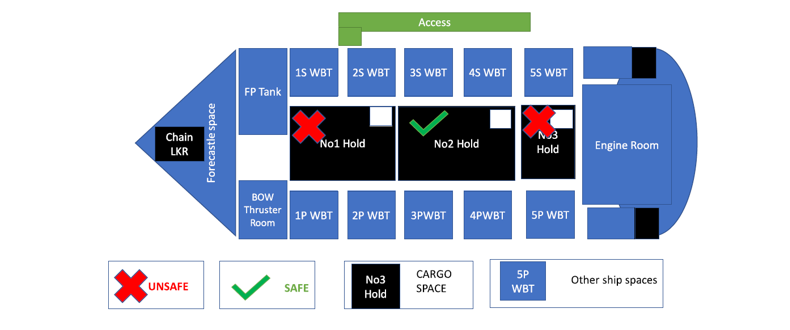
Example of Simplified diagram to be placed at the ship access point to assist shore personnel in identifying safe and unsafe spaces onboard the ship.
5.2 Entry procedure
Entry into enclosed space shall only be carried out if there is no other alternate safe method to complete desired task.
Crew member Shall NOT enter enclosed space without proper authorization by Master and responsible officer and after completion of HSSEQ 11.
Master and C/O shall NOT enter an enclosed space concurrently.
Chief Engineer and 2nd Engineer shall NOT enter enclosed space concurrently.
Reference shall be made to FOM 10.16 for simultaneous operation (SIMOPS) when planning multiple tank entries.
5.2.1 Risk Assessment
- A risk assessment shall be carried out for enclosed space entry via company’s HSEQ form.
- In case of multiple cargo tank or ballast tank entries, risk assessment for each tank is not required provided all applicable hazards for each space are properly identified and recorded in the risk assessment. Risk assessment guidance template is available on company’s HSEQ software library and same can be referred to.
- Risk assessment should include but not limited to:
- Available human resources and rest hours requirements.
- Crew training and familiarization with procedures and task.
- Previous cargoes carried
- Ventilation equipment and condition
- Coating type
- Tank structure
- Review of task
- Effective emergency response
- Potential for a hazardous atmosphere developing due to leakage from an adjacent space or remaining contents of the tank.
Note:
For cargo tank and bunker tank entry, the risk assessments shall be submitted to the Marine Superintendent for review and approval prior carrying out the entry.
Risk assessment shall be discussed with all crew involved in the task.
5.2.2 Permit to work
- HSSEQ-11 shall be used as permit for entry into enclosed space, and this should be attached to the risk assessment.
- Validity of permit shall not exceed 08 hours including any short breaks. New permit is required if task extends beyond 08 hours.
- Each enclosed space will require permit to entry and multiple spaces cannot be listed on same permit.
- Permit is rendered invalid if ventilation fails or any condition stated therein changes during the entry and all crew must vacate as per contingency plan. Responsible person shall re- check atmosphere and re-issue permit.
For entry into cargo and ballast pumproom on board tanker, TNK-16 shall be used. Validity of the TNK-16 “Pump room entry permit” shall not exceed 8 hours. Refer to sub-section 5.4.
5.2.3 Atmosphere checks
- Ventilation should be stopped at least 10 minutes before testing to ensure an accurate reading. Depending on experience, size of the space and potential risk factors. a longer period with ventilation stopped may be necessary to ensure accurate results.
- The atmosphere should be tested using suitable instruments for oxygen, flammable gases or vapours, CO, H2S and other toxic gases as appropriate.
- Isolated pockets of gas should always be considered and. Therefore, samples should be drawn from many different locations and levels within the enclosed space using instruments with pumps and extension hoses.
- Testing must be conducted at least three levels (top, middle and tank bottom levels as well in areas where personnel are expected to be present during entry), with properly calibrated gas detection instruments for the space to be considered safe for entry.
- Approved means of testing as per FOM 10.10 appendix (as applicable to type of vessel) shall be used for atmosphere checks. Master shall ensure vessel is correct measurement tubes are available onboard prior carriage of cargo.
- Testing is to be conducted based upon known hazards associated with specific types of enclosed spaces:
Cargo holds, ballast tanks, and voids Oxygen content to be at-least 20.9 % by volume
Cargo and fuel tanks
- Oxygen Content to be at-least 20.9 % by volume
- Hydrocarbons must be less than 1% LEL
- Carbon Dioxide (CO2); less than 0.5% (5000ppm)
- Toxicity - Not more than 50% of the OEL of any toxic vapours and gases. For cargo and bunker tank entry, the previous cargo / bunker provides an indicator of toxins that could be present -
- Benzene is always suspected for tanks that contained petroleum cargoes. OEL is 0.5 PPM
- Carbon Monoxide is suspected for tanks that contained Vegetable Oil cargoes. OEL is 50 PPM.
- Hydrogen Sulphide is suspected for tanks that contained bunker fuel or crude oil. OEL is 1 PPM.
- Other aromatic hydrocarbons / toxic gases as per cargo carried.
Caution: Vessels shall comply with flag state, local / terminal regulations for OEL of toxic gases, where more stringent requirements may be imposed to limit exposure of personnel.
- Entry shall be carried out within 30 minutes of atmosphere checks. If this is not achieved, then atmosphere shall be re-checked again prior entry.
- Arrangements shall be in place to check atmosphere at interval not exceeding 30 minutes when space is occupied or after short breaks prior re-entry.
- All personnel entering space must carry personal multi-gas meter which is tested for alarms and calibrated as per manufacturer’s manual periodically.
- The space to be entered should be segregated from all other spaces that contain or may contain a non-gas free atmosphere. All common line valves should be secured in the closed position and labelled to prevent transfer of toxic gases.
- Areas of the spaces which are not accessible from entry / exit point shall be checked for atmosphere by adopting controlled entry by 2 experienced personnel one of which shall be responsible person and both crew members to wear SCBA set. Additional PPE such as FAD with safety harness to be used as necessary. Once the atmosphere is tested and verified to be safe, then measures can be normalized.
- Adjacent interted cargo tanks to be kept at minimum positive pressure to prevent any ingress of IG through common system.
5.2.4 Personal multi gas meters
- Personal type gas detectors are intended for monitoring of ambient conditions in the workplace. The detectors are designed to be carried in gas free spaces where unsafe conditions may occur rapidly (e.g. petroleum cargo leak in a pump-room) and to alert person in space on the oncoming danger (visual and audible alarm).
- The personal gas detectors to be calibrated as per manufacturer’s manual or on monthly basis whichever is more frequent.
- Detectors should be capable of measuring oxygen (O2), carbon dioxide (CO2), flammable gases/vapors, toxic gases (e.g. CO), and any other gases identified by the risk assessment
- Record to be maintained.
- Alarms shall be set to alert the user on high concentration of toxic gases / HC exceeding permissible limit corresponding to OEL and low concentration of Oxygen % by volume.
- When wearing personal gas detectors: Keep away from the effects of own exhaled air Ensure the sensors are not covered or blocked Keep away from UHF radio as this may cause a false alarm Refer to manufacturer’s instructions when in doubt.
- Crew shall be given training for the calibration and maintenance of gas meters by competent person.
5.2.5 Gas detection tubes
- Gas detection tubes, or similar equipment, should be used if it is necessary to monitor high concentrations.
- Beware of the stated lower limit of detection and accuracy range of the gas detection equipment used.
- Bunker fuel tanks should be monitored before, during and after bunkering. If H2S has been detected, the bunker tank should be regularly tested.
- Gas testing bunker tank vapour spaces should be risk assessed, considering the design of the bunker tanks, and appropriate measures taken to ensure the safety of personnel.
5.2.6 Ventilation
- Air shall be introduced in cargo tanks only after proper purging and verification atmosphere outside flammable range.
- Mechanical ventilations such as motor driven fans, extraction fans, hydro blowers etc are effective means to achieve proper ventilation.
- Care shall be taken when changing over means of forced ventilation from inert gas to atmospheric air and line up must be verified by responsible officer.
- Use of ducts help in directing supply or extraction of air from remote locations within enclosed space.
- Precautions to be used against static electricity and ensure portable fans are properly grounded.
- Use all means of natural ventilation to expedite gas freeing.
5.2.7 Pre entry checks
- HSSEQ-11 section 1, 2 and 3 must be completed and signed by all personnel involved in task. Master is overall approving authority.
- 1 x Attendant must be appointed for each enclosed space.
Communication
- Officer of the Watch (OOW) is to be advised of each enclosed space entry and the primary and back up means of communication to be agreed and verified.
- Very High Frequency/Ultra High Frequency (VHF/UHF) communication may not be suitable where it is known that reception may be unreliable or noisy. In this case, consider and test the possibility of positioning Attendants with line of sight to workers or using other remote communications or monitoring the system of communication between those entering the enclosed space and those on standby outside the space. Suggested forms of communication include:
| Verbal via UHF Radio | Are you ok / I’m ok |
| Clicking of Torch Light beam | Two clicks – are you ok / three clicks – I’m ok |
| Tapping with a Hammer | Two taps – are you ok / three taps – I’m ok |
- Display a copy of HSSEQ-11 and safety signs as applicable e.g. Red and Green tags for parcel chemical tankers.
- Lock / cordon off entry points of other spaces which may contain non gas free atmosphere.
- Protect open manholes using gratings.
- Carry out safety meeting with all crew involved to reiterate: Work instructions, expected duration of entry and the dangers and hazards that may be encountered Hazard identification and precautionary measures checked and discussed. Additional permits related to the operations checked and details discussed. Working and safety equipment requirements Use of personal multi gas meters and alarms. Contingency and emergency plans including aborting the task in the event of personal discomfort or change in working environment without delay.
Additionally, attendant to receive instruction on:
- Record keeping of personnel entering and exiting space as per section 4 of HSSEQ-11
- Enclosed space atmosphere re-testing requirements as per section 5 of HSSEQ-11.
- Raising the alarm if no communication response or contact with crew inside enclosed space or if any condition changes as per frequent atmosphere checks.
- The OOW will use the General Alarm to alert the crew of any emergency
- Rescue procedures.
5.2.8 Use of tools, electrical lights and electrical equipment
- Inspect all tools before they are used. Do not use worn or damaged tools.
- Tools should be lowered in a plastic bucket or canvas bag to avoid from being dropped.
- Responsible Person should ensure no hazards of hydrocarbon vapour present in the work area prior using chipping hammer or any power tool.
- Use only approved safety lighting or intrinsically safe electrical equipment (symbol Ex) in enclosed spaces that are liable to hydrocarbon vapour re-contamination.
5.2.9 Personal Protective Equipment (PPE) and rescue apparatus
- Use of smart watches, fitness bands, and health trackers and any similar high-powered personal devices in gas hazardous area and enclosed spaces is strictly prohibited.
- Responsible person shall ensure that verification is carried out for each crew to ensure such devices are not used during enclosed space entry including in pump room spaces.
- Conventional battery powered wrist watches are accepted as they do not pose risk of explosion.
- All crew members shall comply with PPE matrix as per document FOM 10.10.
- Additionally, due to risk of vertical fall and serious injuries, crew members entering cargo tanks, ballast tanks, bunker tanks or void spaces shall wear safety harness with shock absorbing lanyard attached to Fall Arrestor Devices (FAD).
- Fully charged safety torch ready for immediate use
- Spare UHF two-way Radio :
- The list of standby equipment is for guidance and is not exhaustive. Vessels can add more gears as per vessel specific contingency plan and periodic enclosed space rescue drill.
- Enclosed Space Register
- Identification of enclosed spaces
- Space-specific hazards
- Ventilation and atmosphere testing methods
- Emergency rescue equipment requirements
- Vessels to make ship specific using HSSEQ-11a SMS form.
- ・ A ship-specific enclosed space emergency response plan should be established and incorporated into the SMS using standard template include in CMS under standard company manuals.
- Rescue equipment should be readily available and maintained in usable condition.
- Regular training and drills for enclosed space entry and rescue should be conducted in accordance with HSSEQ-03 and to be recorded as HSSEQ-04.
Each ship should maintain an Enclosed Space Register containing, as a minimum:
Information on connected or adjacent spaces
Emergency Response and Training
5.3 Special circumstances
5.3.1 Work on pipes and valves / opening equipment and fittings
Where equipment, valves or pipelines are to be opened within an enclosed space and there is a risk that a flammable and or toxic liquid or vapour may be released:
- The equipment, valves or pipelines are to be thoroughly flushed through with water and drained.
- Ensure no pressure within system and additional permits are in place like lock out tag out.
- Properly ventilate the system prior to opening any flange.
- Breathing apparatus are to be available at the work site.
- Continuous gas monitoring is to be conducted while opening up the equipment, valves or pipelines.
Note:
Even after flushing some cargo may remain, which could be a source of flammable or toxic gas. Whenever this equipment is to be opened, the risk assessment should identify the minimum safe working practices, including any need for additional gas tests.
5.3.2 Activity involving mopping /squeezing, removal of sludge, scale and sediment
- Risk assessment for entry into cargo tanks and bunker tanks for such activities must be submitted to Marine Superintendent for review and approval prior commencing the task.
- During removing sludge, scale or sediment, test atmosphere with increased frequency.
- Maintain continuous ventilation throughout the activity.
- Heating process to make cargo / sludge less viscous, may give rise to ambient temperatures and it will have adverse effect on crew such as severe dehydration or feeling dizziness.
- Maximum duration to work in such environment should be agreed upon and mentioned in risk assessment.
- Due to risk of slip trip and fall due to slippery surface and access ladders, each crew to be provided with FAD and safety harness with shock absorbing lanyard anchored to strong point.
- Arrangements to rescue unconscious / dehydrated crew must be in place for immediate use.
Note:
Gas concentrations may increase in the immediate area around the work. Ensure that proper ventilation to achieve effective volume changes of air is available and make additional ventilation as necessary.
5.3.3 Activities that may give rise to unsafe atmosphere e.g. painting
- The company considers spray painting and the use of two (2) component paints, such as Epoxy, in enclosed spaces to be extremely dangerous.
- Any painting in an enclosed space may lead to an atmosphere that is explosive, flammable, and, or toxic and therefore such task should be considered in during vessel’s stay in drydock / shipyard as enhanced risk mitigation measures can be deployed.
- If there is no alternate option and if such activity is required for the safety of vessel, then such entry in enclosed spaces during voyage shall be subject to the following safety guidelines apply when painting in enclosed spaces: Master to issue a written statement declaring that there is no practicable alternative to the proposed task and method of entering the space and that it is essential for the safe operation of the ship Enhanced Risk assessment to be submitted to Marine Superintendent for review and approval. Completion of applicable section included in HSSEQ-11. Additional forced mechanical ventilation to ensure the atmosphere does not become explosive or flammable. The crew assigned to the space has been specifically instructed with regard to hazards expected from use of chemical-based paints and cleaning material. SCBA with positive pressure mask to be worn by crew involved in painting as it will prevent exposure to toxic gases released from chemicals. Chemical protective clothing to be part of additional PPE requirement. Lights and power tools must be pneumatic air driven type. Electric lights are prohibited when painting in confined spaces.
5.3.4 Use of Work Boats / inflatable rafts in enclosed space
Work boats used for tank repair work and tank inspections should be fit for the task.
The following precautions should also be taken:
- Open all deck apertures, e.g. tank washing plates, and maintain effective continuous ventilation while personnel are in the tank.
- Use the work boat only when the water surface is calm.
- Use the work boat only in tanks containing clean ballast water.
- Check that the water level in the tank is stationary or falling. Water level must not rise while the boat is in use.
- Ensure all personnel working in the space are wearing buoyancy aids.
- If the boat is working at a point remote from the tank hatch, position an additional lookout a little way down the access ladder at a point that provides a clear view of the boat.
5.3.5 Enclosed space entry within port limits or at offshore terminals
- Master and Marine Superintendent shall carefully review any specific requirements from terminal, charterer or any other stake holder pertaining to entry in enclosed space (cargo, ballast, and fuel tank, etc.) within local jurisdiction and ensure compliance.
- Port or charterers of the vessel may have more stringent requirements, particularly with regards to additional control measures and usage of PPE and same shall be complied with.
- Master to obtain written permission of port authorities and terminal operators via agent or similar channel as evidence of approval. Marine Superintendent shall be kept informed of this communication.
5.4 Entry into pump room, room fitted with Nitrogen generator and gas compressor
Such spaces, though fitted with forced mechanical ventilation and fixed gas detection system, can be dangerous due to potential gas leaks from pumps and associated piping arrangements or leakage of cargo through shared bulkhead. Vessels fitted with cargo and ballast pumprooms shall comply with ‘TNK-16 – Pump room entry permit’.
Personnel shall obtain formal permission from officer of the watch prior entering such spaces.
- Posters shall be displayed at entry point as stated below and as applicable to type of vessel.
| Poster # | Applicable to |
|---|---|
| 18 | Cargo pump rooms |
| 18A | Compressor room on gas tankers |
| 18B | Nitrogen Generator rooms on tankers. |
- HSSEQ-26 – Daily safety notice to be used for routine tasks and checks in such spaces.
- Risk assessment to be prepared for non-routine and special focus tasks such as maintenance of pumps etc.
- Forced ventilation system is to be in operation at-least 20 minutes prior to entry and at all times during entry and during cargo, ballasting, inerting operations using Nitrogen.
- Comply with any interlock arrangement with fixed illumination and ventilation within such space.
- Entry is to be aborted and the crew evacuated from the space if the ventilation system fails or stops for any reason.
- The ventilation system is to be set to extraction mode, with extraction from the lowest suction point in the space as applicable.
- A check at several levels, including the lowest point, is to be made prior to initial entry to ensure the space is gas free.
- If fitted, the gas detection system should be functioning correctly, calibrated and tested for alarms as per prescribed schedule.
- Atmosphere must be verified using calibrated portable multi-gas equipment and fixed gas detection prior space considered safe for entry. Following criteria to be verified Oxygen content to be at-least 20.9 % Hydrocarbons content less than 1 % LEL Hydrogen Sulphide not exceeding 0.5 PPM (OEL: 1 PPM) Carbon Monoxide not exceeding 25 PPM (OEL: 50 PPM) Other toxic gases less than 50 % of OEL as per SDS if checked.
- A personal multi gas detector are to be worn by the personnel entering such spaces.
- UHF Radio communication may be unreliable due to reception issues and noise, vibrations etc. Use Battery phone (connected between pump room, navigation bridge, engine room and cargo control room) if required to communicate with the person in the space. At least one of the personnel entering the space must carry a UHF radio
- A permanently rigged lifeline and rescue harness is to be rigged ready for use
- During cargo operations, the cargo pump room atmosphere should be re-tested by the duty officer at every change of duty officer watch. The results of all tests are to be recorded in Cargo record book periodic checks section.
- The Duty Officer is to be informed prior to any entry, then every 05 minutes and immediately after departure from the space.
- OOW shall ensure that all entries and exit of personnel are recorded in Separate Log Book mainly meant for Entry purpose of Pump room.
- Record to include as minimum: Rank, Name, atmosphere / gas readings, Time in, any remarks on the task completed, Time Out.
5.5 Paint stores, battery room, fixed CO2 firefighting room, lifeboats ventilation
- Paint Store, Battery Room, fixed CO2 firefighting room and lifeboats may contain hazardous gases due to the contents stored inside the space. Therefore, proper ventilation shall be carried out prior entry. Mechanical means shall be used where fitted. A warning sign to this effect to be displayed outside the entrance of these spaces. e.g. “Ventilate Prior Entry”.
- All Paint Stores, Battery room and fixed CO2 firefighting room natural vents should be kept open except in case of emergency. Caution can be displayed near such vents stating, "To be Shut only in Emergency”.
- While regular inspections of such ventilators in accordance with the vessel’s planned maintenance system, the closing device should be checked and confirmed to be in open position.
- It is a good practice to allow the paint stores, battery room compartment and lifeboats to ‘fully air’ prior to completing any statutory checks on the ship’s batteries.
- Equipment that is not certified ‘explosion proof’ must not be used within the battery room compartment.
- If battery room compartment or lifeboat ventilation is inadequate, or the ventilation is restricted for a period of time, there is a risk of a build-up of combustible hydrogen gas.
- Good housekeeping requires the battery room and lifeboats to be maintained in a clean condition.
- If the batteries require daily or weekly testing, these results should be recorded in a clear concise manner in a battery log.
- The ISPS code and the ship security plans require the battery rooms to be locked or tagged shut. This should not include the ventilator to the battery compartments as safety takes priority over security.
- The battery locker should contain personal protection equipment (PPE) for testing and handling the batteries. The PPE includes a face shield or eyeglasses, chemical handling gloves, chemical resistant shoes or boots, a suitable apron, and a valid bottle of eye wash.
- The PPE must be stowed clear of the batteries to avoid possible contamination from battery acid.
For additional safety, crew members entering such spaces should carry a personal gas meter and ensure proper communication is established over radio with officer of the watch.
5.6 Emergency contingency and training
5.6.1 Training
Master shall ensure that crew members are familiar with below as minimum
- How to operate and test alarms for portable and personal gas meters and use of toxic gas tubes with special pumps. HSSEQ-02 shall be used to record familiarization of every crew upon joining and prior assigning the work and refresher to be provided during periodic emergency rescue drills for enclosed space.
- Location and understanding of Material Safety Data Sheets including primary hazards identified and first aid measures.
- How to determine the permissible Occupational Exposure Limits (OEL) as per MSDS or industrial guidance, company advisories.
- How to use additional PPE such as FAD, safety harness or chemical resistant suits for specific tasks.
- Use of rescue and lifesaving apparatus.
Master shall also ensure compliance to Computer Based Training (CBT) matrix and relevant CBT modules for enclosed space entry and usage of gas meters as established for every rank.
5.6.2 Emergency drill for rescue from enclosed spaces
- All crew members with enclosed space entry or rescue responsibilities shall participate in an enclosed space entry and rescue drill at least once every two months.
- Enclosed space entry and rescue drills should be realistic, and not tabletop discussion.
- Drill plan shall include various enclosed spaces identified onboard and to be conducted in a safe manner to include:
- Checking and use of personal protective equipment required for entry.
- Checking and use of communication equipment and procedures.
- Checking and use of personal and portable multi gas meters and gas tubes for measuring the atmosphere in enclosed spaces.
- Checking and use of SCBA, EEBD and rescue equipment and procedures and
- Instructions in first aid and resuscitation techniques.
- Master shall ensure that every crew member is given instructions on risks associated with enclosed spaces and onboard procedures for emergency rescue operation in safe manner.
- During these drills, each crew connected with enclosed space entry to be trained by chief officer in use of gas measurement equipment on board using HSSEQ-05. Periodic records of such training to be maintained.
- The requirement of drills to be conducted at least once every two months is incorporated in company’s HSEQ software.
WARNING:
In the event of actual emergency to rescue personnel from enclosed space , Master shall assess the situation and may authorize entry without formal permit or formal risk assessment provided that rescue team enter the space with fully charged SCBA sets and back up arrangements are in place.
6 HOT WORK PROCEDURES
6.1 Definition(s) Hot work
Work that involves sources of ignition or temperatures high enough to ignite a flammable gas or liquid or material. This includes, but is not limited to:
- Welding (electric arc or gas).
- Cutting, burning, gouging (electric or gas).
- Heating (blow torch or heat gun).
- Soldering (electric or blow torch).
- Portable electric and Power-driven tools including pneumatic grinders which cause continuous sparks when used.
Following activities may have potential to cause spark and enhanced risk mitigation measures to be adopted based on specific risk assessment which may warrant use of Hot-work permit and office concurrence.
- Non-intrinsically safe electronic equipment e.g. 3D scanning devices, drones, video appliances etc.
- Internal combustion engines (driving air compressors. pumps, pressure washers etc).
Dangerous or Hazardous zone - locations onboard where an explosive atmosphere could be present. These includes the cargo tanks, cargo tank deck, pump rooms and the atmospheric space around and above them, including all areas forward of the main accommodation block and up to 3 meters abaft of the forward accommodation bulkhead.
Designated area - a space which has been assessed to be relatively safe for the performance of hot work onboard. Machinery space workshop is the designated hot work area. The machinery space workshop shall be kept free of combustible materials and in every way fit for doing hot work whenever required.
Hot Work Permit - a document issued by the Master permitting specific hot work to be done during a particular time interval in a specific location.
Responsible officer - A person having necessary knowledge, experience and appointed by master to be responsible to ensure that the hot work permit is followed. Responsible person should not be directly involved in hot work.
One of the senior officers (Chief Officer, 2nd Engineer or the Chief Engineer) shall be appointed as responsible person.
6.2 Safe conduct of hot work
The safe conduct of hot work is feasible provided potential hazards are clearly assessed, defined, specific instructions issued, and the operation carried out in a controlled manner and monitored by a responsible person.
- On tankers that carry petroleum or chemical cargoes all enclosed spaces including the cargo and ballast tanks, void spaces, duct keels and pipelines must always be considered to contain residual pockets of hydrocarbon or other explosive or flammable gases
- On bulk carriers the dust from cargoes of coal, wheat, etc. may have an explosive mix
- On container vessels, the risks presented may be the same as for bulk carrier
- All ships present risks in the vicinity of fuel tanks, hydrogen emission from cathodically protected ballast tanks, ignition of flammable materials or vapours (e.g. paint), and the use of welding and burning equipment may cause the conduction of heat through steel from safe to unsafe areas
The Master is responsible for ensuring hot work is conducted safely and is to ensure that the correct hot work procedures are planned, understood, and followed.
6.3 Prohibition of Hot work
Hot work is strictly prohibited onboard all vessels within port limits in any location including within the designated hot work area.
- If hot work is unavoidable for safety of the vessel or other immediate operational concerns, master must communicate with appointed agent or local authorities in writing to obtain information on prevailing national, international, port, terminal or dock regulations related to hot work permit to be issued by the authorities.
Master shall ensure Vessel manager, Fleet Group Manager and Marine superintendent are included in all the communication regarding port permission and local regulations pertaining to the hot work.
Office concurrence requirements as stated in section 6.6 and 6.7 shall be complied.
Vessels in shipyards or drydocks for repair work and permitted to carry out hot work asper local safety regulations and company’s guidance.
Caution:
Absence of specific guidance should be regarded as prohibition rather than approval.
Additionally, on tankers HOT WORK is prohibited:
- During any bunkering, cargo, or ballast operations.
- During Crude oil washing (COW) tank cleaning, purging, gas freeing, inerting operations and whenever cargo tank vapours are released.
- Within the dangerous or hazardous zone in the loaded passage* (*refer note below).
- No hot work is permitted outside the engine room or accommodation block during loaded passage, unless considered essential for the safety of the crew or the immediate operational capability of the ship.
Note:
On Asphalt carriers and Parcel Chemical Tankers (when carrying non-flammable chemical cargoes-flash point >60 Deg C) & cargo is not being handled at a temperature within 10 Deg C of its flashpoint, hot work may be carried out in loaded passage subject to below measures -
-Hot work concurrence is obtained from office.
-The area is free from flammable vapours.
-All compartments including deck tanks, within 30 meters of the work location have been tested and confirmed to be non-flammable.
-All other precautions are in place as per ICS Tanker Safety Guide (Chemicals).
For tanker vessels engaged in storage duties where the ship is continuously loading or discharging then hot work may be carried out at the engine workshop after:
-Written permission is received from the Terminal including the issue or endorsement of a Hot Work Permit
-Written permission is received from the Port State Authority
Company approval is granted and approval for these cases shall only be given in extraordinary or exceptional circumstances
6.4 Hot work- General precautions
The following precautions must be observed on every occasion when hot work is intended:
- All operations involving the bunkering, cargo or ballast system to be stopped before and throughout the duration of the work.
- Personnel carrying out the work should be adequately trained and competent to carry it out safely and effectively.
- Operator should wear appropriate PPE as per the PPE matrix and be fully conversant with the use of equipment and the safety measures to be adopted.
- All personnel involved in the hot work operation must be briefed about the job scope, PPE and safety requirements in a toolbox meeting prior the start of the hot work.
- Use of welding equipment should be controlled and correct grounding cables should be used. Welding current should not be returned to the transformer via the ship’s hull.
- Suitable and adequate firefighting equipment is to be made ready for immediate use. Where hot work is to be carried out at a compartment boundary then firefighting equipment is to be readied on both sides of the boundary. Effective ways to contain and extinguish welding sparks and molten slag should be established.
- Fire watch procedures should be established for the area of hot work and for adjacent spaces where heat transfer or accidental damage might create a hazard e.g. damage to hydraulic lines, electrical cables, thermal oil lines, etc.
- A fire watchman with radio contact to the bridge is to be posted and fully briefed. The fire watch should monitor the hot work and act if residues or paint coatings ignite.
- The risk assessment should identify hazards to fire watch personnel and how they will be evacuated in an emergency. It should also identify the extra Personal Protective Equipment (PPE) that will ensure risk levels are acceptable. Risk assessment should cover any proximity to fuel or other hydrocarbon piping.
- The hot work area is to be cleared and secured of all combustible material including any combustible material on the adjacent side of any boundary. Adjacent tanks, holds, pipelines, etc. must be confirmed free of any dangers posed by hot work.
- Check the work area and adjacent compartments and tanks are gas free with properly calibrated instruments.
- The work area is to be adequately ventilated. The frequency of atmosphere monitoring is to be established and recorded in Form HSSEQ-07 “Hot Work Permit”. The hot work shall commence within 30 minutes from the time permit is issued. If the start or the work is delayed, all safety measures should be rechecked and recorded before it begins.
- Atmosphere should be re-tested after each break in work periods and at regular intervals as defined in Form HSSEQ-07. The results of these checks are also to be recorded in HSSEQ-07. Checks are to also to be made to ensure there is no ingress of flammable vapours or liquids, toxic gases or inert gas from adjacent or connected spaces.
- Fuel oil bunker tank may be considered safe if tests using a combustible gas indicator give a reading of not more than 1% LEL in the ullage space of the bunker tank however, no heat transfer through the bulkhead of the bunker tank is to be caused by any hot work
- No hot work should be carried out on or within 500 mm of the bulkheads of bunker tanks containing bunkers.
- Hot work on pipelines and valves is permitted when the item has been detached from the system by cold work and the remaining system blanked off.
- The item to be worked on should be cleaned and safe for hot work regardless of whether or not it is removed from the hazardous cargo area.
- Heating coils should be flushed and opened to ensure that they are clean and free of hydrocarbons.
- Isolation of the work area and fire safety precautions should continue until the risk of fire no longer exists.
- Consideration should be given to performing only one hot work operation at a time.
- Additionally, for tanker vessels
- All hot work should be stopped in case the inert gas pressure reaches the relieving pressure of pressure/vacuum valves. If it is found necessary to release tank pressure to atmosphere, all work should be suspended until the venting has been completed.
Note:
Hydrocarbon gas is generally heavier than air and may be present in pockets in compartments that have been ventilated for some time. However, methane gas which may be emitted from coal
cargoes is lighter than air and therefore hatch covers must be tested. It is therefore most important that tests should be made throughout any compartment and at different levels.
Caution:
Hot work should be suspended immediately if any of the specific safety requirements can’t be complied with or circumstances/conditions basis which approval was granted change during the hot work.

Figure 1: Hot work flowchart (Refer FOM 10.12 for office concurrence process)
6.5 Hot work inside the designated area
Note:
Reference is to be made to relevant conditions under Prohibition of Hot work Sec 6.3 prior undertaking hot work in the designated hot work area.
In case hot work is unavoidable first consideration should be given to performing hot work only in the designated hot work area which on our vessels is the machinery space workshop.
A ship specific risk assessment should be carried out via company’s HSEQ software regarding the possible risks and the conditions under which the hot work can be undertaken in the workshop.
The risk assessment should consider among other things adequate ventilation. The risk assessment is to be reviewed at least once every 3 months and a copy of the same is to be posted in the designated hot work area.
Safety boundary to be established inside the designated space for hot work such as electric welding or gas cutting to prevent arc flash and contain sparks. This area should be bound by curtains or another barrier.
Other factors, such as fuel tanks or electrical cables, may also require a safety boundary.
If the designated hot work. area includes a bunker tank bulkhead; the work should not be allowed within 500mm of that bulkhead.
All personnel involved in the hot work operation must be briefed about the job scope, PPE and safety requirements in a toolbox meeting prior the start of the hot work.
A safety notice or sign is to be posted in the designated hot work area giving instruction for the safe working practices and the safe operation of all welding, burning and cutting equipment to be used.
Chief engineer is responsible for the safe conduct of the hot work in the designated hot work area and also for assessing and designating those onboard who may operate the ships welding, burning and cutting equipment.
6.6 Hot work outside designated area-Tankers (Oil, Chemical & Gas)
Note:
Prohibition of Hot work Sec 6.3 supersedes anything contained within this section. Vessels should not be engaged in any of the activities mentioned in Sec 6.3.
Hot work should only be carried out if it is considered essential for safety or the immediate operational capability of the ship, and that it cannot be deferred until the next planned visit to a repair yard.
Alternatives including removal of the damaged section and moving to the machinery space workshop for repairs should be fully explored.
Master to notify the office in writing about the proposed hot work job.
Hot work approval/concurrence from office needs to be obtained prior carrying out any hot work outside the designated hot work area.
Seeking approval/concurrence from office
- Risk assessment along with attached HSSEQ-07A – Hot work concurrence request is to be submitted to office via company’s HSEQ software. (Refer to FOM 10.12 Hot work concurrence workflow, and ISGOTT chapter 4 for industry accepted risk control measures)
- A separate Risk assessment and concurrence request is to be submitted and approved for each intended task and location.
- Once the above documents have been submitted, reviewed and the risk assessment is approved in office; the concurrence will be granted, and vessel will be intimated via company’s HSEQ software.
- Final approval for all hot work will be given by the Marine Superintendent.
Upon receipt of approval/concurrence from office
- Once the concurrence is received onboard, HSSEQ-07 – Hot work is to be completed. (HSSEQ-07 is only valid for eight hours, for any job exceeding eight hours a fresh HSSEQ-07 Form needs to be completed)
- Designate the responsible person in charge of the hot work.
Prior starting hot work
- A safety meeting is to be held with all those involved in the hot work. Briefing on the hot work procedures, communications procedures and any related safety precautions and contingency plans must be conducted.
- Once the initial safety assessment of the hot work area including the necessary checks, atmosphere tests and all the requirements as outlined in the approved concurrence form including any special/ specific precautions has been completed by the Chief Officer or Chief Engineer; the Master will authorise the start of the hot work via company’s HSEQ software.
Notification to company upon starting
- Masters are to notify the company in writing of the actual date & time of the start of the job.
- If the concurrence/approval has been sought for a duration of more than one day, then written notification is to be made to company on each day with time of work commenced and when ceased for the day.
During the hot work
- Throughout the duration of hot work one of the four senior officers i.e. Master/Chief Officer/Chief Engineer/2nd Engineer shall remain at the worksite to maintain a full overview of the job progress and the safety requirements.
- All the precautions including all the incorporated checks and tests are to be carried out prior resuming any hot work after work breaks.
In case a permit is suspended due to change in conditions office is to be notified via email. In all such cases before hot work is resumed office is to be notified again and all the precautions including all the incorporated checks and tests are to be carried out again.
Upon completion of hot work
- The work area to be thoroughly inspected to ensure that all tools and equipment have been accounted for and cleared from any hot work site (especially critical when hot work has been carried out within an enclosed space).
- The hot work permit and risk assessment is to be closed in company’s HSEQ system. The final responsibility to ensure proper close-out of all hot work operations lies with the Master.
- Office is to be notified in writing upon completion of the hot work. The notification implies completion of the hot work and also that the work area is deemed to be safe, cleared and returned to normal safe operation.
6.7 Hot work outside the designated area on dry cargo vessels (Bulk/Containers/General Cargo)
Note:
Reference is to be made to relevant conditions under Prohibition of Hot work Sec 6.3 prior undertaking any hot work.
6.7.1 When carrying non dangerous cargoes
Hot work outside the machinery space workshop should be avoided unless the Master and Fleet Group have confirmed that there is no other viable means for repairs available.
Alternatives including removal of the damaged section and moving to the machinery space workshop for repairs should be fully explored.
In unavoidable cases, whereby the hot work has to be carried out outside engine room workshop (i.e. in engine room, accommodation and deck) & hot work is not being carried out in any of the conditions mentioned in 6.7.2; the following procedures are to be followed irrespective of vessel’s location at sea or within port limits:
Prior starting hot work
- Master to notify the office in writing about the proposed hot work job.
- Office is to be informed in writing prior starting of hot work.
- Risk assessment via company’s HSEQ software should be completed to highlight the hazards and risk control measures implemented in order to lower the risk.
- A hot work permit needs to be completed for each intended task and location.
- HSSEQ-07 is only valid for eight hours, for any job exceeding eight hours a fresh HSSEQ-07 is to be completed.
- Designate the person in charge of the hot work.
- A safety meeting is to be held with all those involved in the hot work. Briefing on the hot work procedures, communications procedures and any related safety precautions and contingency plans must be conducted.
- Once the initial safety assessment of the hot work area including the necessary checks, atmosphere tests and all the requirements as outlined in the hot work permit and the risk assessment have been completed by the Chief Officer or Chief Engineer; the Master will authorise the start of the hot work in the company’s HSEQ software.
- If vessel is in port limits, permit requirements must be complied with as per local regulations and formal documentation must be obtained prior starting the work. Vessel manager shall verify compliance to such regulations.
- Masters are to notify the company in writing of the actual date & time of the start of the job.
- If the hot work is expected to last more than one day, the company is to be notified in writing on each day with time of work commenced and when ceased for the day.
During the hot work
- Throughout the duration of hot work one of the four senior officers i.e. Master/Chief Officer/Chief Engineer/2nd Engineer shall remain at the worksite to maintain a full overview of the job progress and the safety requirements.
- All the precautions including all the incorporated checks and tests are to be carried out prior resuming any hot work after work breaks.
- In case a permit is suspended due to change in conditions, office is to be notified in writing. In all such cases before hot work is resumed office is to be notified again and all the precautions including all the incorporated checks and tests are to be carried out again.
Upon completion of hot work
- The work area to be thoroughly inspected to ensure that all tools and equipment have been accounted for and cleared from any hot work site (especially critical when hot work has been carried out within an enclosed space).
- The hot work permit and risk assessment is to be closed in company’s HSEQ system. The final responsibility to ensure proper close-out of all hot work operations lies with the Master.
- Office is to be notified in writing upon completion of the hot work. The notification implies completion of the hot work and also that the work area is deemed to be safe, cleared and returned to normal safe operation.
6.7.2 Conditions & workflow where office concurrence is required prior hot work on dry cargo vessels
Hot work requiring office concurrence
The following hot work require the vessel to obtain office concurrence prior commencing hot work:
- When carrying dangerous cargoes/IMDG Cargo
- When carrying out hot work within 500mm of any bunker tank opening/bulkhead
- Any hot work inside an enclosed space
- Any hot work in paint lockers & chemical lockers
Hot work should only be carried out if no other viable/acceptable means of repairs are available.
Alternatives including removal of the damaged section and moving to the machinery space workshop for repairs should be fully explored.
Hot work approval/concurrence from office (via company HSEQ software and approved HSSEQ-07A) needs to be obtained prior carrying out any such hot work.
Master to notify the office in writing about the proposed hot work job.
If vessel is in port limits, permit requirements must be complied with as per local regulations and formal documentation must be obtained prior starting the work. Vessel manager shall verify compliance to such regulations.
Seeking approval/concurrence from office
- Risk assessment along with attached HSSEQ-07A – Hot work concurrence request is to be submitted to Office.A separate concurrence is to be requested and approved for each intended task and location.
- Both Marine Superintendent and Tech Spuerintendent are required to review, enter their comments and evaluate the request prior concurrence.
- Once the above documents have been submitted, reviewed and the risk assessment is approved in office; the concurrence will be granted, and vessel will be intimated via company’s HSEQ software/ email.
In case of technical issues with submission via company’s HSEQ software, please submit the risk assessment and PTW in email.
- Final approval for any hot work in paint lockers and chemical lockers will be given by the Marine Superintendent.
Upon receipt of approval/concurrence from office
- Once the concurrence is received onboard, HSSEQ-07 – Hot work is to be completed. (HSSEQ-07 is only valid for eight hours, for any job exceeding eight hours a fresh HSSEQ-07 needs to be completed.)
- Designate the responsible person in charge of the hot work.
Prior starting hot work
- A safety meeting is to be held with all those involved in the hot work. Briefing on the hot work procedures, communications procedures and any related safety precautions and contingency plans must be given.
- Once the initial safety assessment of the hot work area including the necessary checks, atmosphere tests and all the requirements as outlined in the approved concurrence form including any special/ specific precautions has been completed by the Chief Officer or Chief Engineer; the Master will authorise the start of the hot work via company’s HSEQ system.
Notification to company upon starting
- Masters are to notify the company in writing of the actual date & time of the start of the job.
- If the concurrence/approval has been sought for a duration of more than one day, then written notification is to be made to company on each day with time of work commenced and when ceased for the day.
During the hot work
- Throughout the duration of hot work one of the four senior officers i.e. Master/Chief Officer/Chief Engineer/2nd Engineer shall remain at the worksite to maintain a full overview of the job progress and the safety requirements.
- All the precautions including all the incorporated checks and tests are to be carried out prior resuming any hot work after work breaks.
- In case a permit is suspended due to change in conditions office is to be notified via email. In all such cases before hot work is resumed office is to be notified again and all the precautions including all the incorporated checks and tests are to be carried out again.
Upon completion of hot work
- The work area to be thoroughly inspected to ensure that all tools and equipment have been accounted for and cleared from any hot work site (especially critical when hot work has been carried out within an enclosed space).
- The hot work permit is to be closed. The final responsibility to ensure proper close-out of all hot work operations lies with the Master.
- Office is to be notified in writing upon completion of the hot work. The notification implies completion of the hot work and also that the work area is deemed to be safe, cleared and returned to normal safe operation.
6.8 Hot work concurrence (Also refer to FOM 10.12) Initiation – (by vessel)
Vessel to complete the entire form with specific emphasis on:
| Form to be used | : Risk Assessment in company’s HSEQ software/ HSSEQ-18 form. HSSEQ-07 (Tankers) |
| Exact Location | : Be specific as to the exact location |
| Work Scope and Requirement check sheet | : Detail of all action and mitigation actions |
| Reason Necessary | : Why it is critical to conduct this hot work at this particular time |
| Radius of area to be cleaned | : Depending on the scope of the job on the operator’s side as well on the opposite side |
| Written Plan for the work and Planned Safety Precautions | : Detail all preparation including line flushing and water plugs (where deemed appropriate) |
| Master’s Signature | : Physical signature is not required if completed in company’s HSEQ software |
Transmission from vessel
Master to notify the office in writing about the proposed hot work job.
Risk assessment, completed concurrence requests ) and attachments (if any) should be submitted via company’s HSEQ software/ OR ON EMAIL. In case of technical issues with submission via company’s HSEQ software, please submit the risk assessment and PTW in email. (TO: Marine Superintendent & Vessel Manager (for the respective vessel) CC: snq DEPT DPA & TECH DIRECTOR)
Note:
The Master should take into account and allow for sufficient time for office review and approval of the concurrence request documents when planning any hot work.
Review and approval process (In office)
The vessel’s Marine Superintendent is designated to liaise within office to ensure expeditious review of the hot work requests from the vessel.
The final ownership of the Hot work office review process lies with the Marine Superintendent of each respective vessel.
Step 1 – Review by Vessel Manager( TSI)
It is the responsibility of the vessel manager( TSI) to liaise with the vessel to view the initial request and ascertain if this hot work is justified and in line with his own plans for the vessel.
The vessel manager may wish to seek additional information/ clarifications from the vessel regarding the received documents including the area, work scope and the need for doing hot work and input his comments under ‘comments from TSI section’.
Step 2- Final approval/ Concurrence -MSI
The MSI, will review the Hot Work Concurrence request in its entirety and ensure all safety aspects have been identified both in the initial part of the request from the vessel and office departments’ comments( TSI).
Upon the completion of review, he should be satisfied all safety measures are in place. If not, he may instruct any additional measures to be considered. MSI shall escalate to head of HSSEQ Unit if any safety concerns are foreseen as result of the hot work task.
Upon being fully satisfied he may add his comments under “comments from MSI section” and he will approve the concurrence request appending the date and time the concurrence.
The completed HSSEQ-07A concurrence request can then be transmitted back to the vessel via company’s HSEQ software/ Or on email.
Coution:
The risk assessment and concurrence will be circulated via company’s HSEQ software/ or HSSEQ-18 on email..
In case of technical issues with company’s HSEQ software, the risk assessment can be circulated
can be accepted in lieu of signatures provided master signs in dedicated column in 096A upon completion of hot work.
Transmission of form back to vessel
The concurrence request once reviewed and approved as above is transmitted back to the vessel by the Marine Superintendent via company’s HSEQ software.
6.9 Special precautions-hot work All vessels type
6.9.1 Radius of area to be cleaned for hot work
Radius of area to be cleaned for Hot Work
| Height of work | Operator side | Opposite side | ||||
|---|---|---|---|---|---|---|
| Gas cut | Welding | Gouging | Gas cut | Welding | Gouging | |
| 0-5 meters | 1.5 | 5.0 | 4.0 | 7.5 | 2.0 | 2.0 |
| 5-10 meters | 1.5 | 5.0 | 5.0 | 10.0 | 2.0 | 2.0 |
| 10-15 meters | 1.5 | 5.0 | 7.5 | 15.0 | 2.0 | 2.0 |
| >15 meters | 1.5 | 5.0 | 10.0 | 20.0 | 2.0 | 2.0 |
6.9.2 Hot work in the vicinity of bunker tanks
- Hot work in the vicinity of bunker tanks should be treated in the same manner as hot work over the cargo tank deck area.
- When the hot work is associated with fuel tanks and fuel pipelines. consider the potential for hydrocarbon vapours in the atmosphere and the existence of ignition sources.
- No hot work should be carried out on the bunker tank deck or within 500mm from such a deck or bulkhead unless the tank has been cleaned to hot work standards. A risk assessment should cover any proximity to fuel or other hydrocarbon piping.
Bunker tanks should be clearly identified to avoid any misunderstanding as to their location and extent.
6.9.3 Hot work on pipelines
- Wherever possible, sections of pipelines and related items such as strainers should be removed from the system and repaired in the engine room workshop.
- Items/ sections requiring hot work should be disconnected by cold work and the remaining pipework must be blanked off.
- The item to be worked upon must be cleaned and gas freed to a safe hot work standard.
- Consideration should be given to continuous through ventilation of the pipeline with fresh air.
- Heating coils should be flushed and blown through with steam and proved clear of hydrocarbons.
6.9.4 Hot work in enclosed space
- An enclosed space entry permit is to be completed and all enclosed space entry requirements need to be complied in addition to the hot work permit and procedures.
- The space is to be cleaned and ventilated until the atmosphere tests indicate a reading of at-least 20.9 % of Oxygen & Hydrocarbon not more than 1% LEL.
- Arrangements also need to be made to ensure continuous ventilation of the space during the entire duration of hot work including during work breaks.
6.9.5 Hot work over the side / ship’s hull
Hot work on the outside hull may present unique hazards and should be risk assessed before the work starts. Examples are hot work on anchors or chains (from a barge or other vessel) or the aft area of the hull for stern seal or propeller work. Any activity that could directly or indirectly affect the safe performance of the hot work should be avoided. Risk assessment should identify the hazards and control measures for all potential conflicts or challenges.
On tankers hot work that would be conducted on the hull. Such as ballast or other tanks within the cargo tank area, is to be treated as work in dangerous or hazardous areas and FOM10.13 section 6.6 should be complied.
On Dry cargo vessels hot work that would be conducted on the ship’s hull, FOM 10.13 section 6.7.2 should be complied.
When Hot work is done over the side additionally working aloft permit should be complied with.
Additionally, for Tanker Vessels
6.9.6 Hot work inside cargo tanks (Inerted and Non Inerted Tankers)
Reference is to be made to relevant section of ISGOTT 6 Chapter 09 for detailed guidelines for Hot work inside Cargo tanks (Inerted and Non Inerted Tankers) which have also been incorporated in HSSEQ07A (Tankers).
Gas testing should be done before starting hot work and there should be continuous monitoring of the atmosphere in the vicinity during the entire duration of hot work.
6.9.7 Hot work in ballast tanks (Tanker vessels)
Ballast tanks located in the cargo tank area should be treated as dangerous or hazardous areas, similar to cargo tanks and all precautions under section 6.9.9 should be complied with.
Hot work in ballast tanks, e.g. the fore peak and after peak tanks, that fall outside the dangerous or hazardous area and have no adjacent cargo, slop or bunker tanks, may be treated as work outside a designated space, but no hot work should be carried out unless all spaces within 30m are either:
- Gas freed.
- Hydrocarbon vapour content reduced to 2% by volume and inerted.
- Completely filled with water.
Reference is to be made to relevant section of ISGOTT 6 Chapter 09 for detailed guidelines for Hot work inside ballast tanks which have also been incorporated in HSSEQ-07A
6.9.8 Hot work in pumproom
The pump room should be treated as a dangerous or hazardous area, similar to cargo tanks. Adjacent tanks should be either:
- Cleaned and gas freed, with hydrocarbon vapour content reduced to not more than 1% LFL and maintained at that level.
- Emptied, purged and the hydrocarbon vapour content reduced to less than 2% by volume and inerted.
- Completely filled with water.
Pipelines, strainers and cargo pumps should be gas freed, inerted or filled with water. The bilge and work areas should be cleaned to meet hot work requirements.
All slops should be either removed from the ship or securely isolated in a non-adjacent lank at least 30m from the hot work location.
6.9.9 Hot work in the cargo tank deck area (Tanker vessels)
On the tank deck
If the hot work is to be undertaken on the cargo tank deck or at a height less than 500mm above the tank deck, it will be classed as hot work within those tanks and reference is to be made to relevant section of ISGOTT 6 Chapter 09 for detailed guidelines which have also been incorporated in HSSEQ-07A)
Above the tank deck
If the hot work is to be undertaken above the cargo tank deck (higher than 500mm) reference is to be made to relevant section of ISGOTT 6 Chapter 09 for detailed guidelines which have also been incorporated in HSSEQ-07A)
Additionally, for Dry cargo vessels (Bulk/Containers/General Cargo)
6.9.10 Previous cargo residues (Dry Cargo Vessels)
Special attention is drawn to cleaning and preparation of Cargo holds for hot work when carrying out HW inside cargo holds, whereby the last cargo carried was a dangerous cargo. Extra caution needs to be exercised for site preparation to ensure complete removal of residues of previous cargo e.g. coal dust prior commencing hot work.
6.9.11 Stevedore Damages (Dry Cargo Vessels)
When stevedore damage repairs are initiated by terminal and required to be carried out by the shore contractors/ team, vessels shall complete HSSEQ-07 Hot work permit prior starting any hot work. Reference shall be made to relevant section of the FOM 10.13 Sec 4.10 for HSE guidance of visitors and contractors. Master shall notify vessel manager on damages incurred and status of repair.
6.10 Welding, Gas cutting, burning and other equipment
Welding, Gas cutting, burning and other equipment used for hot work should be carefully inspected before each occasion of use to ensure that it is in good condition.
The Chief Engineer has the responsibility of assessing and designating those onboard who may operate the ships welding, burning and cutting equipment.
Where required it must be correctly earthed prior use.
Electric arc equipment
- Cable connectors are to be insulated and designed that live terminal are not exposed on disconnection. Electrode holders should be fully insulated so that no live part of the holder is exposed to touch.
- Electrical supply connections are to be made in a gas free area.
- The cable route to the work site should be the safest possible, passing over gas free or inerted spaces.
- Existing supply wiring should be adequate to carry the electrical current demanded without overloading and causing heating.
- Insulation of flexible electric cables should be in good condition.
- The earthing connection should be adjacent to the work site and the earth return cable should lead directly back to the welding machine. The ship’s structure should not be used as an earth return.
- Adequate ventilation must be provided in all spaces where welding is undertaken to eliminate the gases, fumes and dust caused by the welding operation and respiratory protective masks provided if necessary.
- The operator should be protected by appropriate PPE as per the approved PPE matrix.
- An assistant should be in attendance; ready to assist in case of accidental electric shock or any other injury.
- In restricted or enclosed spaces, the personnel are to be protected from contact with the ship’s structure by the provision of dry insulating mats or boards.
- The electrode holder should be isolated from the current supply before a used electrode is removed and a new electrode is inserted. This precaution is necessary because some electrode coatings have extremely low resistance. Even a flux coating which is normally insulating can become damp from sweating hands and thus be potentially dangerous.
- Extra precautions should be in place when welding operations are undertaken in hot or humid conditions; where body sweat, and damp clothing may increase the risk of electric shock.
- Under no circumstances welding work is to be carried out while standing in water or with any part of the body immersed/in contact with water.
Gas welding, cutting or burning and other equipment
- Compressed gas cylinders
- Are handled with care, properly secured and kept upright with valves up. Have valve covers/caps in place during transport.
- Stored in separate (oxygen & acetylene lockers) which are well ventilated and clear of machinery spaces.
- Valves, regulators and associated fittings are to be kept free of oil, grease and paint and maintained in good condition
- Valves are to be kept shut when not in use.
- Compressed gas pipes and hoses are: Where possible, to be made of a solid construction.
- To have flashback arrestors fitted (oxygen & acetylene), behind the torch, at the gauges and at the bottles.
- To be colour coded (pipelines and hoses).
- To be checked to ensure they are not damaged, kinked, coiled around the cylinders themselves and are protected from damage (e.g. falling slag or sparks)
- Are joined or connected using only proper gas pipe or hose clamps and not water hose type band clamps.
6.11 Grit blasting, mechanically powered tools (other than pneumatic grinders) & hand tools
Mechanically powered tools, e.g. chisels, needle guns, cup brushes and grit blasters have a significant potential for producing sparks.
Enhanced risk mitigation measures to be adopted based on specific risk assessment which may warrant use of Hot-work permit and office concurrence
The following precautions shall be taken and mentioned in Risk assessment
- There should be no cargo, bunkering, tank cleaning, gas freeing, purging or inerting operations in progress.
- The work area should not be subject to vapour release. or a concentration of flammable vapours and should be free of combustible material.
- The area should be gas free and tests with a combustible gas detector should give a reading of not more than 1% LFL.
- Adequate fighting equipment should be laid out and ready for immediate use.
- Mechanical tools should not be used when a tanker is alongside a terminal. unless the Master and the Terminal Representative have given express permission.
- Extra caution must be exercised while using the drilling machines due to the friction heat that may be generated when a drill bit is drilling through hard surfaces.
Additionally, for Grit Blasting
- The hopper and hose nozzle of a grit blasting machine should be electrically bonded and earthed to the deck, or filling being worked on to avoid risk of static discharge.
- Pipelines can be perforated during grit blasting or chipping. so great care should be taken when planning such work. Similar precautions should be adopted for IG and COW lines.
- Before commencing work on cargo lines on tanker vessel’s lines should be flushed, drop line valves should be closed. The atmosphere inside the lines should be confirmed as either inerted to less than 8% O2 or gas free to not more than 1% LFL.
Additionally, for Hand tools
- The use of hand tools such as chipping hammers, scrapers for steel preparation and maintenance is permitted without a hot work permit. On tanker vessels their use must, however, be restricted to deck areas and fittings not connected to the cargo system.
Note:
Non-ferrous (also called non-sparking) tools are not recommended. They arc softer (and less efficient) than ferrous tools and only slightly less likely to cause an incendive spark.
Note:
Pneumatic/Electric Grinders which may cause continuous sparks to be produced are considered as falling within the purview of hot work as per company’s policy and subject to full hot work procedures (as applicable to the area of work).
Additionally, for Hydro-blasting (high pressure water washing)
Hydro-blasting (and slurry blasting) are hazardous activities and enhanced risk mitigation measures to be adopted based on specific risk assessment which may warrant use of Hot-work permit and office concurrence.
There should be no cargo. bunkering, tank cleaning. gas freeing, purging or inerting operations in progress.
Hydro-blasting presents two main hazards: personal injury and static electricity.
6.12 Posted safety instructions
A safety notice or sign is to be posted giving instruction for the safe working practices and the safe operation of all welding, burning and cutting equipment to be used. The sign would normally be posted in the engine room workshop adjacent to the equipment and at the storage site of any oxygen and acetylene bottles. The company standard is provided in the Poster 11 & 17.
6.13 Non-intrinsically safe equipment
Unless approved for use in a flammable atmosphere, portable electrical or electronic equipment must not be used within a hazardous area, on the tank deck area or in areas where gas may be present.
Such equipment shall include but not be limited to:
- Portable Radios
- CD and DVD players, tape recorders and digital music players.
- Electronic Calculators
- Cameras Containing Batteries
- Photographic Flash Units
- Portable Telephones
- Radio Pagers
- Laptop Computers
- Handheld Computers
- UHF / VHF Transceivers
- Torches
- Lamps
- Smart Watches / fitness bands
- Remote controlled devices. e.g. drones.
- Games consoles
- E-cigarettes
- Any other portable or wearable technology that is electrically powered but not approved for operation in hazardous areas.
Mobile phones
Most mobile phones are not intrinsically safe and are only considered safe for use in non- hazardous areas. Mobile phones should only be used on board a ship with the Master’s permission. Unless certified as being intrinsically safe, their use should be restricted to designated areas of the accommodation space where they are unlikely to interfere with the ship’s equipment.
Intrinsically safe mobile telephones are available, and these may be used in hazardous areas however personnel concerned should be prepared to demonstrate compliance if requested by the other party.
Cameras
Camera equipment that contains batteries may produce an incendive spark from the flash or the operation of electrically powered items. This equipment should therefore not be used in a hazardous area unless it is certified as being suitable for use in a hazardous area.
Photographic equipment is available which does not have a flash, or any battery or power operated parts, such as the non-flash plastic disposable types. These cameras can be considered safe for use in hazardous areas.
On Tanker vessels if using a camera which is not certified for use in a hazardous area, the risks associated are considered to be same as Hot Work. Procedures as listed under sec 4.11 including obtaining prior approval from office, completion of HSSEQ-45 and a formal risk assessment are to be complied with.
Torches (flashlights), lamps
Only torches that have been approved by a competent authority for use in flammable atmospheres may be used on board tankers.
UHF / VHF portable transceivers
Handheld UHF / VHF portable transceivers must be of an intrinsically safe type and the power output should be one watt or less.
6.14 Barbeque onboard
The use of any kind of barbeque equipment is strictly prohibited onboard tanker vessels.
Dry cargo vessels to seek office approval from Marine Superintendent via email prior planning any Barbeque onboard.