| FOM-10.14 |
Fleet Operations Manual FOM Hazard Identification Tool |
Doc No.: FOM 10.14
Revision: 01 Date: 15 Oct 2024 Issued by: DPA Approved by: MD |
1 APPLICATION
This document applies to crew on-board vessels managed by the company.
2 PURPOSE
To provide a user-friendly tool that helps to identify specific hazards prior to carrying out a task in order to carry out the daily activities and tasks safely. This tool will not replace anything already in place in the robust risk mitigation measures adopted by the Company Group but will augment the existing processes and training.
3 HAZARD IDENTIFICATION TOOL
3.1 What is a hazard?
- Anything that causes harm to people.
- Anything that can damage the environment.
- Anything with the potential to damage property or equipment.
- A condition or action that has the potential for an unplanned release of, or unwanted contact with, an energy source that may result in harm or injury to people, property or the environment.
3.2 What is the Hazard Identification Tool?
- A visual aid that helps you focus on hazard identification.
- A tool that helps you identify hazards based on energy source identification.
- A simple method to help you complete daily activities and tasks safely and reliably.
- A tool which easily integrates with existing hazard assessment methodologies such as the Risk Assessment, Daily Work Safety Notice, etc.
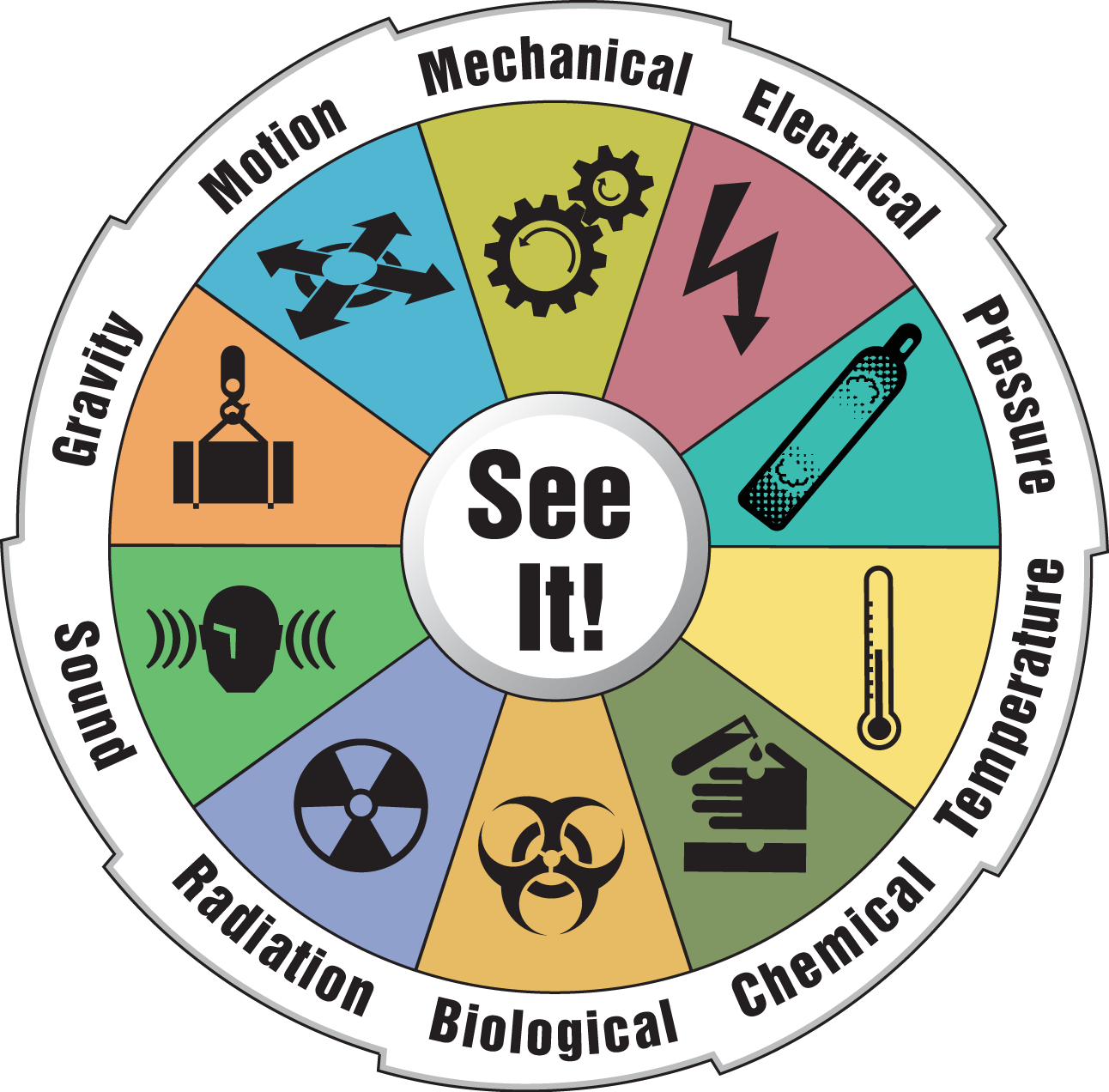
4 ENERGY SOURCES WHICH MAY POSE HAZARDS DUE TO UNPLANNED RELEASE/UNWANTED CONTACT
5. Hazard Controls/Barriers and Interaction of Energy Sources
The presence of an energy source doesn’t mean a hazard exists unless there is a potential for an unplanned release and/or unwanted contact with it. The higher the potential, the bigger the hazard. To keep energy sources under control, several concepts of strategies, barriers and managerial systems for systematic control have evolved over time.
The Hierarchy of controls as outlined in FOM 10.16 Sec 9.3 enlists the following measures to prevent an unplanned release and/or unwanted contact:
Elimination (Remove the source of energy)
- Remove the energy source entirely (shut down the power supply to the equipment to be worked on, remove unneeded objects from overhead surfaces).
Substitution (Modifying the task or substituting the material)
- Limit energy (reduce speed, lower operating temperature and pressure, etc.).
- Material substitution (use of non-sparking tools instead of tools liable to cause a spark).
Engineering Controls (Prevent release, isolation of source, controls/barriers)
- Provide barriers on the energy source (e.g. electrical and thermal insulation).
- Provide containment and guards (railings on elevations, secondary containment for containers with chemicals).
- Provide automatic interlocks (shut down devices, etc.).
- Provide detection systems (temperature gauges, smoke detectors, etc.).
Administrative Controls
- Safety signs, work instructions, limiting exposure time.
PPE (Protect from release)
- Provide Personal Protective Equipment (safety harness and lanyard for working at heights, SCBA, etc.).
- Stop Work Authority must be used if the energy source still presents a hazard.
6. Hazard Identification Tool
A simple Hazard Identification tool to enable us to identify specific hazards prior to carrying out a task in order to carry out the daily activities and tasks safely is outlined below and forms a part of the Poster 40. The tool is to be used when carrying out the risk assessments and associated hazards are to be discussed during the daily work safety meetings on board.