| FOM-10.16 |
Fleet Operations Manual FOM Risk Management |
Doc No.: FOM 10.16
Revision: 01 Date: 15 Oct 2024 Issued by: DPA Approved by: MD |
1. APPLICATION
The document applies to all shore personnel and all vessels fully managed by company.
2. PURPOSE
The purpose of this procedure is to define the risk assessment process to be used in company’s offices and onboard fully managed vessels for various operational tasks so that they are carried out safely and efficiently in order to achieve our goal of zero incidents by establishing safeguards against all identified risks.
3. RESPONSIBILITIES WITHIN THE WORKFLOW(S)
Group marine safety is responsible for preparing and reviewing company’s procedures for risk management and periodic verification and review of its relevance.
Company’s business units (Fleet group operation personnel involved in technical, marine and crewing) are responsible to ensure day to day implementation of procedures onboard vessels and to provide correct guidance to master in ensuring effective risk management.
The Shipboard management personnel under authority of the master, are responsible for implementing the risk management procedures onboard. Master shall ensure that relevant publications available onboard such as Code of Safe Working Practices, are referred whenever required. Risk assessment library to be referred for guidance on sample risk assessment when preparing ship specific risk assessment prior operations.
Master to notify the office in writing about the proposed task where office concurrence is required as guided in this document.
4. DEFINITIONS
Risk Assessment
It is a careful examination of what, in the nature of operations, could cause harm to people, environment, property, business, so that decisions can be made as to whether enough precautions have been taken or whether more should be done to prevent this harm and bring the final risk ranking to ‘as low as reasonably practicable’ (ALARP).
Hazard
It has the potential to cause harm and threaten human life, health, property, environment, or business reputation.
Hazard identification tool
Guidance for easy reference that helps to identify specific hazards prior carrying out a task in order to carry out the daily activities and tasks safely. Refer FOM 10.14
Consequence
It is impact of occurrence of hazardous condition on people, environment, property and business, as quantified by a measure of severity.
Company has categorized ‘Consequence’ as severity values as per 5 x 5 risk matrix, such as ‘Insignificant’, ‘Minor’, ‘Moderate’, ‘Major’ and ‘Catastrophic’.
Severity
It is defined as the measure of undesirable occurrence resulting in serious consequences.
Probability
The possibility of occurrence of the hazardous condition within a certain time period. Company has categorized likelihood in 5 types as per 5 x 5 risk matrix, such as ‘Rare’, ‘Unlikely’, ‘Possible’, ‘Likely’, ‘Certain / Very Likely’.
Risk
It is the combination of the likelihood of occurrence and the severity of the consequence.
Existing Control Measures
Risk mitigation control measures which are readily available on-board vessel and implemented as per SMS, safe working practices as per shipboard publication without the need of extraordinary arrangements.
Initial risk ranking
The evaluated risk after taking into account effective implementation of existing control measures.
Additional Control Measures
Risk mitigation measures that are implemented over and above the existing risk mitigation control measures in order to eliminate or to further reduce the final risk ranking ‘As Low as Reasonably Practicable (ALARP). Shore assistance may be needed to implement such measures through additional efforts of arranging required resources.
Residual Risk Ranking
The residual risk ranking that remains after ‘Additional control measures’ have been implemented as enhanced risk mitigation measures in addition to existing control measure.
Review and approval of risk assessment
Review and approval shall be based on residual risk ranking after taking into account existing and additional control measures. Work activity shall only be carried out if residual risk ranking is very low, low, medium or high, subject to enhanced approval levels.
Residual risk ranking of any one of the four categories shall be considered i.e. People, property, environment or service loss.
| Residual Risk Ranking | Action required |
|---|---|
| Very Low (1 to 3) | Frequent review & monitoring of hazards is required to ensure that the risk level assigned is accurate and does not increase over time |
| Low (4) | Shipboard management control is required |
| Medium (5 to 9) | Notification to office for review and approval from Fleet Group Manager (FGM) or Marine Manager OR DPA is required prior commencing the task. |
| High (10-12) | Notification to office for review and approval from Head of business unit is required prior commencing the task. |
| Very high (15-25) | Unacceptable risk and strictly prohibited to commence or continue the task. Task must be suspended immediately. Final risk ranking must be reduced to ALARP before commencing / resuming the task. Re-evaluate control measures and also consider any alternative method to carry out the task in safe manner. |
Routine Jobs
Jobs that are undertaken on a regular basis, where the actions involved and the procedures are well known and understood and where the risks to people, environment, property, or business, if any, are insignificant.
Non-Routine Jobs
Non-Routine Jobs are specific tasks that are carried out sporadically and due to their nature need to be controlled in order to be executed safely. For example, repairs to any equipment after a breakdown or from the potential for breakdown.
Worksite / Place of work
Any physical location in which work related activities are performed under the control of the organization.
5. RISK ASSESSMENT PROCESS
Risk Assessment is integral part of planning shipboard operational tasks and all crew members involved in the task should participate when preparing risk assessment, particularly hazard identification stage.
Company’s HSEQ software shall be used to record detailed risk assessment for all non-routine tasks and special focus tasks. Risk assessment templates are available on company’s HSEQ software for easy reference and guidance when preparing ship specific risk assessment.
In case of technical issues with company’s HSEQ software, HSSEQ -18 shall be used as secondary means to record risk assessment.
When making risk assessment template, the task may be approached using following stages of the intended operation:
- Stage 1: Planning and Preparation
- Stage 2: Execution / Conduct of the task
- Stage 3: Testing / recommissioning and closing / securing/ boxing back – return the worksite to normal.
Risk assessment involves following steps.
Step 1- Identify the hazards
The process of identification of hazards ensures that:
- Hazards to People, Environment, Property and / or Service Loss are revealed at an early stage, before any harm is caused
- Hazards are recorded so that an appropriate control measure can be put in place so that the hazards are avoided or mitigated
Workplace hazards can come from a wide range of sources.
FOM 10.14 prescribes detailed procedures to identify hazard using hazard identification tool. Reference shall be made to FOM 10.14 and poster 040 when completing this task.
Step 2 – Identify the Impact/Consequences
Decide who and what type of casualty may occur from the identified hazards. Type of casualty maybe more than 1 subject to the hazards identified.
Below four categories are applicable to the consequences:
Step 3- Evaluate the ‘Existing Control’
Ask question how the risk can be reduced. What type of measures need to be in place?
Control measures determined based on measures which is readily available on-board vessel, guidance and details implementation as per Safety Management System (SMS) and industrial safe working practices. No extraordinary arrangements required.
Daily safety Meeting, Toolbox meeting, permit to work system (PTW) and current onboard arrangement for the task can be considered as part of ‘Existing Control’.
Control options should be in the order of preference of hierarchy of controls. (Refer to Step 7 mentioned below and FOM 10.14 Hazard Identification Tool for details on hierarchy of controls.)

Step 4- Determine the Consequence Severity
Ask the questions, “How severe and how likely, what are the risk to People, Environment, Property and Service Loss?
Special attention is to be paid to the identification of risks to health, hygiene and safety of the crew members.
Step 5- Determine the Probability
Similar to severity, ask the questions, “How frequent the incident / event occurs. What is the risk to People, Environment, Property and Service Loss?
Step 6 - Evaluate the Initial Risk Ranking
The combination of these values (probability x consequence) gives you an ‘Initial Risk Rating’ for the hazard you’ve identified.
The risks associated with the hazards should be evaluated in terms of probability or likelihood and severity of impact or consequence to human life, property, the environment and /or the company reputation.
Determine the probability and severity of consequences for each of the category identified, and the initial risk ranking using the matrix below

Shipboard senior management team shall also refer to company circulars on recent incidents and injuries when establishing likelihood.
Step 7 – Identify the ‘Additional Control Measures’ and determine the residual risk
After assessing the initial risk, additional controls are to be added to reduce the residual risks to “ALARP”. When considering additional controls to reduce risk, control measures that are higher up in the Hierarchy of Control should be considered first.
Note:
We cannot create a totally risk-free environment. It is physically impossible. There will always be some amount of risk that we have to tolerate. That tolerance must be as low as reasonably practicable.
Control Options in order of preference are:
- Elimination
Elimination is the process of removing the hazard from the workplace. It is the most effective and preferred way to control a risk because the hazard is no longer present and should be used whenever possible.
Example:
- Substitution
Substitution is the process whereby a hazardous material or equipment is substituted, or the system energy is reduced. It is sometimes grouped with elimination because, in effect, you are removing the first material or hazard from the workplace. The goal, obviously, is to choose a new material that is less hazardous than the original. When substituting extreme caution needs to be exercised to ensure that one hazard is not being traded for another. Before deciding to replace any material with another, consider all the implications and potential risks of the new material.
Example:
- Engineering controls
Engineering controls are methods that are built into the design of a plant, equipment or process to minimize the hazard. Engineering controls are a very reliable way to control worker exposures as long as the controls are designed, used and maintained properly.
The basic types of engineering controls are:
Example:
- Administrative controls
Administrative controls involve minimizing exposure to a risk through use of procedures or instructions. These control measures have many limitations because the hazard itself is not actually removed or reduced.
- Limiting a worker’s exposure by scheduling shorter work times in contaminant areas
- Safety signs, hazardous area marking, photo luminescent signs, markings for pedestrian walkways, warning sirens / lights, alarms, safety procedures, equipment inspections, access controls, safe systems of working, tagging and work permits, etc
Administrative controls are not generally favoured because they can be difficult to implement, maintain and are not a reliable way to control the hazard.
- Personal Protective Equipment (PPE)
Equipment worn by individuals to reduce exposure such as contact with chemicals, objects or exposure to noise.
PPE is used as a last resort when exposure to risk cannot be minimized by other means.
PPE is worn by people as a final barrier between themselves and the hazard. This measure does not control the hazard at the source but relies on behaviour modification for its success.
The success of this control is dependent on the correct PPE being chosen, worn correctly, used correctly and maintained in good condition.
Note:
Administration and the use of Personal Protective Equipment (PPE) are the lowest priority on the
list of controls and are called “Soft measures”.
These controls should not be relied on as the primary means of risk control until the options higher in the control priorities have been exhausted. These controls require management, enforcement, and commitment, together with behavioural modification.
In many cases, it will be necessary to use more than one control measure to manage exposure to risk.
Whatever control measures are being chosen, the “hierarchy of control measures” must be taken into account. Consider those at the top of the list, from elimination, and work down to personal protective equipment as the least desirable choice.
A ‘Target Date’ will be set to close-out any inhibiting factors so that the ‘Additional Control Measures’ can be implemented. This target date must be reflected in the risk assessment form.
‘Final risk’ ranking should be evaluated on the proposed date of completion of the ‘Additional Control Measures’.
Step 8 – Evaluation of the residual risk
If final risk ranking is 5 and above (i.e. Medium and above) for any of the affected categories i.e. People, environment, property, or service loss, then risk assessment must be submitted to office for further review and approval before commencing task.
Office review shall be aimed at further reducing risk ranking to ALARP by considering more effective additional control measures and arrangement of any additional resources to mitigate the risk.
If the residual risk ranking has been determined to be unacceptable (i.e., Very High), re-evaluate and consider an alternative method to carry out the task in a safe manner.
Step 9 – Identify the person in-charge (PIC)
Person in-charge is usually shipboard senior officer responsible to ensure that existing and additional control measures as identified in risk assessment are effectively implemented prior to agreed target date.
Step 10 – Target date
Target date shall be established by which, all control measures (existing and additional) are to be effectively implemented and verified by PIC, confirmed by master as required.
6. SIMULTANEOUS OPERATIONS (SIMOPS)
Simultaneous Operations (SIMOPS) are activities that take place at the same time in the same area or that could directly or indirectly affect the safety of any other activity on the ship or terminal.
SlMOPS should be identified at an early stage to understand the impact one operation has on the other so that the risk assessment can include the individual risks of each operation and the risks from their interaction.
They should be discussed during work planning meetings. A risk assessment is needed to identify the hazards and control measures.
Wherever possible, SIMOPS should be avoided as they may affect safety. In unavoidable circumstances, following shall be considered by the master and to be discussed with vessel manager / Marine Superintendent in office.
- Assessment of urgency and scheduling of the tasks that need to be undertaken simultaneously.
- Available resources, rest hours, qualification and experience of personnel.
- Need for dedicated supervision and compliance to risk management process.
- Likelihood of multitasking resulting in distraction.
- Available means of communications, language barriers if any.
- Contingency plans and back up arrangements.
- Office assistance, arrangement of additional resources, communication with external parties.
Hierarchy of controls principles should be used to priorities those measures and to further identify any additional safety barriers required. Office intervention (approval) is required where necessary. Additional hazards introduced by the SIMOPS should also be highlighted and further reviewed during the assessment.
Toolbox talks should include discussion on SIMOPS. These should cover the control measures and any potential conflicts or challenges.
Be aware of critical phases of activities that may be compromised by SIMOPS. Example of SIMOPS include:
- Bunkering or storing operations at the same time as cargo operations.
- Maintenance operations at the same time as bunkering or cargo operations.
- Testing equipment at the same time as bunkering or cargo operations.
- Enclosed space entries at the same time as cargo and tank cleaning / hold cleaning operations.
- Emergency exercises at the same time as cargo operations.
- Diving operations at the same time as cargo operations.
- Statutory or commercial inspections, surveys etc. with cargo transfer / bunkering operations.
- Ship to Ship (STS) transfer operations. Bridge watchkeeping at the same time as cargo watchkeeping.
Note:
When vessel is expected to conduct SIMOPS, then risk assessment for each task to be completed as required prior to such occasions.
7. SHIPBOARD TASKS
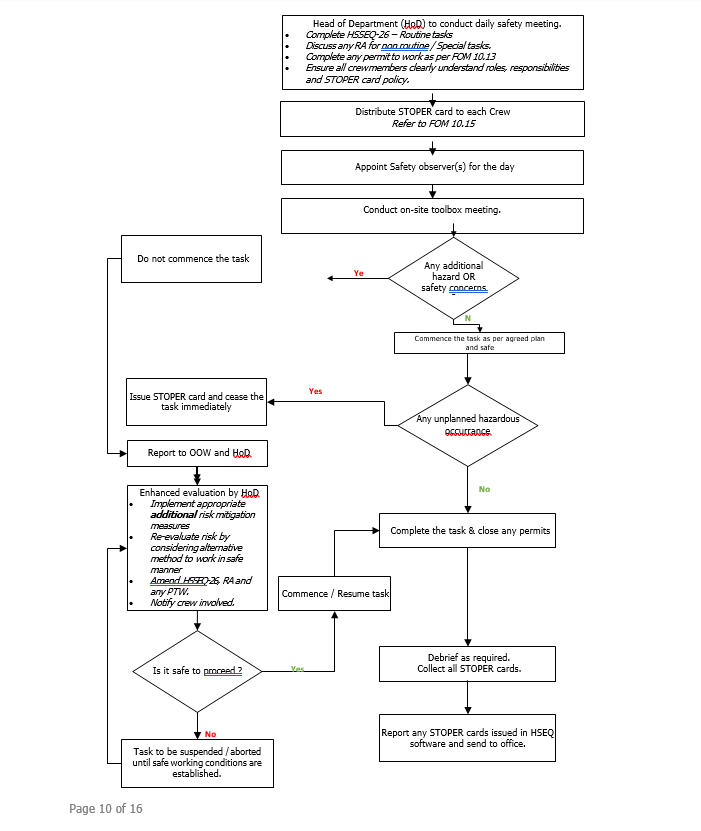
Shipboard tasks are mainly categorized into routine, non-routine and special focus tasks. A simplified flow chart has been developed as below for guidance.
7.1 Conduct of routine tasks
7.1.1 Daily work safety notice
The department heads on-board are to conduct Daily Work Meetings for their respective departments. Each must complete a Daily Work Safety Notice on HSSEQ-26 – Daily Work Safety Notice.
Master is required to maintain an overview of the daily work planning.
The purpose of the Daily Work Safety Notice is to plan and communicate safety precautions for all jobs for the day.
The Daily Work Safety Notice is to be posted by the Chief Officer in the Cargo Control Room / Ballast Control Room and by the Chief Engineer or 2nd Engineer in the Engine Control Room.
All crew involved in the day’s jobs should attend the Daily Work Meeting when possible. Personnel unable to attend should be briefed by their supervisor before commencing the work. Daily Work Meeting agenda:
- Debrief of work from previous day as required
- Discuss any equipment deficiencies / STOPER cards from the previous day
- Discuss the planned work for the day and carry out hazard identification step back 5 x 5 process using FOM 10.14, poster 027 and poster 040.
- Complete HSSEQ-26 - Daily Work Safety Notice Permit to work and ensure understanding by crew on effective monitoring of control measures and validity of permit.
- Discuss fleet circulars on near misses, incidents, injuries etc relevant to the planned job.
- Address any concerns the group may have.
- Distribute STOPER cards to each crew.
7.1.2 Toolbox meeting at worksite
The Toolbox meeting is an important part of overall risk management process.
The aim of the Toolbox meeting is to highlight specific hazards in the workplace as a planning aid prior to commencement of each job. It is an effective method to cover last minute safety checks and must involve all crew members involved in the task.
Toolbox meetings are quick, simple and easy to understand discussion or activity which to be held at the job site immediately prior to commencing work Identify hazards physically, solicit any safety concerns and to review any documented Risk Assessment and / or HSSEQ-26: Daily Work Safety Notice prior performing the task.
Multi – stage jobs may require additional Toolbox Meetings at appropriate intervals to maintain hazard awareness.
Hold a new Toolbox Meeting whenever new personnel are assigned to a job, at shift or watch changes or whenever there is a change to the work scope.
7.1.3 Safety observer
A crewmember will be assigned as the "Safety Observer" for the planned jobs / tasks. The Safety Observer’s primary duty is to call “timeout” if an unsafe act or condition is observed primarily to STOP and rectify the situation. He / She is responsible and obliged to intervene and shouldn’t hesitate to “STOP WORK” if unsafe act / unsafe condition exists Refer to FOM 10.15: STOPER Card.
Safety Observer maybe appointed based on specialised task given or in general for the respective department to oversee the entire safety work practice. Therefore, he / she shall continue performing the allocated tasks and simultaneously observe safe working practices.
Team members are obliged to respect the Safety Observer "timeout" calls and extend good cooperation.
Details of the unsafe act / unsafe condition to be raised vide simplified pocket version STOPER Card (refer to FOM 10.15: STOPER Card)
The job cannot be resumed until the corrective action(s) are implemented and the situation has been restored to the satisfaction of the HOD / Master.
Once the situation restored, the details and corrective actions must be entered on company’s HSEQ software: STOPER Card within 24 hours of occurrence for subsequent actions. Following are basic requirements to appoint a Safety Observer:
- Members are in support or supervisory role such as Bosun, A/B, Oiler, Fitter, etc.
- Possess sufficient experience and knowledge in respective rank in order to observe and stop unsafe job.
- Trainee Cadets and other ratings less than 6 months sea time in rank should not be appointed as Safety Observer unless specifically trained by HOD.
7.1.4 STOPER Card
STOPER is an acronym for Stop, Think, Observe, Prevent and Execute.
The STOPER card system is a behaviour-based safety observation program which is implemented onboard all Safety vessels to effectively comply with intervention policy.
By encouraging all the work team members to observe, identify and intervene the unsafe act or unsafe condition so that an incident can be avoided.
Refer to FOM 10.15: STOPER Card for more details.
7.2 Conduct of non-routine jobs
In addition to all requirements for routine tasks stated in sub-section 7.1, any non-routine task shall require a detail risk assessment as per section 5.0. Risk assessment shall be recorded in company’s HSEQ software.
Reference can be made to risk assessment guidance template prepared by company.
Master shall ensure that any risk assessment with final risk ranking of 5 and above (medium and above) is notified to the office for further review and approval prior commencing task.
7.3 Special focus areas
Special focus areas are the operations which are safety critical and frequently performed by the vessels. These tasks must not be underestimated as routine tasks and therefore, detail risk assessment must be completed for such tasks taking into account prevailing conditions and influencing environmental factors.
| No | Task | RA to be completed and documented | RA to be submitted to office for approval prior performing the task |
|---|---|---|---|
| 1 | Hot work outside of designated area. (Outside Engine room workshop) | X | X |
| 2 | Enclosed space entry in cargo tanks, bunker tanks | X | X |
| 3 | Company UKC policy cannot be complied with as per SMS procedure. | X | X |
| 4 | Maintenance and / or shutdowns of critical equipment | X | X |
| 5 | Any job which, in the opinion of the shipboard management team, may put personnel, assets or company reputation at risk which requires escalated attention from shore management. | X | X |
| 6 | Change of circumstances that may affect operational environment or crew fatigue | X | |
| 7 | Permanent and temporary changes to equipment, personnel, or procedures | X | |
| 8 | Mooring / Unmooring operations | X | |
| 9 | Newly established jobs: due to lack of experience in these jobs, hazards may not be evident or anticipated | X | |
| 10 | Experience of personnel: if personnel have never undertaken the job previously | X | |
| 11 | Modified jobs: new hazards may be associated with changes in job procedures | X |
8. ACTIONS REQUIRED DURING THE TASK
8.1 Review worksite / environmental conditions for
- Weather conditions (wind, rain, etc.) and possible effects on tools or job
- Vessel movement – rolling / pitching (regarding rough weather) or expected movement
- Overhead or below deck hazards (welding sparks falling on personnel below)
- Restricted space regarding manual handling, chemical vapours etc
- Deck / surface conditions regarding slip/trip hazards
- Possibility of falling if unrestrained or barriers required
8.2 Review of the equipment being used
- Is this the best tool(s) for the job? / Fit for its purpose?
- Lighting, noise, deck level etc
- Is the equipment or tools in good order? Guards fitted, grinding wheel in good order, electrical leads intact, slings and shackles visually inspected, etc
8.3 Review of the job method adopted
- Walk through each step and identify what could go wrong
- Are controls in place to avert a potential incident?
- Think not only about safety, but also about the environment and possible damage to equipment onboard
- Is any lifting required - can it be done safely with the person(s) doing the job - are mechanical aids (lifting devices) required? How will you lift this safely – walk through the right technique in your mind
- If more than one person doing the job, is it necessary to discuss the work to be undertaken by the group
8.4 Unplanned occurrence
While the job is being carried out, constant monitoring of the implemented control measures is required to ensure that the options are working, are adequate and have not created other hazards.
If any deviation is detected the ‘Safety Observer’ must issue a ‘STOPER’ card and details to be updated using– Stopper Card as per FOM 10.15: STOPER Card and then corrective action must be taken to close out the unsafe act. Preventive action must then be put in place to prevent recurrence.
Both actions must be accepted and verified by the HOD / Master and then a complete re-assessment must be carried out to resume the job.
Refer to FOM 10.15: STOPER Card for guidelines on issuance of STOPER Card and Step by step procedure guide to STOPER cards flowchart as above.
8.5 Review the job on completion
9. TRAINING
Safety Group believes that whatever the nature of the organization, the competence of its people is the key to achieving its business aims.
Safety has always been in the forefront when it comes to training and education of its officers.
Safety recognizes the importance of quality training to our seafarers and the difference it makes towards them and ultimately the performance of the vessels they operate. It is a belief that training is the key to operating safe and efficient ships on greener seas.
Safety will as far as possible on a regular basis hold training courses in suitable locations. The program will be conducted by Safety or its appointed trainers to assist and cover risk management training which includes the use of hazard and exposure identification techniques and risk assessment tools as appropriate. The intent is that as many Safety officers and crew as possible attend this training.
Safety has also selected reputed external training providers for training of Safety crew. These facilities will primarily be used for upgrading and refresher trainings following the initial contract and subsequent contracts with Safety.
Additionally, Computer Based Training (CBT) via the Seagull Training System is for the participation of all officers and crew onboard the vessel. Seagull produces a Safety specific Training Matrix for each type of vessel under its management and this Training Matrix is to be strictly adhered to.
The Risk management training module of Seagull CBT is mandatory for all ranks onboard on any type of vessel.
The Master is responsible for establishing a training program so that all officers and crew are able to comply with the above requirement.
10. REVIEW OF RISK ASSESSMENTS
The Management shall review and collate all on-board risk assessments to ensure that standards are consistent and that all risk assessments remain relevant at all times. This is ensured by the following:
- The effect of new legislation, equipment and/or change(s) in manning levels is taken into account and incorporated into the Risk assessments.
- The conduct of non-routine tasks may need to be reviewed with time as they may become standard tasks following a review.
- Company has established a risk assessment library, available to all ship staff on the company’s HSEQ software. All vessels are required to use the risk assessments filed in the system.
- They may edit / add hazards, consequence, risk mitigation measures and / or risk ranking; however, cannot delete same, ensuring a minimum consistent standard across the fleet
- If any risk assessment for a particular process is not available in the company’s HSEQ software, the risk assessment should be sent for approval of the shore management.
- FOM 10.16 Section 7.3- Special focus areas guide that all risk assessment for operations as listed should be submitted to the office for approval irrespective of the risk ranking. This ensures that all the risk assessments used are consistent to a standard required by shore management
- Master to review collectively with respective department, any room for improvement to be suggested / raised in Master System Review.
- Risk assessments in the company’s HSEQ software library shall be subject to review and amendments as applicable by shore personnel once every three years as a minimum to ensure suitability for application across the feet.
- Potential hazards which are recognized in risk assessments and other undesirable operations should be used to improve the Safety’s safety management system (SMS) The company also identifies best practices for common areas of risk assessment through experience feedback from internal audits, external audits, vessel inspections (internal and external) and from incident / injury investigations and shares them across the fleet as part of knowledge sharing.