| FOM-10.19 |
Fleet Operations Manual FOM Control of Substances Hazardous to Health |
Doc No.: FOM 10.19
Revision: 01 Date: 15 Oct 2024 Issued by: DPA Approved by: MD |
1 APPLICATION
Fully Managed Vessels
2 PURPOSE
To ensure that hazardous substances are dealt with in a safe way and to make a suitable and sufficient assessment of the risks posed by any hazardous substance in use, to the health of employees and others on board.
3 RESPONSIBILITY
- Marine Superintendent
- The Shipboard Management Team
- Crew
4. Introduction
This procedure provides guidance on:
- The use and storage of chemical substances hazardous to health;
- The various types of chemical substances found on board and risks associated with them;
- The use of SDS and PPE while working with or using such hazardous substances.
5. General
- Employees must remain alert to prevent accidents when handling harmful materials.
- Chemical substances must not be used unless the corresponding Material Safety Data Sheet (SDS) is available and understood.
- All chemical substances and SDS must be available on board in English.
6. Assessments
Upon receiving chemicals on board, the Chief Engineer or Safety Officer must verify the presence of an SDS, provided by the manufacturer or downloaded from their official website. If unavailable, the product is to be quarantined.
SDS must be stored in the area where chemicals are kept, alongside a fully updated Chemical & Hazardous Substances Register and related risk assessments. A second set must be kept on the bridge.
Risk Assessment
A COSHH Risk Assessment must be carried out before using any substance that could cause harm. It must be based on the SDS and the specific work environment. The Risk Assessment (TOM form 089/Bassnet) must aim to reduce risks to a low or allowable level.
Implement Controls
All controls identified in the Risk Assessment must be in place before using the chemical. If controls cannot be implemented, the chemical must not be used. Crew must be trained and supervised accordingly.
7. Using Hazardous Substances
- Understand the SDS and COSHH Assessment.
- Ensure proper ventilation and availability of extinguishers, spill kits, and first aid materials.
Usage
- Wear proper PPE as per the SDS. Ensure it's in good condition.
- Do not eat, drink, or smoke when handling chemicals.
- Clean hands and PPE after use.
Use of Chemical Substances
Follow instructions on packaging and SDS. Do not use products without the necessary PPE and safety facilities.
Spills
Wear correct PPE before addressing spills. Clean immediately and dispose of the material appropriately. Report spills as per SOPEP/SMPEP Manual.
8. Radioactive Substances
Radioactive substances are rarely carried unless requested by a Client. The contractor must:
- Provide safety and emergency procedure handbooks.
- Advise the Master on evacuation and safety precautions.
- Act as Radiation Protection Advisor and monitor operations.
- Ensure storage in marked containers in designated IMDG areas.
- Use appropriate protective gear and radiation measuring devices.
- Update hazardous area plans with storage locations.
9. Standard Symbols Indicating Hazard
Below is the symbols and indication of danger which was adopted by several countries including EU, USA, Australia and UK
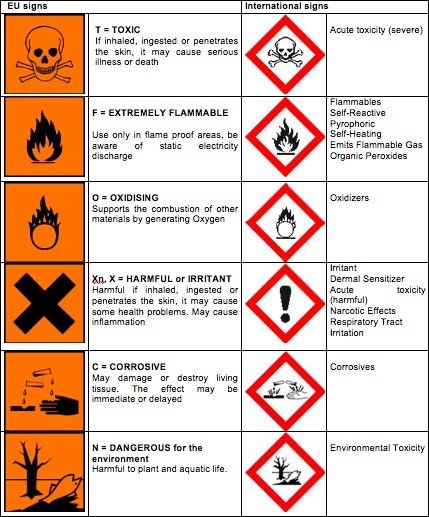
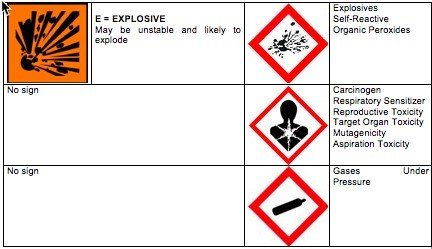
The classification of dangerous substances is based on their properties and effects. Below are key categories:
Carcinogenic
A number of substances cause cancer. They may be in solid or liquid form and of a chemical or physical nature. For instance, Beta-naphthylamine is known to cause bladder cancer, and blue asbestos (and other forms of asbestos) can cause lung cancer and mesothelioma. Cancer is fundamentally a disorder of cell growth, and may remain localized (benign) or invade and destroy surrounding tissues and organs (malignant).
Corrosive
A substance that can destroy living tissues upon contact. Corrosive materials act by chemical action and may cause severe damage or chemical burns. Examples include strong acids (e.g., anhydrides, acid chlorides) and bases (e.g., hydroxides), halogens, and oxidizing agents. Additional hazards may include container corrosion or violent reactions with water or other substances.
Cryogenic
Cryogenic substances are extremely low-temperature liquefied gases. Examples include: liquid nitrogen (−196°C), liquid oxygen (−183°C), and liquid helium (−269°C). Associated hazards include:
- Chemical: Violent reactions with other chemicals (e.g., liquid oxygen with oil);
- Physical: Brittle failure of materials exposed to low temperatures (rubber, plastics, metals);
- Physiological: Risk of frostbite, skin burns, and anoxia due to rapid vaporization in confined areas.
Explosive
Explosives are substances that may detonate due to flame, shock, or friction. Explosions result from rapid exothermic reactions that produce gases and a sudden increase in pressure. Conditions causing explosions include:
- Mechanical shock (e.g., dropping or jarring containers);
- Friction (e.g., stirring or transferring materials);
- Temperature buildup (e.g., due to heat accumulation);
- Violent chemical reactions between incompatible reagents.
Explosive substances include solvent vapors, authorized explosives, and thermodynamically unstable materials like acetylides, azides, polynitro compounds, diazo compounds, fulminates, and some nitrates and oxidizers.
Extremely Flammable
Substances that have a flash point below 0°C and a boiling point of 35°C or less. These are classified as extremely flammable if:
- The liquid meets the flash point and boiling point criteria;
- It makes up more than 45% by weight or 250g of an aerosol dispenser's content.
Flammable
A flammable substance:
- Has a flash point ≥ 21°C and ≤ 55°C, and supports combustion as tested under official standards;
- Is part of an aerosol dispenser with more than 45% by weight or 250g of liquid having a flash point between 21°C and 100°C.
Harmful
A substance which, if it is inhaled or ingested, or if it penetrates the skin, may involve limited health risks.
Highly Flammable
This is a substance which:
- May become hot and finally catch fire on contact with air at ambient temperature without any application of energy;
- May readily catch fire after brief contact with a source of ignition and continue to burn or be consumed after the ignition source is removed (e.g., methanol);
- Is gaseous and flammable in air at normal pressure (e.g., butane);
- In contact with water or damp air, evolves highly flammable gases in dangerous quantities (e.g., sodium produces hydrogen gas);
- Is a liquid having a flash point below 21°C, and when such a liquid forms more than 45% or more than 250g of the contents of an aerosol dispenser, the content is considered flammable.
Irritant
A non-corrosive substance that, through immediate, prolonged or repeated contact with the skin or mucous membranes, can cause dermatitis or localized inflammation.
Mutagenic
Substances capable of damaging individual cells in a way that causes uncontrolled cell division. In normal body cells, this may lead to cancer.
Narcotic
Some chemical substances, such as alcohol, affect the brain and central nervous system, causing a depressant effect on their functions.
Oxidizing
An oxidizing agent is a substance which causes a highly exothermic reaction when in contact with other substances, particularly flammable ones. Strong oxidizing agents:
- Support combustion in oxygen-deficient atmospheres;
- React vigorously with reducing agents (e.g., organic solvents, paper, cotton), potentially causing ignition.
Examples include: concentrated perchloric acid, persulphuric acid, organic peroxide compounds, concentrated nitric acid, potassium chromate, dichromate, and permanganate.
Radioactive
A substance that emits ionizing radiation. Many are isotopes of elements (e.g., cobalt-60, strontium-90) and emit alpha particles, beta rays, gamma rays, or neutrons.
Toxic
A substance which, if inhaled or ingested, or if it penetrates the skin, may cause serious acute or chronic health risks, including death.
Very Toxic
A substance which, if inhaled or ingested, or if it penetrates the skin, may result in extremely serious, acute or chronic health risks, and even death.
10. Training
To ensure personnel are able to handle chemical or hazardous substances safely, training is essential. When determining the level of training required for existing and new employees, the following factors should be considered:
- The hazard associated with the hazardous substance to be used;
- The complexity of the work processes;
- Any controls, work practices, and PPE required to minimize the risks.
Existing and new crew/personnel must be able to recognize and interpret information on hazardous substances in the workplace. Therefore, training programs shall incorporate the following:
- Labelling of containers of hazardous substances, including explanation of each part of the label and its importance;
- How to access and understand Safety Data Sheets (SDS);
- How to perform Basic and Full COSHH Assessments;
- Information about hazardous substances to which crew may be or are exposed during work;
- Work practices and procedures for handling, usage, storage, cleanup, and disposal of substances;
- Measures used to control exposure, including:
- Proper use of Personal Protective Equipment (PPE);
- Emergency procedures involving hazardous substances;
- Incident reporting procedures.