| FOM-10.21 |
Fleet Operations Manual FOM Infectious Disease Outbreak Management |
Doc No.: FOM 10.21
Revision: 01 Date: 15 Oct 2024 Issued by: DPA Approved by: MD |
1. APPLICATION
All Vessels
2. PURPOSE
Deal with the aspects of infectious disease outbreak investigation and control on ship.
3. RESPONSIBILITY
Marine Department
Shipboard Management Team
Safety Committee Members
Safety Officer
Environmental Officer
4. INTRODUCTION
The investigation and control of disease outbreaks on board vessels is a multi-disciplinary task requiring skills in the areas of clinical medicine, epidemiology, laboratory diagnostics, environmental health and an understanding of aspects of ship operations.
This chapter focuses on the practical aspects of outbreak investigation and control but also provides generic guidance for vessels.
4.1 Frequent infectious diseases with case notification threshold
Two or more (consult Office):
- Diarrhoea and/or vomiting;
- Infectious agents can include Norovirus, salmonella;
- Pandemic Flu.
One case (initiate measures in consultation with Office):
- Tuberculosis;
- Meningitis;
- Chickenpox;
- Cholera;
- Measles;
- Typhoid;
- Legionella (investigation).
5. BEFORE AN OUTBREAK - RECOMMENDED MEASURES
5.1 Forward planning
- The vessels have arrangements for consultation and informing the authorities at local, national and international level;
- The precise roles and responsibilities of ship crew and individuals involved;
- The resources/ facilities available to investigate outbreaks (if suspected on-board);
- Master should convene an outbreak control team, as soon as it is evident that more than 20% cases have been reported with similar symptoms.
As a significant portion of persons carrying and transmitting infectious diseases do not present any symptom or would be infective before becoming sick, it is very important to adopt the following critical preventive measures:
- Require Hand washing or sanitizer use at Galley/ Pantry/ Mess-room entrances;
- Limit or eliminate food self-serving;
- Daily disinfection of frequently touched surfaces in common areas;
- Self-isolation for sick workers, specially catering staff;
- Arrival health check.
5.2 Arrival health check questions
- Do you feel or you are getting sick;
- Have you had fever (37.5°C or 100°F) in the last 24 hours;
- Have you started having fever with any of the following symptoms in the last 24 hours:
- Cough;
- Sore throat;
- Sneezing;
- Chest discomfort;
- Aches, pain;
- Extreme fatigue;
- Diarrhoea;
- Vomiting;
- Upset stomach.
5.3 How to wash your hands
Hand-washing, is the single best way to prevent an outbreak and the spread of germs and illness.
IF WATER AND SOAP ARE NOT AVAILABLE: Use an ethanol alcohol-based (a minimum 62%) hand sanitizer, preferably in a gel form.
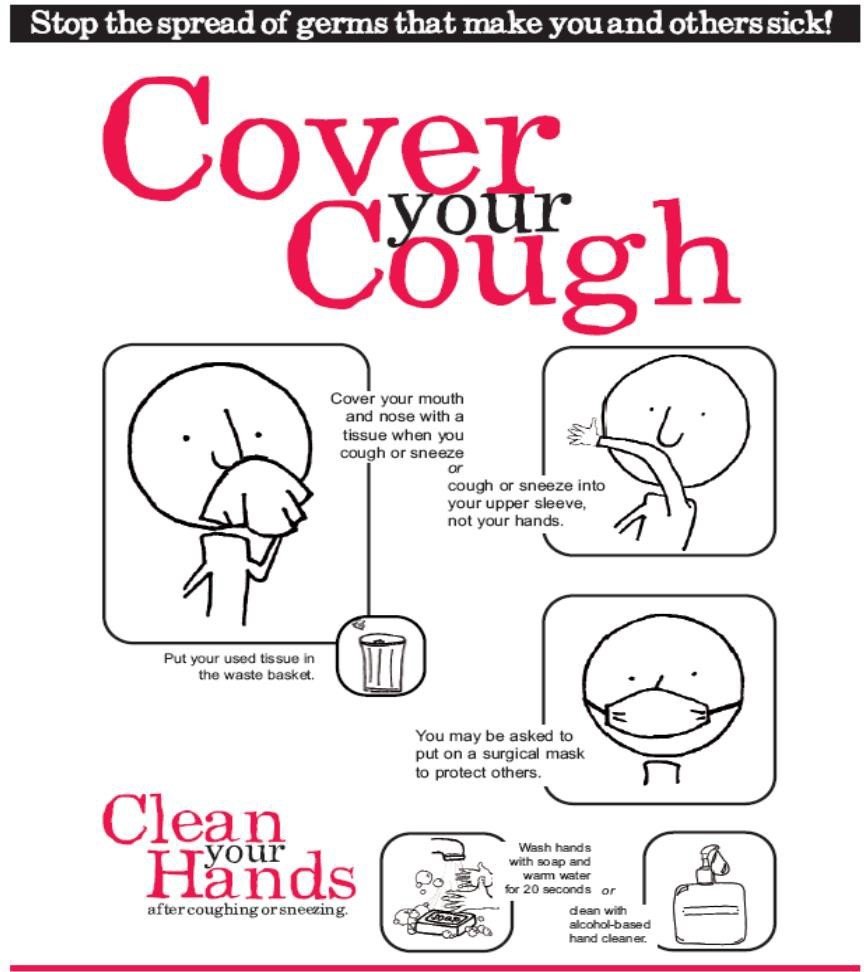
5.4 How to Stop Spreading Germs
6. DURING AN OUTBREAK – RECOMMENDED MEASURES
6.1 Contagious Disease Outbreak
During an outbreak of contagious disease in the ship, isolation is mandatory. A plan should be made for the isolation of contagious patients.
Who should be isolated may include: suspected cases of influenza, norovirus and other gastrointestinal infections, MRSA, and tuberculosis.
Isolation ends when the infected worker is evacuated or when his or her symptoms have disappeared after a certain period of time.
Daily communication between the medic, the Person In-Charge and the isolated worker is necessary, with medical care given as needed.
6.2 Isolation
Isolation of infected worker(s) helps disrupt infectious disease transmission. The spread of communicable diseases on board can be prevented – or at least reduced – by isolating the patients.
The purpose of isolation is to block the different modes of transmission:
- Direct contact (Example: wound infections);
- Droplet spread (Example: Influenza);
- Faecal-oral spread (Example typhoid fever, infectious diarrhoea).
Separate bed linen and towels for isolated patients shall be provided.
The isolation room should be identified prior to an outbreak.
The most critical issues are the ventilation and the possibility to make an in-between zone.
Minimize visits to the isolation room and keep visits as brief as possible. Visitors should remain at least 6 feet / 2 meters from the infected worker, avoid touching any surfaces, and should wash hands after the visit.
When occupied by a worker sick with communicable infectious disease, the designated room should comply with the following practices:
- Use exterior signs to clearly identify the isolation room to crew and staff;
- Restrict the use of the isolation room to infected workers;
- Keep the door to the isolation room closed when not in use for entering or exit;
- Direct the exhaust of the isolation room to the exterior of the facility when possible.
If the isolated worker must leave the isolation room, minimize his or her movement and instruct the isolated worker to wash hands frequently.
Have the isolated worker consume food and beverages in the room.
It is practical to define two types of isolation:
- Strict isolation;
- Standard isolation.
Strict Isolation
Strict isolation will be used mainly for diseases spreading via the faecal-oral route.
The patient must be confined to the ship’s hospital or to a dedicated cabin.
The cabin should be located in a quiet corner of the ship and be stripped of all unnecessary furnishing, carpets and upholstery to facilitate cleaning and disinfection.
The patient should preferably be nursed by only one person, or a maximum of two. These persons must be well acquainted with nursing procedures. Visits by other personnel are not permitted.
It is advantageous to use disposable plates and cutlery. If these are not available, the utensils must be boiled (20 minutes) after use.
Bed-linen and towels must be boiled or disinfected.
Faeces and urine should be put into bedpans or bottles and disposed of in a dedicated flushing toilet. In ports, the local authorities will give instructions for disposal.
Needles and other sharp items that may be infected must be placed in needle containers.
Supply hand sanitizer at each entrance to the isolation room with a sign instructing everyone to use the sanitizer before entering and after exiting.
For air borne illnesses, instruct the isolated worker to wear a face mask during any visit and cover his or her nose with the inside of the elbow while sneezing. Replace face mask as appropriate.
Hand washing by the patient and the nurse is by far the most effective procedure to prevent spreading via the faecal-oral route.
Standard isolation
The patient is isolated in a dedicated cabin, or in the ship’s hospital. In the case of droplet transmission (influenza, other communicable respiratory infections) it is recommended that the patient wears a face mask during nursing and visits (if permitted).
The strict rules for utensils do not apply.
6.3 Transfer of sick or injured person from the ship
A sick and injured person may need to be transferred on a stretcher from the site of accident to the ship’s medical facility, and further to the deck for evacuation. Ship should have a plan in place for this purpose (e.g. dedicated winching area).
Sick worker transportation procedures
- Transport service should be notified that a person with a potential contagious illness needs to be transported.
Protection of the pilot, crew, and other passengers
- The pilot and crew may want to wear a mask during transfer when the infectious disease can be communicated by air (surgical mask provide limited protection);
- Passengers and pilot maintain a distance of 6 feet / 2 meters from the ill worker;
- Ill worker should be seated in the back row maintaining 6 feet / 2 meters from other passengers and pilot.
Persons assisting the transport of the ill worker
- Wear protective equipment adapted to the disease transmission routes;
- Have the ill worker wash his/her hands prior to boarding and after arrival;
- Put a mask on the ill worker if the disease is air borne and if he/she moves from the isolation room to any common area while on board.
6.4 Decontamination of isolation room(s) / Disinfecting the ill worker room(s) and common areas
- Immediate disinfection of contaminated surfaces and materials is critical to disrupting the outbreak;
- Personnel involved in disinfecting should not be involved in cooking at least 72 hours after the last case occurs;
- Workers involved in cleaning and disinfecting must wear protective clothing, gloves and goggles;
- Protective equipment used during cleaning should be disposed as per GMP;
- Steam clean carpets, curtains, and other soft furnishings where possible because some pathogens can live for several days on such surfaces;
- Scrub walls and mop floors. Do not vacuum carpets or buff floors, which can potentially recirculate the infective agent;
- Immediately collect contaminated bedding (from adjacent beds), and removable fabrics in plastic garbage bags labelled biohazard;
- Minimize the number of workers handling these fabrics; do not fluff the linens and bedding, they may disseminate pathogens into the environment;
- Launder all collected materials at high temperature (160°F or 71°C) for a minimum of 25 minutes;
- If wash water cannot reach the minimum recommended temperature, consider adding Virkon (or similar disinfectant) to the wash;
- Launder visibly soiled sheets and blankets twice. Discard heavily soiled sheets, blankets, and pillows;
- Launder contaminated pillows unless they have an impermeable plastic cover; in such case, disinfect them with a diluted household bleach solution;
- Continue enhanced cleaning and disinfection practices for at least 72 hours after the last symptomatic case is reported on site;
- Wash hard surfaces exposed to infected workers with soap and water using a disposable cloth;
- Then disinfect with a bleach solution of one part household chlorine bleach to nine parts water prepared within 24 hours;
- In sick worker room, disinfect door handles, knobs, push plates, tables, chairs, counters, keyboard, telephone, pens, pencils, etc.;
- In common areas, disinfect at least twice daily all frequently handled surfaces;
- They include door knobs, railings, elevator buttons, exercise equipment, taps, and toilets with the diluted household bleach solution;
- Spray bunks/beds and lockers with disinfectant;
- After use, disinfect non-disposable mop heads or throw away disposable mop heads.
6.5 Food handling
The galley Cook for the food service should help ensure that food served to workers is safe while applying Company’s Food Safety Measures:
- Food service personnel must isolate themselves if they have symptoms such as fever, cough, chills, sore throat, diarrhoea, or vomiting and should not report to work if they are feeling sick prior to going to work;
- Personnel cleaning and disinfecting should not be involved in the preparation of food during outbreaks;
- Workers entering in the Galley/ Pantry should be required to wash their hands and hand sanitizer be positioned in each Galley / Pantry for use by workers as they enter the area if hand washing is not already done;
- Prepositioned individually wrapped plastic knives/ forks should be utilized and shared serving forks and other utensils should be eliminated;
- Communal condiments (salt and pepper shakers, ketchup, mustard, mayonnaise, etc.) should be replaced with single-serving products;
- Discontinue the use of communal bins for cookies, candies, and snacks;
- Dispose any food that may have been contaminated or food that has been handled by any non-galley worker, such as fruit kept in a communal place;
- Discourage hand-shaking among workers within Galley/ Pantry after they have washed their hands;
- If a hand-washing station in the Galley/ Pantry area is not installed, proceed immediately with the installation if feasible;
- Disposable paper towel should be used to dry hands and communal fabric towel be eliminated, should they have been in place;
- The galley cook or galley steward should serve workers to reduce hand contact with contaminated utensils and mitigate disease transmission;
- Galley workers must wear food preparation gloves to serve food during the outbreak;
- Hot water for pots and pans sanitization in manual ware washing operations should be capable of maintaining water temperature of not less than 77°C or 171°F minimum or as hot as possible;
- After each service, cleaning and disinfection of the floors with disposable cleaning cloths and disinfecting solution;
- All high-frequency contact surfaces like counters, tables and chairs should be washed with soap and hot water and treated with disinfecting solution.
6.6 Notification process for an infectious disease outbreak
- When two or more workers at an offshore vessel/ facility develop the same symptoms at about the same time that might indicate that an infectious disease outbreak may be in progress;
- the PIC (or the person delegated) should promptly notify his or her supervisor and the local health authority must be contacted within 24 hours;
- Local Health Authority should be consulted if questions arise regarding implementation of outbreak prevention and mitigation measures;
- Based on the information received, Local Health Authority provides guidance to management and the PIC regarding sick worker medical treatment, isolation duration, and whether to evacuate the worker from the offshore vessel facility;
- Personnel at the site should be regularly updated on the outbreak risk and mitigation measures in place;
- The PIC, management, and Local Health Authority jointly review the situation and develop appropriate strategies to investigate & manage the suspected outbreak.
6.7 Outbreak control team
In case when vessel is entering geographic locations identified to be under the threat of an outbreak. The vessel will be notified of the precautions required by the port and additionally by the company via internal Circular.
If the vessel is identified to have an outbreak or suspected to be the source of outbreak when in port, it is usually, Port Health Authority in the area which first identifies and reports the outbreak and initiates proceedings to set up an OCT. OCT membership will vary according to circumstances and to the discretion of the local authority but normally shall include:
- A Public Health Practitioner or Epidemiologist under the authority of the Public Health Officer in charge;
- An Environmental Health Officer;
- A Microbiologist;
- Secretarial support;
- Ship’s Engineer;
- Ship’s Cook; and
- The Ship's Medic and other clinical staff (if available).
In addition, one or more of the following may be needed according to the presumed nature of the outbreak:
- Engineer in-charge for water generation and adding supplements;
- Chief Officer (since he/she is responsible for receiving FW from shore);
- A Virologist; or
- A Toxicologist.
6.8 Records
From the beginning of a suspected outbreak it is essential to ensure that all information received and all decisions taken by the OCT and others is recorded reliably and with the appropriate level of confidentiality. This includes that:
- Individual members of the OCT keep personal daily logs;
- All OCT meetings are formally recorded and distributed;
- Action notes are distributed immediately after OCT meetings.
6.9 Communication
An important aspect of successful outbreak management is effective communication. Throughout the course of an outbreak it is important to share relevant information with:
- Company Emergency Response Team;
- Media;
- Port health authorities/port authorities;
- Water supplying (last ports) companies;
- The Ship’s Medic;
- The Ship’s Master;
- The crew and passengers if any / crew.
6.10 Inspection of the ship
Before assessing specific procedures related to a suspect source the overall structure and operational hygiene of the ship should be inspected. The investigation should always be guided by what is already known about the outbreak. If a source has been identified, the investigation should focus on why this particular source became contaminated. If laboratory investigations (based on samples sent ashore) identified a particular pathogen or toxin, this should be made available to the OCT formed by the external experts and the investigation should focus on those sources and conditions known to be associated with that hazard. Office with assistance of local representatives must keep the vessel team appraised of the conditions and precautions to be taken.
Environmental investigations without a clear focus are expensive, time consuming and of limited value.
To investigate the role of a suspect food requires knowledge of its complete processing and preparation history, including sources and ingredients, crew who handle the items, procedures and equipment use, potential sources of contamination, and time temperature conditions to which food were exposed, past inspection records (any findings), freezer temperature log and any other information that maybe of relevance. Investigation of galleys and food areas on ships will usually require:
- An inspection of the overall structural and operational hygiene arrangements;
- A specific assessment of procedures that a suspect food underwent; and
- Food and environmental sampling.
To investigate a role of suspect water requires knowledge of its complete history throughout the water supply chain - source of water, procedures at port to treat water, procedures at port to load water, backflow prevention at loading, storage conditions, treatment and residual disinfectant used on board the ship, backflow prevention devices on the ship, any repair works or cross connection, frequency of maintenance and cleaning of storage tanks and any other information that maybe of relevance. In order to assist with the investigation the ship team should keep the data readily available. Investigation of the water systems will usually require:
- An inspection of the overall design and structure including water tanks and pipes;
- A specific assessment of any water treatment e.g. filtration, disinfection;
- Water sampling;
- Disinfection residual testing; and
- Assessment of procedures to monitor backflow preventers.
6.11 Control of source
Once the investigations have identified a suspect source associated with transmission of the suspected pathogen, measures should be taken to control these sources. Steps may include:
- Removing implicated substances from the ship and informing the supplier from where the items were purchased;
- Emptying stocks of material (such as pool or drinking water, foodstuffs), thoroughly cleaning the containment and then refilling from a safe source;
- Treating contaminated substances or remedying defects; and
- Modifying processes once environmental investigations identify faults.
6.12 Control of transmission
The risk of spreading infection by infected persons depends on their clinical picture and their standards of hygiene. Persons with diarrhoea present a far greater risk of spreading infection than a person with no evidence of disease with subclinical illness spread. In some cases, patients should be asked to remain in their cabins to avoid spreading diseases that can be transmitted by direct person-to-person spread via air and fomites. No person should handle unpackaged food - even if clinically well - if having any of the following conditions:
- Excretors of Salmonella typhi or Salmonella paratyphi;
- Excretors of the aetiological agents of cholera, amoebic talephy or bacillary dysentery;
- Hepatitis A or Hepatitis E and all other forms of acute Hepatitis until diagnosed to be Hepatitis A or Hepatitis E;
- Taenia solium (pork tapeworm) infection; or
- Tuberculosis (in the infectious state).
7. AFTER AN OUTBREAK - RECOMMENDED MEASURES
7.1 End of outbreak
- Consider the outbreak over when no new cases have occurred after a certain period specific by pathogen. (72 h for Norovirus);
- The recommendations/ control measures will be shared by the company with the entire fleet;
- The following steps summarize post-outbreak notification activities:
- Follow-up on ill workers and assess their fitness for duty;
- Try to determine the specific causative agent and what steps can prevent future outbreaks;
- The person in charge, supervisor, and MOH contact compile lessons learned to improve prevention and response;
- Share lessons learned with other sites to improve practices;
- Review and resume the pre-outbreak steps listed under prevention/ preparedness strategies.
7.2 Responsibilities of Supervisors or Person in Charge
Key expectations: training of crew/contractors onboard, supplies and services in place, isolation room identified, notification process established:
- Use safety meetings to communicate the importance of preventive measures such as frequent hand-washing and respiratory etiquette;
- Minimize operational disruption and illness spread by notifying the Local Health Authority and Office when two or more similar illnesses occur in the workplace (as outlined in Section 1 - Introduction);
- Stress to workers the importance of monitoring flu-like symptoms. If they exhibit symptoms, arrange for repatriation;
- Amend contracts for galley hands and cleaners to add more personnel if needed during an outbreak;
- Office to monitor for possible infectious disease outbreaks and send advisories to the fleet;
- Monitor local health information to identify infectious disease outbreaks in the area of operation and potential threats to vessel crew.