| FOM-10.3 |
Fleet Operations Manual FOM Accidents Incidents and Hazardous Occurences |
Doc No.: FOM 10.3
Revision: 01 Date: 15 Oct 2024 Issued by: DPA Approved by: MD |
1. APPLICATION
This document applies to personnel involved in investigations both ashore and onboard fully managed vessels under business area Vessel Management.
2. PURPOSE
To define the work processes to be used for investigating and reporting accidents, incidents and hazardous occurrences on-board managed vessels.
Note: Code of conduct violations or accusations shall be handled in accordance with crew disciplinary procedures.
3. RESPONSIBILITIES WITHIN THE WORKFLOW(S)
The roles below are as follows.
3.1 DPA
- Categorising severity levels.
- Monitoring the closure of investigations.
3.2 The Incident / Injury Investigator
- Gathering all available information and evidence relevant to the nature and severity of the incident / injury.
- Sending a request for required information and documentation.
- Analysis of evidence and the determination of causal factors.
- Drawing conclusions relevant to the causal factors.
- Ensuring that the report is factual and complete.
- Completion of all information within the incident reporting module.
- Distributing a draft report to the Reviewer.
- Preparation of the final report.
- Developing recommendations which includes corrective and preventive actions.
- Track and monitor closeouts of corrective and preventative actions.
- Analyse incidents over a defined period with the intention to identify trends and recommend action plans.
3.3 The Incident / Injury Report Reviewer
- Reviewing the draft report in collaboration with operations teams and incident investigator.
- Verify that the root cause model is correctly applied.
- Verify that all relevant information related to the root cause analysis, human factor analysis and other mandatory information is properly filled out on the incident reporting module.
- Verify the accuracy of severity classification, investigation methodology, causal factors, corrective and preventative actions.
- Ensuring appropriate recommendations are in place for the incident / injury and documented in the report.
- The reviewer shall not approve any report whose root cause is not correctly identified and whose preventive action does not address the root cause.
- Incomplete reports shall not be approved.
3.4 Vessel Manager/Marine Superintendent
- Shall initiate collection of data and initially review documents at the onset of an incident so as to expedite the investigation process.
- Shall ensure that all information and documentary evidence, requested by the nominated Incident Investigator, is provided in a prompt manner in case the Master of the vessel is unable to do so for any reason.
- Coordinating with external parties such as original equipment makers (OEM), service providers, service engineers, shipyards, vendors, etc. should their services be needed to aid an investigation.
- Reporting to external parties. This includes initial reporting using HSSEQ-17, updates and submission of final incident/accident report.
4. DEFINITIONS
Company (Also Office)
The owner of the ship or any other organization or person, such as the manager or bareboat charterer, who has assumed the responsibility for the operation of the ship from the ship-owner and who on assuming such responsibility has agreed to take over all the attendant duties and responsibilities.
Continual Improvement
A set of recurring activities that an organization carries out to enhance its ability to meet requirements.
Immediate Corrective Action
An instant action that is taken to eliminate the causes of an existing undesirable deviation or non-conformity.
Long Term Corrective Action
Proactive action taken to prevent causes of an existing deviation or non-conformity from future re-occurrence.
Exposure Hours
24 hours per day while serving on board.
Fatality
A death directly resulting from work injury regardless of the length of time between the injury and death. Fatalities are included in the Lost Time Injury Count.
First Aid Case (FAC)
A one-time treatment and subsequent observation, or minor injuries such as bruises, scratches, cuts, burns, splinters etc. The first aid may or may not be administered by a physician or registered medical professional.
FAC includes:
- Follow-up visits to a physician or nurse for observation ONLY, or for routine dressing change.
- Negative X-ray results.
- Cleaning abrasions / wounds with antiseptic and applying dressing.
- Irrigation of eye and removal of non-embedded foreign objects using a cotton swab.
- One-time administration of oxygen after exposure to toxic atmosphere and resumption of normal (but not restricted) work the following day.
- Soaking, application of hot-cold compress and use of elastic bandage on sprains and strains immediately after injury.
- Applying one-off cold compress or limited soaking of a bruise.
- Use of non-prescriptive medicines.
- Use of elastic bandages.
- Treatment of First Degree burns.
Hazardous Occurrence
An observed situation or incident where a danger was identified that could have resulted in an accident. Sometimes referred to as a near miss, a hazardous occurrence is not specific to navigation and may include any identified dangerous situation.
Human Error
The resultant of performance of humans that deviates from the desired performance.
Human Factor Analysis
A comprehensive study of the human error factor in an incident.
Immediate Cause
The substandard conditions and / or acts that initiated or allowed the undesired event to occur.
Incident
An uncontrolled or unplanned event, or sequence of events, that results in, or could have resulted in, fatality, ill health or injury to seafarers on board a ship or whilst ashore on company business, damage to property, damage to environment, pollution claims, cargo contamination, commercial loss or loss of process.
- Incidents involve People, Property, Process and Pollution.
This excludes suicide or attempted suicide, criminal or terrorist activity, a deliberate act on the part of another individual and incidents which occur off the ship but where the consequences appear on board at some later time. An incident can be both an accident and a near miss. It can be an accident because it has immediate consequences, but also a near miss because the incident could have resulted in more severe consequences.
Investigation
An investigation means an investigation or inquiry (however referred to by a State), into a marine casualty or marine incident, conducted with the objective of preventing marine casualties and marine incidents in the future. The investigation includes the reporting of the incident, collection of, and analysis of, evidence, the identification of causal factors and the making of safety recommendations as necessary.
Office Nominated Incident Investigator
A qualified person responsible to carry out the investigation process to identify the immediate and root causes of an incident in an effort to conclude recommendations on corrective and preventive actions. An office nominated incident investigator is the person who leads a team or teams of investigators assigned for the task.
Ill Health
Identifiable, adverse physical or mental condition arising from and / or made worse by a work activity and / or work-related situation.
Loss of Process
Defined as any stoppage in port or at sea that results in a delay to the vessel. Delays covered by this category, include but are not limited to:
- Mechanical failures that result in a delay to the vessel.
- Grounding.
- Collisions.
- Cargo delays as the result of shipboard problems.
- Deviations in response to distress calls from other stations.
- Deviations to land sick / injured personnel.
- Delay due to arrest of the vessel.
Lost Time Injuries (LTI)
The sum of Fatalities, Permanent Total Disabilities, Permanent Partial Disabilities and Lost Workday Cases. (LTIs = Fatalities + PTD + PPD + LWC)
Lost Time Injury Frequency (LTIF)
This is the number of Lost Time Injuries per unit exposure hours. The most common unit in respect of LTIF is one million man hours.
LTIF = (LTIs/Exposure Hours) x 1,000,000
Lost Workday Case (LWC)
Defined as any injury which results in an individual being unable to carry out any of his duties or return to work on a scheduled work shift on the day following the injury, unless caused by delays in getting medical assistance. An injury is classified as an LWC if the individual is discharged from the ship for medical treatment.
Master
A person having command of a ship.
Medical Treatment Cases (MTC)
Any work related loss of consciousness, injury or illness requiring more than first aid treatment.
MTC’s include, but are not limited to:
- Injuries which result in loss of consciousness, even if the individual resumes work after regaining consciousness.
- Sutures for non-cosmetic purposes.
- Any general surgical treatment.
- Removal of embedded objects from an eye by surgical means.
- Use of other than non-prescriptive drugs or medication.
- Use of a series of compresses for treatments of bruises, sprains or strains.
Near Miss
An event, or sequence of events, which did not lead to an, injury, damage to property, damage to environment, cargo contamination, commercial losses, loss of process, or any lost time but which, under slightly different circumstances, could have done so.
- Any event that leads to the implementation of an emergency procedure, plan or response and thus prevents a loss.
For example:
A collision is narrowly avoided.
Crew member double checks a valve and discovers a wrong pressure reading on the supply side.
- Any event where an unexpected condition could lead to an adverse consequence, but which does not occur.
For example:
A person moves from a location immediately before a crane unexpectedly drops a load of cargo there.
A ship finds itself off-course in normally shallow waters but does not ground because of an unusual high spring tide.
- Any dangerous or hazardous situation or condition that is not discovered until after the danger has passed.
For example:
A vessel safely departs a port of call and discovers several hours into the voyage that the ship’s radio was not tuned to the Harbour Master’s radio frequency.
It is discovered that ECDIS display scale does not match the scale, projection, or orientation of the chart and radar image.
Near Misses are seen as an extremely important part of the overall incident investigation / loss prevention process, as it is through the effective reporting of these problems and the dissemination of such information to the fleet that the number of actual incidents can be reduced.
Serious/High Potential/Significant Near Miss
Near-miss that has the potential to cause losses equivalent or above severity level 2 incidents would be categorised as Serious / High potential / Significant near miss.
Near Miss Reporting additionally makes good business and economic sense because it can improve vessel and crew performance and, in many cases, reduce costs.
Investigating near-misses is also viewed as an integral component of continuous improvement in safety management systems.
It is a strong belief that learning the lessons from near-misses should help improve safety performance since near-misses can share the same underlying causes as losses.
Permanent Partial Disability (PPD)
Any work injury which results in the complete loss, or permanent loss of use, of any member or part of the body, or any impairment of functions of parts of the body, regardless of any pre-existing disability of the injured member or impaired body function, that partially restricts or limits an employee’s basis to work on a permanent basis at sea. Such an individual could be employed ashore but not at sea in line with industry guidelines.
Permanent Total Disability (PTD)
Any work injury which incapacitates an employee permanently and results in termination of employment on medical grounds (e.g. loss of limb(s) permanent brain damage, loss of sight) and precludes the individual from working either at sea or ashore.
Restricted Work Case (RWC)
Any injury which results in an individual being unable to perform all normally assigned work functions during a scheduled work shift or being assigned to another job on a temporary or permanent basis on the day following the injury.
Root Cause
A factor identified as the fundamental reason for the problem. This factor, if changed or removed, will eliminate the problem.
Root Cause Analysis (RCA)
An analysis that identifies the immediate cause (unsafe act or condition) and leading root / system causes (personal job factors) of an incident and develops recommendations to address each level of the analysis.
Total Recordable Cases (TRC)
The sum of all work-related fatalities, lost time injuries, restricted work injuries and medical treatment Injuries.
(TRCs = LTIs + RWCs + MTCs)
Work Injury
Any sign or symptom of physical damage or impairment to any part of the body directly resulting from an incident, regardless of the time between the incident and the appearance of the injury.
Total Recordable Case Frequency (TRCF)
The number of TRCs (i.e., LTIs + RWCs + MTCs) per unit exposure hours. The most common unit in respect of TRCF is 1 million man hours.
TRCF = (LTIs + RWCs + MTCs) x 1,000,000
5. INCIDENT INVESTIGATORS
- The DPA (BU) is responsible for:
- All investigation coordination.
- Assigning office nominated investigators.
- Tracking and monitoring incidents to ensure they are investigated, reviewed and closed within the time frame.
- Incidents, injuries and near misses shall be investigated by the following office nominated investigators.
Incident/Injuries Level 1-3
| No | Incident / Injuries / NM | Office Nominated Investigator |
|---|---|---|
| 1 | Technical | Vessel Manager |
| 2 | Marine | Marine Superintendent |
| 3 | Environment | Vessel Manager |
| 4 | Security | Marine Superintendent |
| 5 | Injuries | Marine Superintendent or HSSEQ Supt (BU) |
Incident/Injuries Level 4-5
| No | Incident / Injuries / NM | Office Nominated Investigator |
|---|---|---|
| 1 | Technical | Incident Investigator (Tech Support- FSI) |
| 2 | Marine | Incident Investigator (M&S- FSI) |
| 3 | Environment | Environment compliance department |
| 4 | Security | Security department |
| 5 | Injuries | Incident Investigator (M&S- FSI) |
- The workflow for various Incident levels and reviewers are as per appendices to FOM 10.3.
- Persons conducting the investigation are not connected with the incident.
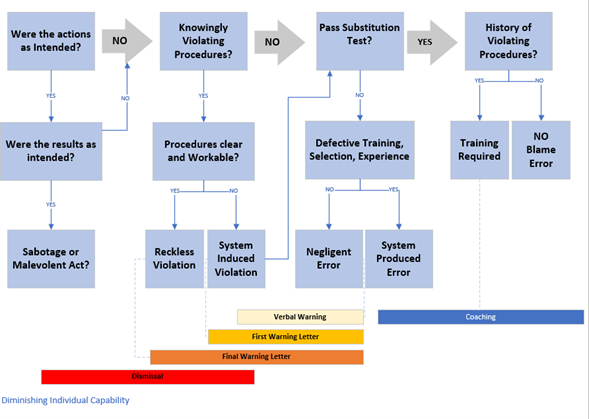
Caution: The Just Culture Consequence Management Flow Chart should be followed for all investigation after an incident or near miss.
6. SEVERITY LEVEL OF INCIDENTS
Caution:The severity level of an incident or an injury is determined by the highest of the four factors as described in the table below.
| Severity Level | People / Injury | Environment | Business / Property |
|---|---|---|---|
| Level 1 | First Aid Case (FAC) - a one-time treatment and subsequent observation, or minor injuries such as bruises, scratches, cuts, burns, splinters etc. | Inconsequential impact on environment e.g. Oil / Noxious liquid spill contained on-board. | Financial loss << $5,000 USD. |
| Level 2 | High potential / significant near miss, Medical treatment case (MTC) Moderate injury requiring medical attention e.g. lacerations; burns; concussion; serious sprains; minor fractures; resulting in a Restricted Work Case (RWC). | Inconsequential impact on environment e.g. Oil / Noxious liquid spill contained on-board. | Financial loss $5,000 - $50,000 USD. |
| Level 3 | Lost work case (LWC) - an individual being unable to carry out any of his duties or return to work on a scheduled work shift on the day following the injury, unless caused by delays in getting medical assistance. | Oil / Noxious liquid spill is contained within Oil boom / containment around vessel. Noncompliance to regulatory requirement. | Bad widespread publicity, loss of charter, restriction of navigation. Vessel arrests. Financial loss $50,000 - $500,000 USD. |
| Level 4 | Significant injuries resulting in Partial or Permanent disability e.g. amputations etc. or fatality i.e. death of a crew member. | Oil / Noxious liquid spill is contained within berth or terminal zone. Noncompliance to port requirements. | Extended vessel dry dock, international press coverage. Loss of reputation. Loss of Oil major acceptance. Ensuing loss of use of vessel. Financial loss $500,000 - $5,000,000 USD. |
| Level 5 | Multiple Fatalities or multiple life threatening injuries. | Oil / Noxious liquid spill is not contained within Port/ Harbour limits. Legal Violation. | Severe pressure to cease operating; Major National and International media coverage, public. Financial loss in excess of $5,000,000 USD. |
7. NOTIFICATION
7.1 Initial Notification Information Required and Format
Send the following information in the format below as part of the initial notification:
- AA. Ship Name,
- BB. Time / Date (LT/UTC)/ Brief description of the Incident Cargo on - board (Loaded / Ballast) Weather & Sea Conditions
- CC. Geographical Location of the Vessel (Position at Sea, Name of port / terminal etc.)
- DD. Impact of the Incident (Injury / Environment Pollution / Hull or Machinery Damage / Delays / Security or Others)
- EE. Assistance required & other details
- And, only in case of a telephone call,
- FF. Time/Date of Report (LT/UTC)/Caller’s name/Contact phone of caller/ Agree on Next contact
- GG. Any oil major involved (casualty-emergency reporting format as indicated on Voyage orders / instruction (voice or email)
Only in case of telephone case
| Task | Severity Level | Means of Notification | Time Line |
|---|---|---|---|
| Incident / Injury Notification | Level 1 and 2 | Email to (illusion as applicable) MTSI or TSI as applicable NB - Refer to HSSEQ-44 | Within 24 Hours |
| Level 3, 4 and 5 | Technical Director/ DPA | Immediate / As soon as possible. |
Warning:Not every incident is a crisis. However, be particularly mindful of an incident turning into a crisis. Contact the Incident Commander in this event.
8. PRINCIPLES OF INCIDENT INVESTIGATION
8.1 General
- The purpose of investigation is to:
- Allow the Company to analyse the incident with the objective of improving safety and pollution prevention.
- Establish procedures for the implementation of corrective actions, including measures intended to prevent recurrence.
- Establish causal factors as to why events have occurred i.e. it is not sufficient to say that a person has failed to carry out a task or duty; the underlying reason why task was not carried out must be identified.
- It is important to:
- Identify and determine the cause through thorough checking and evaluation of all the evidence, statements, tests, etc.
- Identify if recurrence is possible or likely, including an evaluation of the reliability of machinery and equipment.
- Identify controls to minimise or eliminate the problem.
- Identify any underlying trends or incorrect procedures.
- Investigations shall be thorough and unbiased.
- Investigations shall be documented.
- The loss causation model shall be used for all investigations and root cause analysis.
- All messages from the fleet group, marine, incident investigation are to be copied to the e-file email address of the vessel so that all parties coming into action at a later time / date do not repeat the questions to the vessel.
8.2 Teamwork and Coordination Between Departments
- Incident investigators shall be supported by both the Operations and Support teams.
- Transparency, teamwork and coordination shall be afforded to incident investigators to ensure that investigations are carried out without obstructions.
8.3 Improving Safety and Organisational Performance Through A Just Culture
- A ‘Just Culture’ in Company is founded on two principles, which apply simultaneously to everyone in the organisation:
- Human error is inevitable, and the organisations’ policies, processes and interfaces must be continually monitored and improved to accommodate those errors.
- Individuals should be accountable for their actions if they knowingly violate safety procedures or policies.
- Our processes, procedures and training seek to reduce both the number of such errors and the severity of their impact.
- To achieve these Company has developed an open reporting & investigation system.
- Just Culture recognizes that individuals should not be held accountable for system failings over which they have no control. It examines the type of error and the individual’s behaviour to come to a just and fair conclusion.
- In contrast to a culture that touts no blame as its governing principle, a Just Culture does not tolerate conscious disregard of clear risks to employees or gross misconduct, such as falsifying a record, performing duties while intoxicated, etc., and attaches accountability to one’s choice of actions.
- Based on the philosophy of "Just Culture", company follows a framework for the analysis of a wrongful act, which will be used to assure just treatment for all Company employees and contractors.
- Our objective is to ensure a uniform approach towards the handling of cases, that have resulted in an incident or accident. A swift and transparent process is required when dealing with such cases.
Note: We will investigate thoroughly to get to the root causes, and in the process, we expect full collaboration from all stakeholders and those involved in the incident, without fear of retribution. Due regard shall be given to the degree of co-operation and an “honest mistake”, the willingness to learn from it. Violations shall be treated with the principles of Just Culture explained above.
The Just Culture Consequence Management Flow Chart should be followed for all investigation after an incident or near miss.
- This will ensure that all cases are treated with the same scrutiny, consistency and objectivity to guarantee a fair review has taken place. The same approach will be followed, regardless of the rank and nationality of the employees, whether based on board or ashore.
- In every case, regardless of outcome, a written report for accident prevention will be created and learnings will be shared for ongoing awareness and further training.
- The company philosophy related to disciplinary procedure is based upon Just Culture. The procedures cover employees and contractors include:
Reporting
The point of reporting is to contribute to organizational learning. It is to prevent recurrence by making systemic changes that aim to redress some of the basic circumstances in which work went awry. This means that any event that has the potential to shed some light on (and help improve the conditions for) safe practice is, in principle, worth reporting and investigating. Incident reporting, Call or emails to responsible person to escalate an issue fall in this category. Anonymous complaints do not amount to reporting but are often used to trigger investigation.
The ability to reach out to senior management anonymously (open reporting) is a powerful tool given to our employees, and we trust them to use it responsibly.
Reporting mechanism aims to provide maximizing accessibility to the employees and an environment of minimum anxiety.
Investigation
This is to be led by the domain experts, but they do not have a decision making on the just culture consequence. The investigation may not be led by the line manager who may have a conflict of interest.
As a follow up of investigation, necessary lessons learn will be shared with the stakeholders to improve awareness and engagement.
Before commencing a formal investigation process, Vessel/Crewing Managers must gather facts from those immediately involved. Early intervention should look at what happened, for example, who was hurt or harmed, why did this happen and what is the immediate way ahead to ensure there is no repeat.
Fact finding is not part of the formal process and should start with a conversation with the individuals involved. Statements should be obtained, including from witnesses if appropriate, Managers should try and understand any mitigation or contributor to what has happened, what steps could be taken immediately and whether any activities need to be restricted whilst this information is gathered and reviewed.
Once all this information has been gathered the respective Manager should attach copies of the documents that have been obtained as part of their fact finding and meet with an appropriate level of Senior Management to decide whether the case should proceed to a formal investigation.
The appropriateness of a formal investigation and the appointment of the most suitable Investigating Manager will be discussed with an appropriate level of Senior Management (see subsequent section on Levels of Authority).
The purpose of the investigation is threefold:
- To determine whether there is a case to answer.
- To be thorough, fair, and objective, respecting the rights of all the involved parties.
- To collect relevant evidence and to establish facts, to be used in preparation for action if formal procedures need to take place.
If there is any possibility of fraud, bribery, or corruption then the Managing Director and Legal Department should be consulted, and those investigations will be conducted in accordance with the governing law.
HSSEQ17- to be shared by vessel as preliminary report whereas after detailed collected information but within 3 days HSSEQ17A to be shared with office.
Defined Levels of Violation & Actions to be Taken
These are as determined by the just culture flow chart and drawing the line between behaviors. Violation in the following areas will amount to summary dismissal:
- Drug and Alcohol policy
- Sexual harassment policy
- An act involving outrage of modesty
- Criminal acts (basis international and national laws)
It is to be noted that any dismissal can be appealed against, refer to Appeal Procedures.
Levels of Authority
This is established to decide who in the organization gets to draw the line between acceptable and unacceptable behaviour.
When it is obvious that the error was unintentional and the risk consequences were low, the TD or respective Crewing Manager will decide the appropriate action.
When there is an ambiguity whether the actions were unintentional or when the risk consequence are high, the decision on appropriate action will be using two Directors, one of which must be the domain expert and if not then involving a domain expert in addition to two directors.
Appeals Procedure
This section explains the procedure you need to follow if you do not agree with an investigation outcome and wish to appeal against it.
Any appeal against an investigation outcome must be raised within 30 days directly to the DPA of the company. The DPA will further assign an alternative investigator (who was not previously involved in the investigation process) to review the previous investigation outcome.
The investigation may approach you again for more details. As far as practical, second review will be completed within 30 days from the date of receiving the appeal request and information to be shared by the appealing party.
8.4 Just Culture Consequence Management Flow Chart
Acknowledgement
Just Culture Consequence Management Flow Chart, originally known as The Incident Decision Tree is based on an algorithm for dealing with staff involved in safety errors in the aviation industry. This model, called the “Culpability Tree,” was developed in 1997 by chartered psychologist Professor James Reason, professor emeritus at the Department of Psychology, University of Manchester.
9. REQUIREMENTS FOR OFFICE NOMINATED INCIDENT INVESTIGATOR
The following criteria is established as minimum requirement to qualify as investigator:
For Vessel
- Senior management rank on-board e.g. Master, C/O, C/E, 2/E.
- Person not connected with the incident.
- Successful completion of shore-based incident investigation course or an on-board CBT Module # 149 OR Shore based Vessel Safety Officer Course.
- Revalidation of above courses shall be carried out every 3 years to remain conversant with the theory of investigation process. Respective crewing managers shall be responsible for ensuring the validity of these courses for on-board personnel.
- Possess experience in incident investigation, risk assessment and root cause analysis. Newly appointed C/O and 2/E should understudy the Master or C/E during on-board investigation process.
- In case office nominated incident investigator couldn’t meet the above company requirements, a risk assessment must be carried out. Additionally, approval from Chief Technical Officer must be obtained as part of the risk assessment before appointing the mentioned office nominated incident investigator. HSSEQ17A to be shared with Office.
For Office
- Successful completion of shore based incident investigation training. Marine Superintendent or tech Superintendent are equally considered competent enough to carry out independent Investigation Provided they have participated in past 2 Investigations as assistance (Observer).
- Should have participated in 02 investigations as observer.
- Revalidation of shore-based training shall be carried out every 5 years to remain conversant with the theory of investigation process. Respective HR managers shall be responsible for ensuring the validity of these courses for the office-based personnel. A20 form to be used for Investigation submitted by office.
3rd Party Appointment
- If 3rd party investigators are needed, they shall be appointed by the Head of the Business Unit.
- 3rd parties shall be selected on the basis of capability in the areas of expertise needed to carry out an investigation in order to determine root causes.
- A final report shall always be provided as part of the final deliverables. Other supporting documentation, at the discretion of the Head of BU, shall be also be provided.
Investigation reports shall be reviewed by office personnel in managerial rank who:
- Possess adequate experience of independent incident investigation.
- Has completed shore based course of incident investigation and revalidated every 5 years.
10. REPORTING TO EXTERNAL PARTIES
Warning:Prior sharing any investigation reports (level 1 to 5) with external parties such as the Owners, Charterers, Oil Majors, OCIMF, Intertanko, Flag states, Classification societies, Coastal state, Port & Terminal authorities, Insurance companies or any such entity, the report must be reviewed by the Managing Director.
10.1 Initial Reporting
- Initial incident reporting to the following external parties shall be made in accordance with the specific guidelines for each individual party, within the stipulated time frame:
- Flag state.
- Coastal & port authorities and/or port state.
- Classification society.
- Charterers, Owners and / or other stake holders.
- Oil majors involved in voyage as charterers / subcharterers.
- OCIMF repository in case of incident with severity level 4 and above or at the discretion of the Managing Director, Business Unit.
Note: HSSEQ17 shall be used for preliminary incident reporting if requested.
10.2 Reporting Prior to Final Incident Report
- External parties shall not be copied in the investigation process until such time the final report has made and reviewed.
- Provide updates on the investigation process and only supply facts.
10.3 Final Reporting
- Send reviewed and PDF copies of the final incident report.
- Do not send editable documents to external parties.
10.4 Post Investigation Reporting
- If there are any errors found in the final incident report, all changes shall be approved by the nominated Reviewers.
- Changes shall prompt a new revision of the incident report.
11. POST INCIDENT DOCUMENTATION
- Details of documents considered to aid an investigation post an incident and requiring preservation.
- Recording and preserving evidence is of the utmost importance post an incident.
- Audio, video and graphic evidence is of particular assistance to an investigator in trying to establish the facts and as such must be preserved.
- All personnel on board (not only the Master) have a positive role to play in incident reporting, loss prevention and collection of evidence.
- Any documents that may have relevance to the investigation must be preserved.
- Wherever possible, original documents must be retained.
- If not practicable, authenticated and dated photocopies should be taken.
- The nominated Incident Investigator shall promptly send a request to the Master for a list of documents and information required for conducting an investigation.
- The vessel’s Vessel Manager, Marine Superintendent, Marine Manager and FGM shall be copied in the aforementioned request so as to allow them to assist in the collection of this information. Other stake holders may be copied in the email, if so required.
Note: Masters must familiarise themselves with the practical operation of the VDR and its downloading procedures.
12. URGENT NOTIFICATIONS TO THE FLEET (24 HRS)
- All incidents, based on the risk-based discretion of the Incident Commander, including any event that requires the manning of the crisis room (see Emergency preparedness), will require an urgent notification on email shall be sent across the fleet and company offices, as appropriate, by the DPA within 24 hours of the incident.
- This notification gives a short description of the known facts and states what relevant operations will be reviewed or suspended, or what specific action will be taken.
- The implementation of the actions and or recommendations, identified in the above urgent fleet notification, shall be followed up by Tech Director.
13. INVESTIGATION STATUS AND CLOSING OF ACTIONS
13.1 Monitoring of the Incident Investigation Status
- Incident and Injury investigation reports are deemed to be closed once the report is reviewed and the recommendations implemented.
- Compliance with the stipulated time frames for investigation and review shall be ensured by the nominated investigator and the reviewer, respectively.
- In case the investigator or the reviewer is unable to meet the due date time limit, he or she, shall explain to the DPA, in ample time, the reasons and / or restrictions for not being able to do so.
- Weekly monitoring if investigation status and closing of recommendations shall be carried out.
13.2 Monitoring of Corrective and Preventative Actions
- All reports shall contain corrective and preventative actions which address both root cause and human factors shall be formulated.
- All actions shall be practical and actionable, and reviewers shall verify and evaluate this prior to report completion.
- All actions shall have a person appointed who will be responsible for the closure and implementation of actions.
- The person responsible for closure shall notify the investigator on the status of closure and once the action has been closed out.
- All corrective and preventative actions shall be closed no later than 90 days from the date of the incident occurrence.
- If an action cannot be closed out within the due date, DPA shall be notified in advance. The reasons for the inability to close out shall be detailed. Further actions shall then be taken to handle the issue as advised by the DPA.
14. SHARING OF LESSONS LEARNT
- All incidents shall be analysed to identify lessons learnt.
- Action plans shall be developed with the aim of preventing recurrence.
- Lessons learnt shall be shared via HSSEQ circulars viz. HSSEQ circular 011 and circular 013 at a frequency stated below.
| Injury & Incident Level (Severity) | Frequency |
|---|---|
| Level 1-5 (all) | Quarterly (Analysis) – HSSEQ Circular |
| Level 4 & 5 & incidents requiring activation of the crisis room. | On completion of investigation – Fleet Alerts sent by the DPA |
- Quarterly circulars shall contain an analysis of the quarter’s incidents, in addition to an overall summary, statistics, lessons learnt, experience feedback, actions and recommendations.
- Alerts shall be distributed for level 4 & 5 only after the details of the investigation are verified and relevant actions to be taken are identified. Urgent notifications within 24 hrs shall be sent nonetheless.
- Circulars and notifications shall be discussed as part of the Monthly Safety Environment Report (MSER) onboard vessels. Actions shall be taken as mentioned within circular and confirmation must be sent to the office.
- The circulars or details contained with, may be used during Sea Staff Seminars and Senior Officer briefing before joining /after signing off.
- The DPA may send out alerts for lessons learned in advance of the quarterly circulars in the event that trends are identified.