| FOM-10.4 |
Fleet Operations Manual FOM Deficiency Management |
Doc No.: FOM 10.4
Revision: 01 Date: 15 Oct 2024 Issued by: DPA Approved by: MD |
18.1 RESPONSIBILITY
- The Master is responsible for making such reports to the company and is also responsible for verifying implementation of corrective actions to non-conformity occurrences.
- It is also his responsibility to ensure that everyone on board is familiar with the steps associated with this procedure.
- Senior Officers are responsible for completing reports of incidents, non-conformities and for determining appropriate corrective actions.
- All crewmembers are responsible for reporting any incident or non-conformity to their superiors.
18.2 REPORTING & HANDLING OF INCIDENTS
(Accidents/Incidents, Near Miss, Deficiencies and Non-conformities)
- Incidents (terminology used for Accidents, Damages, Deficiencies or Non-conformities from internal / external parties) can arise for several reasons, including insufficient resources or training, inadequate documentation and the failure of staff to adhere to the planned arrangements (procedures) set out in the SQEMS.
- The purpose is to ensure quick follow-up on incidents as well as to analyse causes to prevent future recurrence.
- Corrective and preventive actions for any nonconformance that is found during surveys, audits and inspections shall be documented and corrected to ensure continual monitoring and improvement of SQEMS.
- Any changes in the documented procedures that occur due to corrective and preventive action shall be recorded and revisions shall be reviewed, approved and implemented.
- The basic flow of handling of Incidents is
- Incidents are identified, reported and investigated;
- Root causes are identified;
- Corrective and Preventive actions are identified and implemented; and,
- Actions are tracked and their effectiveness is verified.
- The procedure consists of the following steps:
- Reporting
- Incident Investigation
- Corrective Action / Follow-up
18.2.1 Reporting
18.2.1.1 Deficiency Reporting Program (E-24 form TDL)
- All incidents, including those from 3rd parties, (except observations from SIRE and PSC deficiencies) or other external parties, breach of any statutory rule or international regulations, machinery breakdowns, blackouts, stoppages, or damages, must be reported as soon as possible to company through Deficiency Reporting Program (E-24).
- While filling up Deficiency Reporting Program, all entries shall be done as instructed in Deficiency Reporting Program Manual.
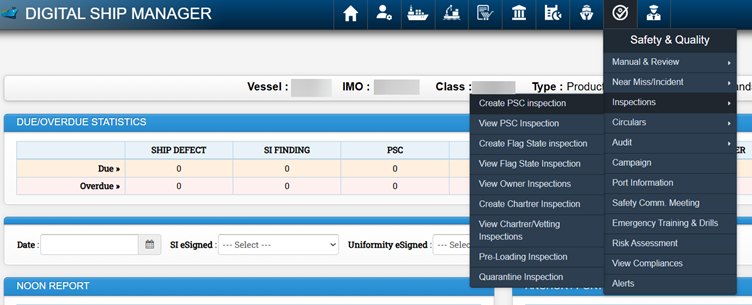
- Vessels with DSM to report all incidents, including from the 3rd parties, PSC deficiencies, CDI and SIRE observations using the modules in the Software and Closer report to them using INSP-03 form.
- While filling up the in the DSM, all the entries shall be done as per the instructions in the User manual.
- Each deficiency should be marked for its significance as per the Severity Matrix which also determines the Target date for closure to ensure that deficiencies with high severity are corrected earliest.
- In case the deficiency cannot be rectified by the target date, the TSI/MTSI should plan the extension of the target date in consultation with the vessel and record the reason for the delay such as vessel schedule, supply of parts or suitable opportunity for rectification.
- Above information to be entered in the Deficiency Reporting Program (E24 form) and DSM (Ship Defect List) for reference and follow-up.
- An Incident Investigation and Analysis Report form may be required as per the Severity Matrix in Deficiency Reporting Program.
- The report shall clearly indicate the details of incident and remedial measures taken and preventive measures suggested.
- The Deficiency Reporting Program shall be sent to office as cumulative list after each new entry or Weekly.
- Office Database will be updated by the vessel PIC where applicable, with the Deficiency reporting program file received from the vessel.
- Then the same file shall be returned to vessel after comments and signatures. Where applicable, it will be utilized again by vessel to make the next report.
- The workflow in the DSM shall be followed for the timely closure of the findings, and all actions must be completed prior to closure of the findings by Tech Director.
- Any Incident (including damage or defect) that may be discovered, and which might adversely affect safety or the environment or statutory certificate, shall also be reported to the relevant Classification society, the maritime administration of the Flag state and/or the authority of the port state.
- Office should be consulted about any such issues immediately. It is to note that dispensation from Flag state may be required for such defects.
- All medical incidents including Injury, Illness cases and doctor’s visit shall be reported through CRV-09 only or any other program specifically provided by the company. Medical Incident Report HSSEQ-16) shall be asked by the TSI/MTSI where required.
- All PSC/FSI inspections and deficiencies shall be reported through email or any other program specifically provided by the company including any inspection resulting in NIL deficiency. Closer report to be submitted using INSP-03. Master to record each PSC/FSI deficiency as NON-Conformity in HSSEQ-01 and share to Office along with completed INSP-03.
- All SIRE inspections on tankers shall be reported through email or any other program specifically provided by the company including any inspection resulting in NIL deficiency. Closer report to be submitted using INSP-03.
18.2.1.2 Near Miss
- Near-miss is a sequence of events and/or conditions that could have resulted in loss. This loss was prevented by a fortunate break in the chain of events and/or conditions. The potential loss could be a human injury, environmental damage or a negative business impact (e.g. repair costs, delays, contract violation, loss of reputation). Some examples are:
- An event that leads to an emergency and/or immediate response to prevent a loss. e.g. a collision is narrowly avoided,
- a crew discovers that a valve is closed when it should be in fact open.
- Near-miss is an event where an unexpected condition could have led to adverse consequences but did not occur. e.g. a man who was standing below a load on crane and moves away just before the weight fell accidentally, ship went off course over a shallow patch but did not run aground as there was an unusual high tide.
- Near-miss is a dangerous or hazardous situation or condition that was discovered after the danger had passed. e.g. VHF was set to a wrong channel, small scale chart was used when a large-scale chart was available on board, the radar was tuned wrongly due to which it could have missed some targets.
- All Near Misses and Unsafe Acts/Unsafe Conditions / shall be reported to the company by using the Near Miss Reporting Form- HSSEQ21 and DSM (As applicable) as soon as it’s observed.
- Near-miss reported in the Near Miss Reporting form- HSSEQ21/DSM shall not be duplicated in the Deficiency reporting program (E-24) form.
- All the Near-misses are required to be investigated and require Root Cause Analysis or M-SCAT on ships with DSM functional).
- The Master shall use the Near Miss reporting module in the DSM for the investigation, including the Root Cause Analysis using the M-SCAT.
- Care shall be taken by senior management on board to ensure that Near Misses are very clear and not Unsafe Acts or Unsafe Conditions for the purpose of documenting and investigating / conducting proper RCA.
- Nearmiss- Corrective actions/ Preventive actions to be verified by Office.
18.2.1.3 Unsafe Act
- A departure from an accepted, normal, or correct procedure or practice which has in the past actually produced injury or property damage or has the potential for producing such loss in the future; an unnecessaryoraj exposure to a hazard; or conduct reducing the degree of safety normally present.
- Not every unsafe act produces an injury or loss but, by definition, all unsafe acts have the potential for producing future incident, injuries or losses.
- An unsafe act may be an act of commission (doing something which is unsafe) or an act of omission (failing to do something that should have been done). Some examples are:
- Operating without qualification or authorization.
- Lack of or improper use of PPE.
- Failure to tag out /lockout.
- Operating equipment at unsafe speed.
- Failure to warn.
- Bypass or removal of safety devices.
- Using defective equipment.
- Use of tools for other than their intended purpose.
- Working in hazardous locations without adequate protection or warning.
- Improper repair of equipment.
- Horseplay
- Wearing unsafe clothing
- Taking an unsafe position.
- Unsafe Act- Nearmisses reported as Unsafe Act to be closed by Onboard SSC.
18.2.1.4 Unsafe Conditions
- Any physical state which deviates from that which is acceptable, normal, or correct in terms of its past production or potential future production of personal injury and/or damage to property or things; any physical state which results in a reduction in the degree of safety normally present.
- It should be noted that incidents are invariably preceded by unsafe acts and/or unsafe conditions.
- Thus, unsafe acts and/or unsafe conditions are essential to the existence or occurrence of an incident. Some examples are:
- Defective tools, equipment, or supplies.
- Inadequate support or guards.
- Congestion in the workplace
- Inadequate warning systems
- Fire and explosion hazards
- Poor housekeeping
- Hazardous atmospheric condition
- Excessive noise
- Poor ventilation.
- Unsafe Condition- Nearmisses reported as Unsafe condition to be closed by Onboard SSC.
18.2.1.5 Reporting of PSC Observations on Panama Flag Ships
- All Panamanian Flag vessel are required to submit inspection reports including those where NO deficiency was found.
- This report should immediately be sent to Panama PSC Section with crew list. (Refer to Panama MMC-380).
- Master shall coordinate with PIC if so required.
18.2.1.6 Reporting of Annual Safety Inspections (ASI) on Panama Flag Ships
- The Panama Administration requires that the corrections of deficiencies raised due to an Annual Safety Inspections (ASI) to Panamanian Flagged vessels, shall be reported to the Flag State Section within the next 30 days of the inspection.
- The correction of deficiencies shall be sent by the Captains and or Operators using the format in appendix I of this Merchant Marine Circular: “Monitoring and Correction of Deficiencies Reports” Form (F-IASI-01-01).
- The address to which such report to be sent is given in the Panama PMMC No.201
Note: Similar requirement may exist with some other Flags also. Master to check with PIC and ensure compliance.
18.2.2 Investigation
- All Incidents, Damages Deficiencies, Non-conformities and Near-miss, shall be investigated as per the procedures described in ECP-12-00.
- This investigation shall form basis for any corrective action or recommendation for improvement.
18.2.3 Corrective Action / Follow-up
- When an incident or non-conformity has been reported or one or several findings have been given during an inspection, the vessel shall take necessary corrective action upon agreement with the company.
- As a minimum, corrective actions should be generated to eliminate proximate causes and eliminate or mitigate the negative effects of root causes.
- Periodically, trend reports may be created and should be sent to the company to alert them to potential problem areas.
- Proposals to corrective action following accidents, incidents or non-conformities shall be made through the concerned group manager.
- The procedure for conducting corrective actions is the same procedure used for non-conformance findings in an SQEMS audit.
- Any corrective action taken to eliminate the causes of actual and potential nonconformance should be appropriate to the magnitude of the problems and commensurate with the Health, Safety, Quality and Environmental protection.
18.2.4 Requisition for Shore Service
- When the vessels request for Shore Service in order to rectify deficiencies, this shall be clearly indicated on the Requisition for Shore Service (Shore Form- P1) form.
- The tracking/serial numbers of the related incident report are to be mentioned on the requisition form in order to track the history of supply.
- Complete details, including the contact details of the manufacturer, as required shall be provided on the requisition form.
18.2.5 Emergency Requisition for Spare Parts & Stores
Refer FOM- Purchasing & Stores
18.3 NONCONFORMING MATERIALS, EQUIPMENT OR CARGO SPACES
- Vessel shall make adequate preparations and ensures that relevant material, equipment and cargo loading spaces prior to arrival at load port, in all practical circumstances.
- Such preparation shall be made to the requirements of Charterer’s instructions and guidelines as provided in the Voyage
- Instructions and with due consideration to standard industry practices.
- Upon receipt of voyage instructions, the Master shall inform the company and provide information on the preparation of vessel to meet the specific requirements for safe and efficient cargo operations and carriage of cargo.
- Such information shall be made during e-mail exchange with vessel’s marine manager.
- The Master shall make a final confirmation of vessel’s readiness in all respect and report it to the company by making a remark in the Port arrival message.
- If for any reason such preparations could not be made well in time, or upon rejection of cargo spaces for loading next cargo, Master shall immediately take corrective action and inform the company of the non-conformity.
- A non-conformity report shall be subsequently made and investigated for root causes of failure.
18.4 ROOT CAUSE ANALYSIS OF INCIDENTS
Please refer to ECP-12-00 Accident Investigation Procedures