| FOM-3.12 |
Fleet Operations Manual Navigation Guidance on Pilot Ladder Rigging and Maintenance |
Doc No.: FOM-3.12
Revision: 01 Date: 15 Oct 2024 Issued by: DPA Approved by: MD |
1. APPLICATION
This document applies to Masters, navigating officers and watch keepers onboard fully managed vessels. The guidelines mentioned in this document shall apply to all the pilot ladders on board, including the spare ladders.
2. PURPOSE
To specify requirements for and highlight important aspects of rigging and maintenance of pilot ladders.
3. REQUIREMENTS
- Safety of Life at Sea (SOLAS Chapter V, Regulation 23) sets out the principal requirements for the rigging of pilot ladders.
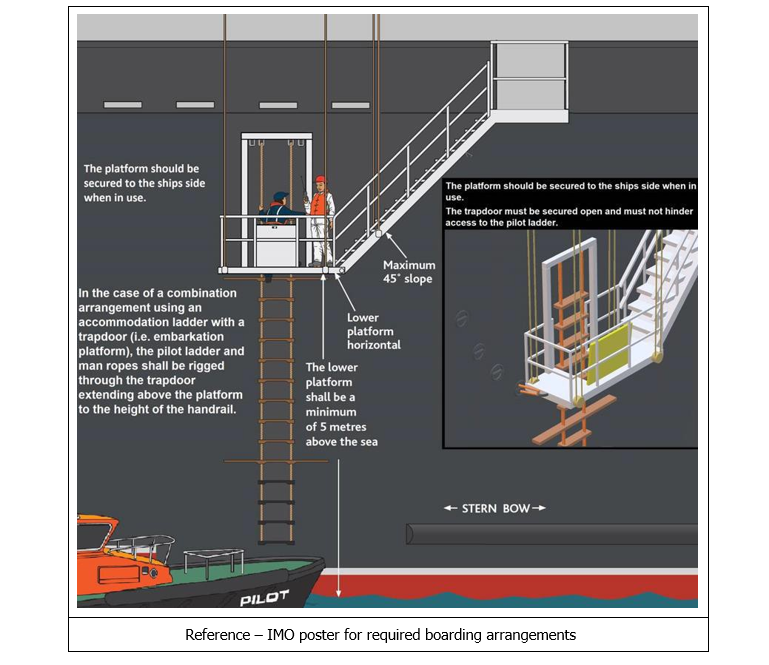
- IMO/IMPA Required Boarding Arrangements for Pilot poster.
- ICS Bridge Procedures Guide.
4. RESPONSIBILITIES
4.1 Master & Deck Officers
Master and deck officers shall ensure:
- The rigging of the pilot transfer arrangements and the embarkation of a pilot must be supervised by a responsible officer having means of communication with the navigation bridge and who shall also arrange for the escort of the pilot by a safe route to and from the navigation bridge.
- Check the condition of the ladder before it is rigged and ensure it is secured to the ship. While this is done, officer should always take care of their own safety, wearing all appropriate PPE (a life jacket and lifeline if necessary).
- Closely observe the boarding and disembarkation of pilots from ladders, ensuring that SOLAS requirements are met.
- Ensure that a safe, convenient, and unobstructed passage is provided from the pilot boarding area to and from the vessel’s navigation bridge.
- Maintain a lee until the pilot vessel is well clear.
Note:
At all times during the rigging, use and de-rigging of any pilot transfer arrangements there should be no risk to the ship’s crew. Crew members should not normally be required to leave the protection of the ship’s safety rails or bulwarks. A lifeline or safety harness should be worn if there is any risk of falling.
4.2 Chief Officer
Chief Officer shall ensure:
- The inspection regime and records are adequate and maintained.
- Replacement ladders are quickly and readily ordered for prompt supply.
CAUTION:
All Pilot ladders, manropes and associated equipment are to be used only for marine transfers (pilots and other personnel) and must not be used for any other operations onboard the vessel such as for draught readings or any maintenance work. All equipment is to be clearly marked as “For Marine Transfers only”.
5. RIGGING PILOT LADDER & COMBINATION LADDERS
5.1 Rigging Pilot Ladders
In addition to the guidance provided in the IMO/IMPA poster for “Required Boarding Arrangements for Pilot”, below instructions should be complied with when rigging the pilot ladders:
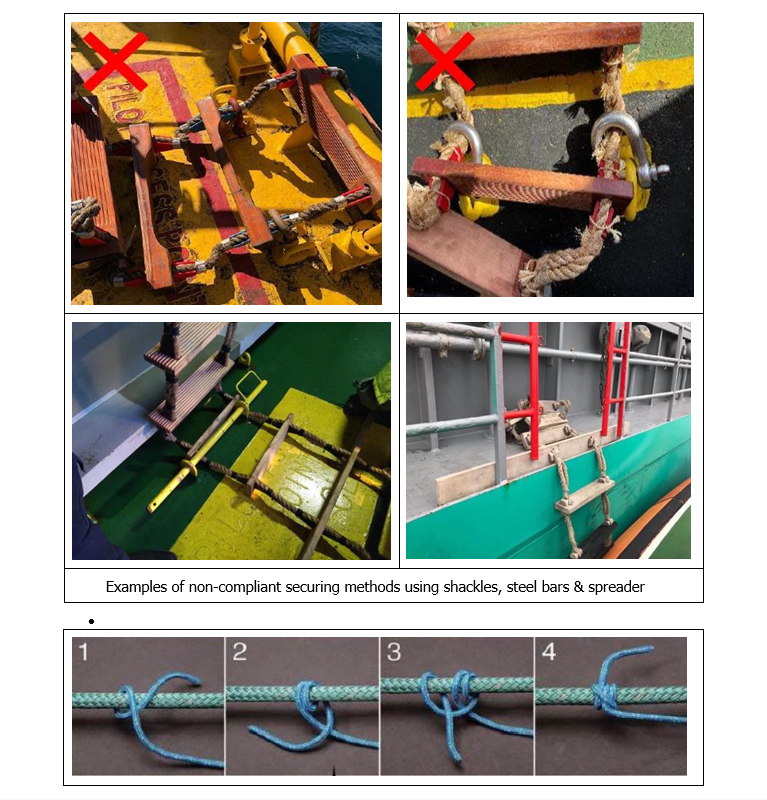
- Use of shackles, welded steps or steel bars for securing - The use of shackles or welded steps to secure / choke pilot ladder side ropes or steps when securing on deck is prohibited. Using shackles to shorten / secure ladders cause the weight of the ladder to be taken up by the shackles impacting directly against the mechanical securing clamps (widgets) which secure the ladders treads in place, including the seizing twine and will eventually damage them.
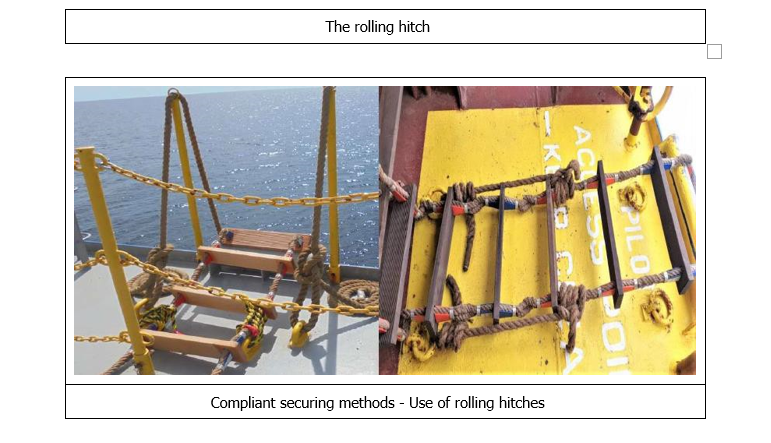
- The side ropes of the pilot ladder should be secured to a strong point on deck using a rolling hitch as shown in below pictures. The rope used for this purpose should be of a strength similar to that of the side rope of pilot ladder i.e of MBL 24 KN.
5.2 Trap Door Arrangements and Use of Combination Ladder
When a combination ladder is used, the lower platform of the accommodation ladder should be in a horizontal position and secured to the ship's side. If a trapdoor is fitted in the lower platform to allow access from and to the pilot ladder, the trapdoor should open upwards and be secured either flat on the embarkation platform or against the rails at the aft end or outboard side of the platform and should not form part of the handholds.
Each step of the pilot ladder must rest firmly against the ship’s side. The pilot ladder must be secured to ship’s side using eye pad or handhold or by a mechanical device such as magnetic clamps or a pneumatic suction pad.
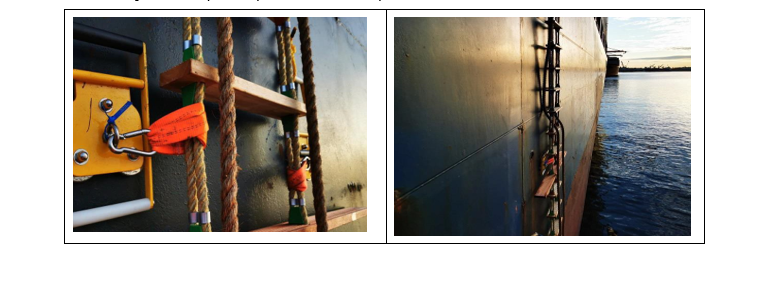
5.3 Manropes
Two good manropes of not less than 28 mm and not more than 32 mm in diameter shall be fixed at the rope end to the ring plate fixed on deck and shall be ready for use when the pilot disembarks, or upon request from a pilot approaching to board. Manropes shall be made of grade 1 manila rope.
5.4 Use of Winch Reel
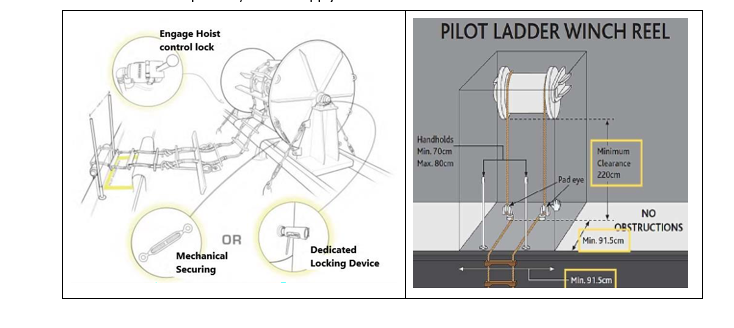
Where the pilot ladder is stowed on a pilot ladder winch reel which is located either within the ship's side opening or on the upper deck.
- The winch reel should not take the weight of the ladder.
- The pilot ladder should be secured to a strong point at deck level inside the ship side opening and independent of the pilot ladder winch reel.
- As an additional safety measure the winch reel should be secured by a mechanical fastening or via a dedicated reel bolt or the hoist controls be locked to prevent accidental use.
- If no lock is present, the air supply should be isolated from the reel.
6. INSPECTION, MAINTENANCE & RENEWAL
6.1 Inspection and Maintenance
Pilot ladders should be inspected before & after every use and as per planned maintenance system to confirm that they are in good condition. The below points to be kept in mind when inspecting the pilot ladders:
- Ladder including all steps and ropes should be clean and the siderails are free from any type of grease.
- Check for any wear and tear. Ladders must not be used if damaged or sign of deterioration exists.
- Although the surface of the rope may appear to be in satisfactory condition, natural fibre rope may self-abrade from the inside. Therefore, the lay should be opened at regular intervals along the ladder to check for signs of wear.
- If the fibres on the surface appear to be weak or frayed, and can be picked away with a fingernail, then this suggests that the ladder is due for replacement.
- Steps, clamps, and chocks should be inspected for damage including cracks, wear, splits, sharp edges.
- Check the condition of all associated fittings like manropes and securing cordage are in line with pilot ladders requirements.
- The man ropes must be of the correct diameter and construction, in good condition and properly secured to the vessel's deck.
- All steps should be horizontal, and should not be painted either partially or completely, as this may mask the presence of flaws.
- The condition of Marlin seizing ropes should be checked to confirm they have not degraded. Seizing’s should be intact and tight, holding the chocks or rungs securely in place.
- Shackles securing ladders to pad eyes on deck should be inspected to ensure that they are not corroded beyond acceptable limits. Ideally stainless-steel shackles should be used.
- Rope used to secure the ladder must be inspected, should be free from any fray ends and should not have any signs of deterioration.
- Pad Eyes should be inspected for damage and corrosion, welds checked for excessive wear down and cracks.
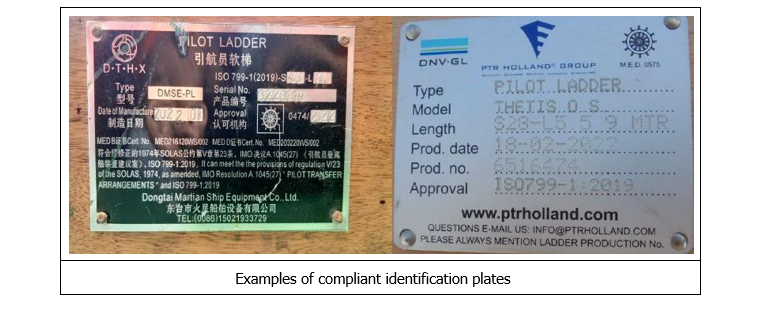
- Identification tag should be available on the ladder for easy identification of the ladder.
- The pilot ladder should be secured to the deck in a correct way and after use must be properly covered and stowed to avoid any contact with water/cargo and exposure to direct sun.
- Check the conditions of the stanchions, deck fitting and securing arrangement.
- Check if there adequate lighting at the point of embarkation / disembarkation.
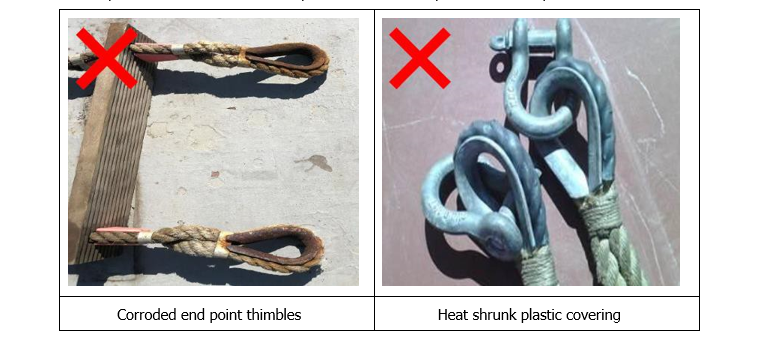
- Attention to end points (Thimbles) - Corroded end point thimbles can damage the side ropes, thereby leading to the failure of the side ropes. The rope portion around the thimble must be inspected as part of the inspection routine. Heat shrunk plastic covering for end points must not be used as it prevents detailed inspection of the rope area.
Note:
During any maintenance routine, all safety precautions are to be observed most rigidly. Suitable warning signs are to be put up when maintenance is being carried out to avoid the possibility of accidental or unauthorized operation of the equipment.
6.2 Emergency Replacement of Pilot Ladder Steps
Follow the below instructions in case of damage to the Pilot ladder steps, when no spare pilot ladder is available:
- No pilot ladder should have more than two replacement steps which are secured in position by a method different from that used in the original construction of the ladder. Any steps so secured should be replaced as soon as reasonably practicable by steps secured in position by the method used in the original construction of the pilot ladder.
- When any replacement step is secured to the side ropes of the pilot ladder by means of grooves in the sides of the step, such grooves should be in the longer sides of the step.
6.2.1 Guidance for Replacement of Pilot Ladder Steps Secured with Chocks & Whipping
The damaged step or spreader should be carefully removed along with the whippings above and below the step. Every care should be taken not to damage the side ropes during this operation.
The replacement step/spreader should have the chocks placed on either side of the step where the cut outs are. Half of the chock on one side of step and the other half on the other side.
The step/spreader should be placed in the ladder with the side ropes on both sides running along the groove in the chock. The step/spreader should be placed mid distance between the upper and lower step.
A figure 8 seizing of 3 ply tarred marlin should then be applied both above and below the winnet on both sides of the ladder to hold them tightly in place.
The whipping should consist of a minimum 38mm length around both ropes and should be locked off by means of a double frapping and finished off by passing between the side ropes.
6.2.2 Guidance for Replacement of Pilot Ladder Steps Secured with Chocks & Metal Clamps
The damaged step or spreader should be carefully removed. Every care should be taken not to damage the side ropes and clamps during this operation.
The replacement step/spreader should then be slid into position with the grooves facing upwards between the chocks and set ready to take the nuts and bolts.
These are tightened gradually securing the step in its new position.
6.3 Pilot Ladder & Manropes Renewal Period
The pilot ladder and manropes should be renewed if deemed necessary due to any alarming condition. If any doubt exists, the ladder should be removed from service and repaired or replaced.
Below is the maximum allowable period for use of the pilot ladder and manropes, unless makers recommendation specifies a lesser period.
- Maximum permitted age of pilot ladders for use is 30 months. The period of 30 months is to commence from the date when the ladder was received onboard. Evidence of the receipt must be retained onboard.
- Maximum permitted age of manropes used with pilot ladders is 12 months. The period of 12 months is to commence from the date the manrope was put in service. A new manrope must not be cut out from an existing coil onboard that is more than 12 months old.
CAUTION:
Manrope and Side ropes are separate and shall not be confused with each other.
7. STOWAGE AND CARE
Although manila fibre rope has properties that make it ideal for use in many marine applications, it is susceptible to damage and loss of strength due to several factors if it is not stowed and handled carefully. Abrasion or cuts may occur during routine handling. Bulwarks, fishplates, deck edges, decks, and any other surfaces, which may meet the ladder, should therefore be smooth and free from obstructions or defects, which may chafe or cut the rope.
Ensure below are complied with before stowing the pilot ladders:
- Ladders should not be stowed when wet as the preservatives may become less effective over time.
- Ladders should not be stored together with acids, detergents or paint as these products and their fumes may cause the fibres to deteriorate quickly.
- Ladders should not be dragged over decks, which need cleaning.
- If a ladder is dirty, it should be washed with fresh water. Soaps or detergents should not be used as these products may affect the natural oils and chemical preservatives in the rope. High pressure water guns should also be avoided as these may force dirt or grit into the fibres.
- The ladder should be allowed to dry naturally prior to storage.
- Once dry, the ladder should be shaken to remove any particles that may remain. Ideally, rope ladders should be stored in a cool, dry, well-ventilated compartment.
- Ladders stored outside should be inspected more frequently to ensure that they are still in a good condition. In sub-zero temperatures, they should be thawed thoroughly before use, as frozen rope fibres are more susceptible to breakage.
- To protect ladders stored outside from the effects of rot, mildew, chemicals, acids, and detergents, they should be stowed on a suitable grating. Wooden pallets, cut down to size, are ideal for this purpose. The height of the grating should be such that the ladder will not meet free water on deck that may contain potentially harmful products.
- Rope ladders stored outside should therefore be covered when not in use to protect them from the effects of sunlight. Coverings will also protect ladders from precipitation and frost.
- Dedicated and protected spaces on board must be identified for storing the ladders.
8. CERTIFICATION AND MARKING
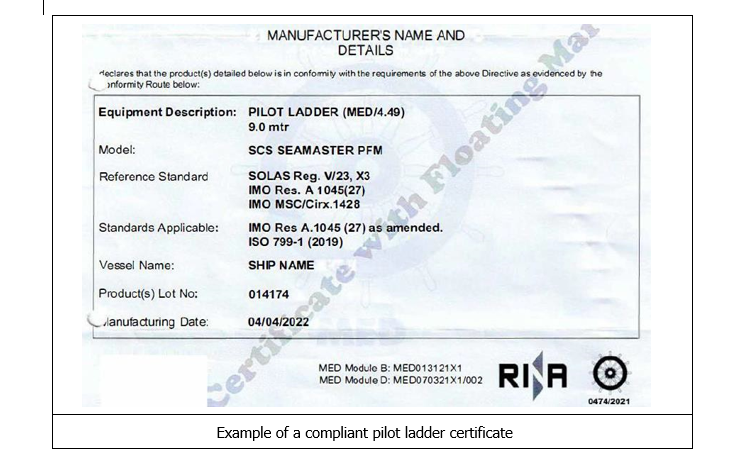
Pilot ladders must be certified by the manufacturer / Classification Society as complying with the latest IMO and ISO requirements. Proof of certification must be kept on board and produced when requested by Pilots/Port authorities.