| FOM-3.31 |
Fleet Operations Manual Navigation Squat |
Doc No.: FOM-3.31
Revision: 01 Date: 15 Oct 2024 Issued by: DPA Approved by: MD |
1. Principle of Squat
A ship transiting through shallow waters experiences an increase of draft and this effect is known as ‘Squatting’. Vessels start to ‘Squat’ when the depth of the water decreases to approximately two and a half times the maximum draft.
When the squat effect takes place, then:
- the ships speed decreases
- Propeller ‘paddle wheel’ effect is accentuated due to cavitation of the propeller
- Rudder effect is reduced due to cavitation of the propeller
- Increases Bow cushion or Bank suction and Smelling the ground effects
- Increases ship interaction effects
- Increases vibration effects onboard the ship
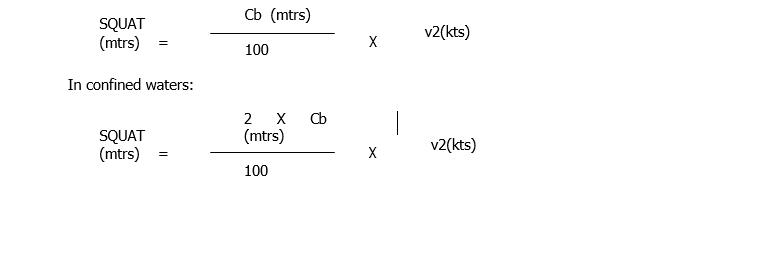
Squat effect depends upon the block co-efficient of the vessel and is directly proportional to the square of its speed. Other factors governing squat are:
- The relation between the ship’s draft and the water depth
- The ratio between the ships midship underwater section and the channel cross-section.
Vessel’s having a block coefficient (Cb) of less than 0.70 are known as fine formed vessels and have a tendency to trim by the stern.
Vessel’s having a block coefficient (Cb) of more than 0.70 are known as full formed vessels and have a tendency to trim by the head.
2. Guidance on Squat Calculations
A rough mathematical guide for squat calculation can be used as follows: In open waters: