| FOM-3.33 |
Fleet Operations Manual Navigation Under Keel Clearance |
Doc No.: FOM-3.33
Revision: 01 Date: 15 Oct 2024 Issued by: DPA Approved by: MD |
1. Application
This document applies to Bridge Teams on all fully managed vessels.
2. Purpose
- To specify instructions for Under Keel Clearance (UKC).
- To give guidance and advice regarding special conditions which may affect the draft of the vessel.
3. Responsibility
- The Master is responsible for implementation of the Under Keel Clearance Policy.
- The Second Officer is responsible for calculations involving Under Keel Clearance.
- All watch officers are responsible for monitoring the UKC while at sea, at anchor, or at berth.
4. Under Keel Clearance (UKC) Policy
The company requires the implementation of Minimum under Keel Clearance policy for:
- Ocean passage
- Fairways outside ports (Shallow waters)
- Fairways inside ports (Within Port Limits)
- While alongside the berth or at SBM/CBM moorings
- At Anchorage (with / without cargo operation)
A. Minimum UKC Requirements:
| Depths | Minimum UKC |
|---|---|
| Ocean Passage | 50% of Dynamic Draft or 5.0 mtr dynamic UKC, whichever is greater |
| Fairways outside ports (Shallow waters) | 15% of Dynamic Draft or 1.5 mtr dynamic UKC, whichever is greater |
| Fairways inside ports (Within Port Limits) | 1.5% of the moulded breadth or 0.6m Dynamic UKC, whichever is greater |
| Whilst alongside the berth, SBM/CBM moorings | 1.5% of the moulded breadth or 0.3m Static UKC, whichever is greater |
| At Anchorage (With / Without Cargo operation) | Minimum 2.0m at all times |
- For CATZOC Category D or U, vessels shall ensure minimum UKC of 50 % of the deepest dynamic draft.
Note: Charterers, Ports, and Canal Authorities may have rules that are stricter than the above criteria. Comply with the higher UKC allowance in such a case. It is essential that information is made available to the vessel prior to fixing the vessel in order that the vessel can safely load. The UKC applies to the dynamic draft of the vessel where the variables listed in this chapter are applied to the static draft. Consider waters with depth less than 2.5 times the vessel’s draft as Shallow Waters. Compute Squat calculation accordingly.
5. UKC Requirement in Special Cases
Straits of Malacca and Singapore - Deep draught vessels and VLCCs shall allow minimum UKC of 3.5 m. Refer to – “Passage Planning guide - Malacca and Singapore straits” and BA 5502 -Mariners' Routing Guide Singapore and Singapore Strait.
6. Factors Affecting UKC
Consider following factors in UKC assessment:
- Tide- Predicted height
- Changes in the predicted tidal height, caused by:
- wind speed and direction
- high or low barometric pressure
- Bottom - Nature and stability – i.e. sand waves, siltation etc.
- Hydrographic data - accuracy (often included as notes on charts)
- Water density - Change of water density and the increase in draft due to freshwater allowance
- Vessel’s size and handling characteristics and increase in draft due to heel.
- Wave response allowance - Vertical displacement of the hull due to heave, roll and pick motions.
- Draft observations and calculations - Reliability
- Hogging and sagging - Estimates
- Underwater Obstructions - Reduced depths over pipelines and other obstructions
- Bow Cushion/ Bank Suction Effect - See ‘FOM 3.30 – Shallow water effects’ for details
- ‘Smelling the Ground’ Effect - See ‘FOM 3.30 – Shallow water effects’ for details
- Squat – See ‘FOM 3.31 – Squat for details
Master shall carefully appraise the chart, nautical publications, weather, sea conditions and its effect on vessel’s hydrodynamics for above listed factors. An appropriate correction may be applied to draft if effect of above listed factors is significant.
7. UKC Calculations
Under Keel Clearance is required to be calculated for each leg of the passage and recorded in NAV Form 001 – Passage Plan.
NAV Form 002 shall be used for ‘UKC Calculations’ for:
- Each arrival and departure, for all ports and passage under pilotage.
- Any course leg where the depth is less than 2.5 times the vessel draft.
Note: In case of passages having numerous short legs (Like long river passages/canal) UKC calculated to be recorded in NAV Form 001 in waypoint sheet under UKC column. However, NAV Form 002 to be completed for the shallowest leg every 10 NM of such passage.
For vessels fitted with ECDIS:
- Check accuracy of chart data (reliability) for UKC calculation.
- Use CATZOC Consideration sheet in NAV form 002 and corrections due to reliability of survey.
- Source of Information:
- Get latest sounding information and the nature of the bottom from the local authorities or terminal well before arrival.
- Cross-check against other available sources such as Charts, Guide to Port Entry and Sailing Directions.
Note: If above is not available, request guidance from Marine Superintendent.
Caution: If discrepancies are noted:
- Inform Marine Superintendent.
- Seek clarification about depths from the Port Agent and the Charterers.
8. Office Approval
Notify Marine Superintendent to seek office approval as per FOM 3.32 for any conditions stated below:
- Vessel is unable to comply with company’s minimum UKC policy.
- CATZOC waiver is required after CATZOC calculations.
- The calculated air draft is less than 2 meters.
- Any other concerns prior undertaking the passage.
- Additional risk mitigation measures are required.
Following supporting documents are required:
- Completed NAV Form 002 - Under Keel Clearance calculation.
- Risk Assessment.
- Other supporting documents e.g., email communication from agent, port authorities, and relevant extract of nautical publications for depth data.
Caution: Proceed only when written approval is received from the Marine Superintendent. Vessels shall comply with local port authority UKC & air draft regulations if more stringent than company’s policy.
9. UKC Monitoring - In Port
Include following in the cargo plan:
- UKC calculations based on depth at the berth at lowest predicted tide.
- If the height of the tide is required to maintain the minimum UKC.
- Estimate of the expected berthing window relative to the tide.
- Calculations to determine safe limits for any other restrictions such as air-draft, water line to manifold, UKC etc.
Calculate UKC for max laden draft alongside berth at High Water / Low water every day.
Note: Use NAV Form 002B - UKC Monitoring during cargo operation. Attach this to Cargo loading / Discharge plan.
Cargo watch officers shall write down the actual UKC experienced in the above form at the HW and LW.
Note: The UKC can be from echo sounder or using hand lead line or sounding rod at the deepest draft.
Master shall sign this form once every day.
Where the depth for a certain port is suspected, or when calling Port where UKC is less than company standard requirement:
- Take due precautions to constantly check and record the same.
- Take Manual Depth sounding at the first instance after berthing and during various stages of loading.
- Take extra precaution during final stages of loading operations.
Caution: Bulk carriers shall use hand lead line to measure depth upon arrival at berth as soon as all mooring lines are made fast. This task can be done concurrent to draft survey prior cargo transfer. Depth shall be measured using hand lead line at minimum 6 locations distributed on port and starboard side on forward, mid-ship and aft of vessel. The measurements shall be recorded in deck logbook by chief officer and compared against charted depth corrected for prevailing tide. If measurements taken by hand lead line are less than charted data, master shall notify Marine Superintendent immediately for further actions and risk mitigation measures.
Warning: If alongside and in any doubt about the risk of grounding, vacate the berth.
10. Cargo Operation Over Tide
When a ship is required to load or discharge cargo at a berth, which offers insufficient depth of water to permit the ship to lie safely afloat in the loaded or part loaded condition at or near low tide:
- The operation should be planned in such a way that company’s UKC criteria always remain in compliance.
- Liaise with the local agent and commercial operator to ensure that terminals with such draught limitations and significant tidal variations have procedures in place if discharging or loading operations over the tide are to be permitted.
- Exercise due diligence to ensure that depth data and tidal information is correct.
- Effects of squat must be anticipated due to strong tide / current when loading / discharging with small UKC clearance.
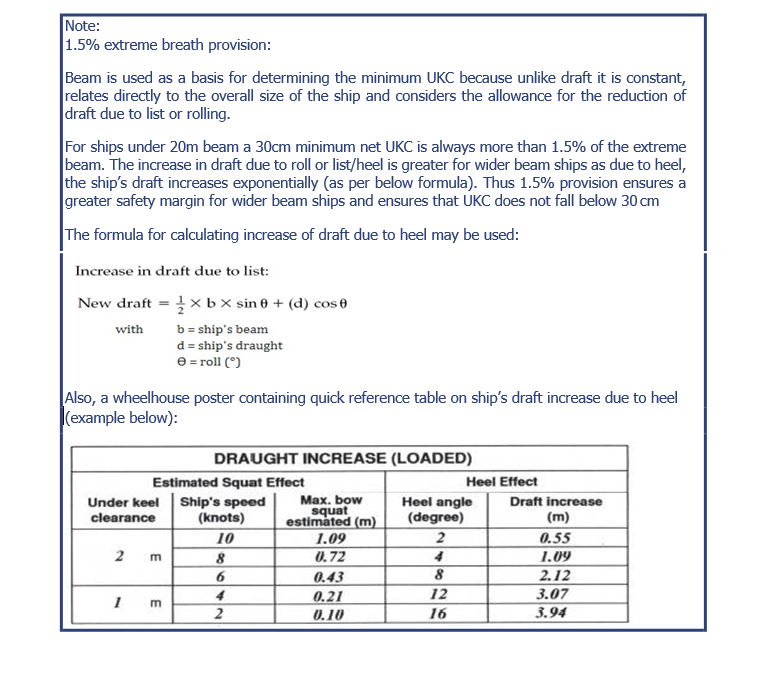
- Vessel is maintained upright and on even keel when the vessel’s draft is close to the minimum UKC. Small angles of list on wide vessels can result in large increases in draft.
- Echo sounder should always be kept ON and UKC regularly monitored.
- During final stage of loading / closing to Low water drafts to be visually monitored.
- De-ballast as soon as possible while loading and take minimum ballast while discharging to ensure maximum UKC.
- When the vessel is alongside the berth, carry out manual check of depth at six points around the vessel and verify this with the charted depth.
- Discuss with the agent and terminal representatives the contingency measures to leave the berth in case of any unsafe situation during the vessel’s stay at berth.
- Main engine should be kept standby for operation at short notice.
- Carry out a Risk assessment for the planned operation.
Caution: Request approval from Marine Superintendent prior planning such operation.
When discharging over tide:
- Properly estimate the time required for start of cargo operation after berthing and expected discharge rate to ensure that draft is reduced sufficiently before the low water.
- Keep contingency plan in place for removing the vessel from berth in sufficient time in case of delay in start of cargo operation or if the discharge rate is below the required rate.
- Ensure vessel is always brought bodily up taking minimum ballast i.e. even-keel to have sufficient clearance at all points.
11. Squat
- Be aware of and counter the effect of “SQUAT” in shallow waters.
Caution: Squat will increase vessel’s draft and change the trim. This will also alter manoeuvring characteristics.
Allow following for Squat calculations:
- expected maximum speed
- vessel-specific block co-efficient
Shallow water and Squat effects are largely dependent on the ships speed. To minimize these effects, reduce ship’s speed.
Draw up and post a table of Squat Values on the Bridge.
See ‘FOM 3.31 – Squat’ for details on the principle of Squat.
12. Minimum Air-Draft Clearance
General
Minimum air draft clearance required for passing under bridges or overhead cable is:
2 metres
If calculated air draft clearances are less than 2 meters, notify Marine Superintendent to seek office approval. Following documents are required:
- Completed NAV Form 002A – Air Draft Calculation
- Risk assessment
- Other supporting documents e.g., email communication from agent, port authorities, and relevant extract of nautical publications for air draft data
Caution: Calculate the clearance for each individual bridge and cables to be transited (if more than one) and prepare separate NAV form 002A. Enter the calculated clearances in form NAV-05 - Master-pilot information exchange and NAV-04 Pilot card.
High Voltage Cables
Minimum air draft clearance below High Voltage cables:
- Is decided upon by the local authorities
- Normally ranges between 2 to 5 meters
- Depends on the voltage rating of the cable.
Caution: If the safe air draft clearance is not specifically stated, nor is obtainable from local authorities:
- Inform Marine Superintendent
- Perform a thorough Risk Assessment and implement additional control measures as required after discussion with the office.
13. Referenced Forms and Checklists
- NAV Form 001 – Passage Plan
- NAV Form 002 – Under keel clearance calculation
- NAV Form 002A – Air draft calculation
- NAV Form 002B – UKC monitoring during cargo operation
14. Appendices
- FOM 3.30 Shallow water effects
- FOM 3.31 Squat
- FOM 3.32 Guidance to Master for UKC and Air Draft compliance