| FOM 5.1 |
Fleet Operations Manual FOM Glossary and Guidance for Mooring Ropes |
Doc No.: FOM 5.1
Revision: 01 Date: 15 Oct 2024 Issued by: DPA Approved by: MD |
1 Types of Ropes
1.1 General
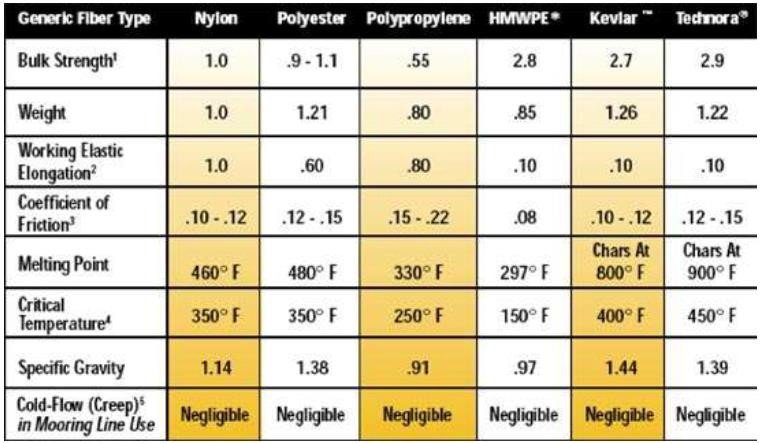
A number of newer synthetic material for ropes, such as Aramid fibres (Kevlar) offers high strength, low weight, low stretch, and flexibility and corrosion resistance. The main benefits of Aramid fibres are reduction of diameter and therefore weight of line required. This reduction is advantageous if winch drum size is limited whereas the reduction in weight makes handling substantially easier. The disadvantage of Aramid ropes are with regards to Bend radius and there is a need to sheath the fibres to guard against ultraviolet rays and mechanical wear. Damage to this outer sheath can result in rapid degradation of the core fibres.
A mooring wire is to be connected to the mooring tail by means of a shackle (Mandal – has a curved roller and the wire should be connected to it or Tonsberg – has a straight pin and the tail should be connected to it). In addition, the tail should be served with leather or plastic sheathing. Only one type of connecting shackle is permitted on board a vessel.
1.2 Material of Synthetic Rope
Nylon
Dry Nylon rope is slightly stronger than polyester rope. However, moisture reduces the strength of nylon fibre, and wet nylon rope has about the same strength as wet polyester. Wet nylon rope loses strength much faster under cyclic loading than polyester. Thus, a heavily used nylon rope will become weaker than a heavily used polyester rope of the same size. Nylon is more elastic than any other material. When broken in it will stretch 12% or more at MBL.
Polypropylene
Polypropylene rope has approximately the same elasticity as polyester rope but is significantly weaker than either polyester or nylon. Polypropylene has a low melting point and tends to fuse under high friction. It also has poor cyclic loading characteristics. Lastly prolonged exposure to the sun ultraviolet rays can cause polypropylene to disintegrate due to actinic degradation. Polypropylene is lighter than water and can be used for floating messenger line. Otherwise, the use of polypropylene for mooring is not permitted.
Polyethylene
Polyethylene is similar to polypropylene is appearance but is generally weaker and is less resistant to abrasion. It has about the same elasticity as polypropylene. Polyethylene rope is acceptable for floating messenger line provided they are constructed from top quality fibres.
High Modulus Fibre Moorings Lines (HM)
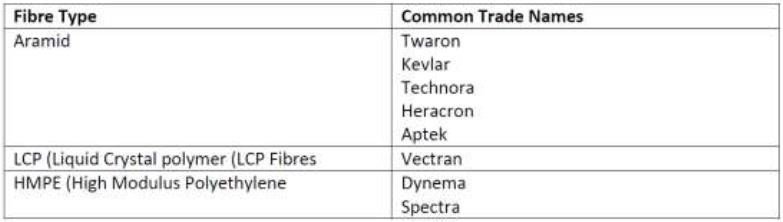
High Modulus (HM) Ropes have a strain of approximately 1% elongation at 30% of the breaking load, which is approximately the same as wire rope. Therefore, HM ropes present a much lower risk of “snap back” than conventional synthetic ropes. Nevertheless, when fitted with pennants “snap back” remains a hazard.
High modulus polyethylene is a fibre form of high density polyethylene. Amsteel Blue which is lighter than water thus it has a higher specific strength than Aramid. It has a relative low melt point. These lines which are urethane coated have a good resistance to ultraviolet degradation over time have excellent resistance to Ultra-violet light. It has tendency to creep and can rupture due to that property at sustained high loads. These fibres do not exhibit axial compression fatigue problems; it has a low coefficient of frictions and has very good abrasion resistance. Amsteel blue is also flexible, easy to handle and it floats.
Spectra Fibre
Spectra fibre is one of the world’s strongest and lightest fibres. A bright white polyethylene, it is ten times stronger than steel, more durable than polyester and has a specific strength that is 40 percent greater than aramid fibre. Spectra fibre is made from ultra-high molecular weight polyethylene. Light enough to float; it also exhibits high resistance to chemicals, water, and ultraviolet light. It has excellent vibration damping, flex fatigue and internal fibre-friction characteristics, and Spectra fibre’s low dielectric constant makes it virtually transparent to radar. Spectra fibre is hydrophobic; it will not absorb moisture or deteriorate in water.
Spectra fibre can be an ideal substitute for wire and steel in mooring lines for tankers, Complementing Spectra® fibre’s high strength is its extremely low elongation of just three percent. A rope with low-stretch properties provides greater sensitivity, allowing crew members to know what is happening on the other end of the line. Hawsers made with Spectra® fibres weigh only 2.75 lbs. per foot and have a diameter of only 3.5 inches. Therefore fewer crew are needed to handle the line, and it is easier for them to perform critical tasks without kindizing their health and safety.
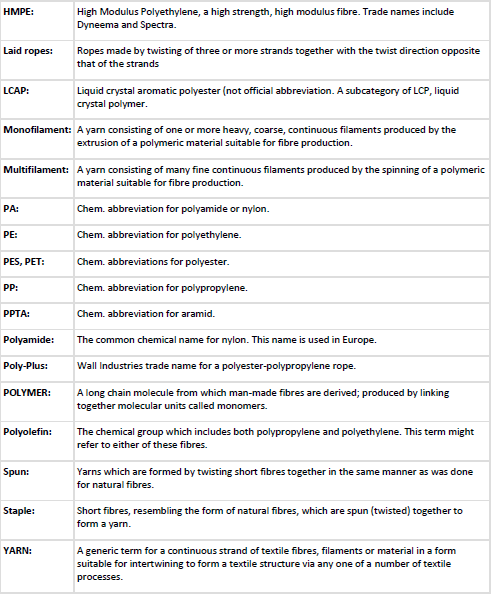
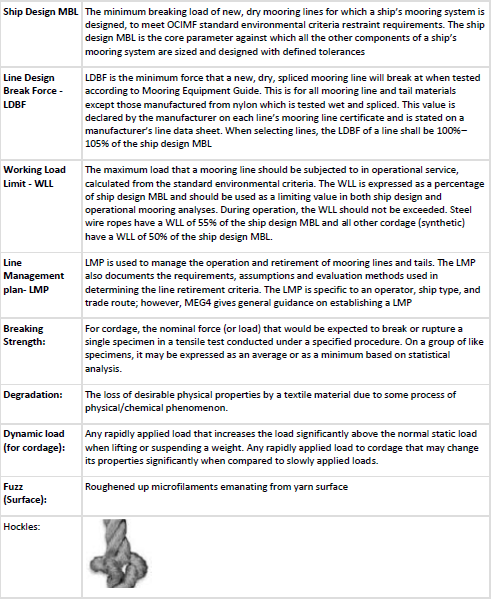
2 Glossary of Ropes: Material Terms and Trade Names
3 Care and Maintenance of Aramid Mooring Ropes (Kevlar)
Protect the fibres against ultraviolet rays and mechanical wear. Protect against damage to the outer sheath which could result in rapid degradation.
4 Care and Maintenance of HMPE Mooring Ropes (Amsteel Blue, Spectra)
Amsteel Blue mooring ropes do not require lubrication because it does not rust. Its flexibility and extreme light weight will allow for an easier, faster, and safer mooring sequence. When using these lines ensure the chocks and lead maintenance should be instituted to eliminate rough wearing surface, metal burrs and sharp cutting edges (localized grinding and surface preparation). To ensure best performance of the lines maintain bending radius recommendations and that all bending surfaces are smooth and free of abrasive and/or cutting edges. Inspect the winch drums for rust, corrosion, or scoring damage. These areas should be cleaned up so as not to cut and abrade these ropes. The maintenance of deck winches is important in the long term service life and performance of the rope. These lines are excellent resistance to ultra-violet light as they are urethane coated. Avoid metal friction for extended period of time and recommended to use of chafing gear in chocks between the metal and the rope. Inspect the line each time they are deployed or re-reeled. If you find melted or cut fibre further inspection is warranted.