| FOM 5.3 |
Fleet Operations Manual FOM Types of Moorings |
Doc No.: FOM 5.3
Revision: 01 Date: 15 Oct 2024 Issued by: DPA Approved by: MD |
5.3 General
(a) Vessels are to be securely moored and kept alongside during loading and discharging. Movement up and down the jetty can damage the shore loading arms and result in large-scale pollution.
(b) Holding a ship in position alongside a berth is the responsibility of the ship's staff. The best way to stay in position is by carefully planning and arranging the mooring layout when berthing in consultation with the pilot.
(c) Proper Pilot/Master Information Exchange should include factors like position adjustment alongside by mooring ropes only. The use of engines should be refrained. Lateral approach speed and Parallel berthing should be discussed considering the prevalent wind and current/tide. Another important factor must be to consider the Power of the Tugs.
(d) Master should not use Engines for final position adjustment and should do so with Mooring Ropes. However, in certain circumstances if required to use engines, extra vigilance should be maintained by entire bridge team and mooring team.
(e) Bow Thruster should only be operated by Master and this should be clearly advised during Master/Pilot Information Exchange
(f) Master shall ensure that all mooring personnel are trained and educated prior being involved in mooring operations through the process described in section 5.2.6 below.
(g) Mooring personnel is defined as the personnel tasked to assist in the activity of mooring and unmooring ships, either ashore or from mooring boats, carried out within the framework of port marine services.
5.3.1 Responsibility
(a) The Master has the overall responsibility to take any steps he considers necessary to protect the crew, the vessel, the cargo and the environment. He is also responsible for ensuring that the vessel is safely and securely moored and there is an effective deck watch to ensure compliance.
(b) Chief Officer shall be responsible to the Master for ensuring mooring equipment is well maintained and safe mooring practices are observed. He is also responsible for ensuring that an effective mooring attendance is organised and executed.
(c) Officer of the Deck Cargo Watch (OOW) shall be responsible for ensuring that the vessel is securely moored, operations are carried out in accordance with instructions issued by the chief officer and for preventing any type of pollution. He shall observe international, national and local rules and regulations.
(d) C/O will supervise forward station while 2/O is in-charge of aft station during the mooring operations. Master can make changes as and when required.
(e) In addition to above, as a minimum following manpower shall be available at each station during every mooring operation:
Forward: Bosun, OS 1, OS 2
Aft: AB (2), Pump man or Oiler
(f) The Officers in charge of mooring operations fore and aft have a duty to oversee their responsibilities and not get involved in the actual mechanics of rope handling and winch operation. They are the Master’s eyes and ears in remote locations and one of their prime duties is to keep the Master fully appraised of the current and developing situation as the mooring operation progresses. They are also responsible for the safety of operations and the personal safety of all personnel in their work area.
(g) If vessel calling a berth/terminal for first time, Master shall request information from all available sources such as Charterers, Terminal, Agents & Pilots regarding Mooring layout, fittings, depth, channel width, tidal ranges and passing traffic on berth and prepare RA for safe mooring and safely moored stay at berth.
(h) In addition to above (g), master should also consult Office beforehand for any specific info about the unfamiliar Port where the Vessel is likely to call. Port Information in the form of “BDP -05-06A” (or free form) may be available in the Company database, submitted by other fleet vessel having called to the same port in the past. Similarly, Charterers also has detailed information for ports around the world which shall be asked for, through the office.
(i) For gas carriers especially LNG, complete ship/shore compatibility exercise must be done by office and master shall be provided with all relevant info. For LNG ship/shore compatibility shall include mooring forces analysis optimizing no. of mooring and directions of moorings using Opti-moor software.
5.3.2 Planning
(a) Master and deck officers are to plan the mooring pattern at each berth and obtain the most efficient mooring that the ship's equipment and the layout of the berth allow.
(b) Tidal calculations should be carried out in advance for the vessel stay in port.
(c) JSA shall be conducted prior every mooring operation. Ship specific RA shall be made or reviewed prior to each mooring operation.
(d) Master shall ensure that all personnel involved are properly familiarized with mooring operations and equipment.
(e) All third-party personnel shall follow the instructions of Officer in-charge at each station. They shall be part of JSA meeting and shall be properly briefed with the hazards involved.
(f) Before starting operations, the officer assigned to mooring station shall conduct an onsite Toolbox talk with the mooring crew to discuss mooring requirements and safety as advised by the Master at the pre-arrival meeting.
5.3.3 Mooring Arrangements and Layout on Tankers
5.3.3.1 Ship to Ship Operation (STS)
(a) This can take place with the Mother vessel at the anchor or with both vessels underway or while one vessel at the berth. Specialized Pilots are required for this operation. The recommendations given in the STS transfer Guide must be strictly followed.
(b) Wind and sea situation must be very calm for such an operation. Both vessels must be ready to abort the operation at any time due to weather changes.
(c) During the mooring, both masters have to watch how the operation is conducted on the other vessel and advice if they are not satisfied.
(d) Since the mooring is very seldom helped by tug boats, the vessel’s engine is to be used, and the crew must be well aware of the possibility of sudden weight on the ropes. Extra ropes must be always ready to supplement/replace the mooring.
(e) The mooring is very similar to that of the vessel lying at a berth influenced by a wide range tide, since the relative freeboard between the two vessels vary considerably during the transfer.
(f) Since the timeliness of the operation is essential, at least 4 heaving lines are to be at hand on both stations, since most of the times the first one is thrown too early and seldom reaches the other vessel on the first instance, so no time must be lost due to the need of recover it to try again.
(g) The various STS Check List Forms must be completed accordingly.
(h) On tankers, reference to be made to STSOP Manual for detailed guidance.
5.3.3.2 Double Banking at Berth
(a) This operation involves one or more vessels mooring alongside a vessel that is already moored to a jetty and is a relatively common practice in certain trades. Before double banking at berth operation is agreed, consideration and agreement should be reached by all parties concerned on issues that may include the following:
- (i) Safe arrival and departure procedure.
- (ii) Integrity of the berth, including fender panels and mooring fittings, with regard to the potential loads involved.
- (iii) Personnel access, including emergency escape provisions for personnel on involved vessels.
- (iv) Roles and responsibilities of involved parties.
- (v) Contingency planning, fire-fighting and emergency un-berthing.
(b) The master of the vessel moored to the terminal should be aware of the total displacement of his vessel and vessels berthing alongside his vessel. The mooring arrangements should be adequate for the anticipated loads.
(c) Consideration should be given to the availability and need for the line handling support. The vessel alongside the terminal may provide crew to receive and secure the lines of the other vessel being double-banked but this should not detract the safety of any ongoing cargo operations.
(d) Local port regulations may require that licensed line handles are used and these should be arranged prior to commencement of manoeuvring.
5.3.3.3 Reverse Lightering Operation
(a) Reverse Lightering’, sometimes referred to as ‘topping-off’, is a vessel to vessel transfer operation in which a laden tanker, typically of Suezmax or Aframax size, is manoeuvred alongside a partially laden VLCC or ULCC in order to transfer cargo to the larger vessel. This differentiates the operation from conventional STS activities in which the manoeuvring vessel is typically in a ballast condition.
(b) In reverse lightering operations, the manoeuvring vessel is often fully laden and will therefore be more difficult to manoeuvre alongside in anything other than calm weather conditions. Primary fenders will commonly be rigged on the manoeuvring vessel and in planning the operation, it is prudent to err on the safe side when selecting fenders and to take account of the potential for increased berthing velocities and higher angles of approach when compare with conventional STS operations.
(c) The recommendations given in the STS transfer guide must be strictly followed.
5.3.3.4 Single Point Mooring (SPM)
(a) Single point mooring (SPM) is a floating buoy/jetty anchored offshore to allow handling of liquid cargo such as petroleum products for tankers. SPM is mainly used in areas where a dedicated facility for loading or unloading liquid cargo is not available. Located at several kilometres from the shore-facility and connected using sub-sea and sub-oil pipelines. These single point mooring (SPM) facilities can handle vessels of large capacity such as VLCC’s.
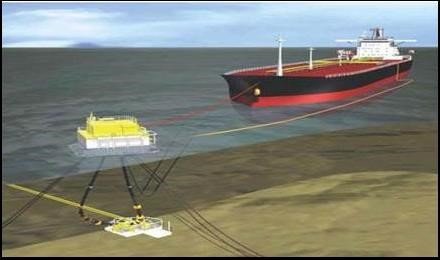
(b) Mooring at Single Point Mooring (SPM) berths, although a relatively straightforward operation can still be a hazardous task and as such planning and contingencies are vital to ensure a safe and successful operation. The highest standards of seamanship are required on the part of the Master and his staff.
(c) Prior to mooring at an SPM all personnel to be involved should be fully briefed as to the method and hazards of the operation. During the briefing the following should be discussed:
- (i) the number and location of personnel to be involved in the operation
- (ii) the equipment to be used and its method of operation
- (iii) safety issues that include, but are not limited to:
- Tension in ropes (intentional or otherwise).
- Any terminal supplied equipment that may be in a questionable condition.
- Rope/wire handling.
- Correct application of stoppers to ropes/wires where required
- PPE
- Prevailing weather conditions
- Wet and slippery decks.
- Pressure from the terminal to complete operations quickly
(d) Before undertaking the operation ensure that all necessary equipment is standing by and in good condition. This equipment should include:
- (i) Stoppers
- (ii) Messengers
- (iii) Shackles
- (iv) Sledgehammer
- (v) Large axe
- (vi) Grease pot
- (vii) Crowbar
(e) Additionally, prior to arriving at the SPM, the winches and tongue stoppers should be checked to ensure they are in an operational condition.
(f) Normally the operation is supervised by a mooring assistant stationed on the bow. He is to be accompanied by a responsible officer who should be in radio contact with the bridge ready to pass on the Master’s instructions.
(g) Whenever possible, the messenger should be led straight to a winch reel and acute angles of lead should be avoided. If circumstances, such as vessel design, so dictate, the messenger may be recovered by heaving on the winch drum end. The Master must be satisfied that everyone engaged in this operation is fully briefed and aware of all potential hazards.
(h) While moored at an SPM, a forecastle watch is to be maintained to monitor distance and relative direction to the mooring buoy, as well as the weight on the mooring system. In the event of a terminal watchkeeper maintaining this watch on the forecastle, it shall be ensured that the Officer of the Watch is included in any communications from the forecastle. In case of difficulties due to language barriers, watch on the forecastle will be supplemented by vessel crew who will communicate directly with the OOW.
(i) It is advisable to have the pullback tug in attendance. The pullback tug might be casted off, before the vessel casts off the SPM. Ensure that the tug’s line is clear of the propeller before using main engines. Do not try out the engines without Pilot /Mooring Master’s consent.
(j) After disconnection and lowering of hose into water, keep them clear of the vessel’s propeller and manoeuvring zone using support boat or a tug. Keep both the wheelhouse doors open during these critical manoeuvres.
(k) While falling astern of the SPM, the forecastle crew must keep slacking the pickup rope. Do not overstress the rope. Manoeuvre the vessel clear from the SPM.
(l) Monitor the position of hoses and mooring hawser until the vessel is well clear. If Master deems it is unsafe to carry out the operation, abort the operation and immediately inform office.
5.3.3.5 Tandem Mooring to FPSO
(a) This operation is similar to Single Point Mooring. In this case, instead of a buoy, vessel is moored to another vessel in Tandem using similar chain what is used for Single Point Mooring.
(b) All precautions for this operation are similar to what are required for SPM operation. In this operation, generally there is no mooring assistant available at the Bow and a responsible officer is stationed at the stern of FPSO who remains in contact with the Pilot for safe approach and mooring operation.
5.3.3.6 Conventional Buoy Mooring (CBM)
(a) A conventional buoy mooring (CBM) system includes multiple buoys that are fixed to the seabed by means of mooring lines and marine anchors. The three to six buoys are permanently installed in a rectangular pattern that allows safe mooring of a vessel which is positioned between the buoys with tug assistance.
(b) The buoys provide the strong points to which the vessel’s on-board mooring lines can be attached. In some terminals both ships anchors are used to hold the bow in position along with use of mooring lines to buoys.
(c) For tankers CBM berths are combined with a fluid transfer system that enables connection of (subsea) pipelines to the midship manifold of the tanker. When no tanker is moored, the submersible hose or hoses are stored on the seabed.
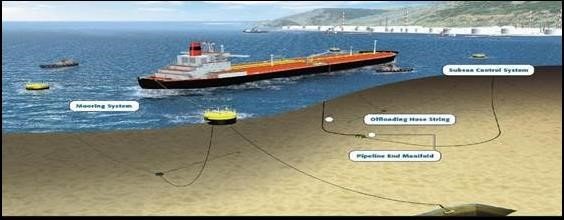
(d) Mooring at a CBM can be complicated and a hazardous operation. Great care must be taken in planning the operation, taking in to account the contingencies. A very high standard of seamanship skills is required on the part of the Master, Pilot and ship’s crew.
(e) All crew must turn out for the berthing operation. There should be no other secondary jobs designated during this period (like manifold blank removal, fixing of reducers, rigging of gangway etc.). The required number of personnel in mooring gang at the aft station will be more as most of the heavy work will be done here. Additionally, consideration should be given to place Chief Officer at the aft station where more experience will be required.
(f) The exact position where the anchor is to be dropped should be clear and be known to all members of the Bridge Team. To high light the critical stage of the first anchoring, there should be verbal countdown (50 meters to go, 40 meters to go.) to letting go anchor.
(g) The crew responsible for the dropping of the anchor should be alert and kept fully advised on the approach and if any time lag is anticipated in the anchor being released this should be factored in to the time taken to drop the anchor after that order is given.
(h) Considering the prevailing wind and current directions a contingency plan must be in place to safely extricate the vessel from the berth if the anchors are misplaced such that she cannot be aligned properly, and the mooring operation must be aborted.
(i) On deck the Officers in charge of the ship’s mooring crews fore and aft will remain so even where terminals provide mooring gangs of their own (to ‘assist’ the ship’s crew) along with their associated ‘Shore Bosun’. These personnel should be advisers only and should take no part in rope handling or winch operations unless manpower resources make it necessary. In any event, they should not be allowed any decision-making responsibilities and act only on the orders of the officer in charge. By delivering a short briefing to shore personnel on safety expectations the authority of the Officer in charge should be established from the outset.
(j) Safety issues with CBM work are manyfold, and the following issues should be discussed with all personnel involved at a pre-mooring briefing:
- (i) Tension in ropes (intentional or otherwise)
- (ii) Poor tug handling and condition of towing hawsers
- (iii) Condition of any terminal supplied equipment that may not be in the best condition of its life.
- (iv) Rope/wire handling.
- (v) Correct stoppering off ropes/wires where required.
- (vi) Wet and slippery decks.
- (vii) Pressure from the terminal to complete operations quickly prevailing weather conditions.
5.3.3.7 CAVOTEC (Automated Mooring System used at a few terminals for Mooring Container and Bulk Carrier)
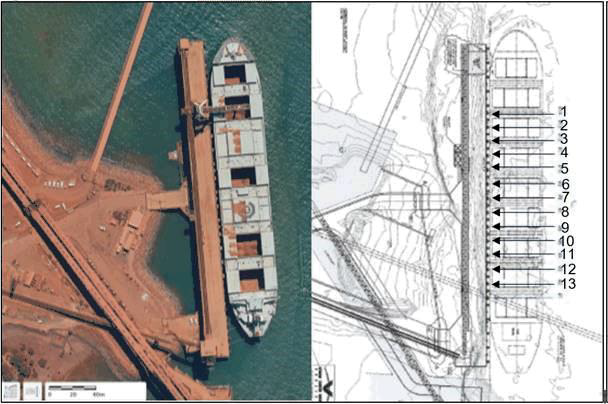
(a) Automated mooring eliminates the need for mooring lines with automated vacuum pads that moor and release vessels in seconds at the push of a button.
(b) Many Australian ports use this technology for making fast Bulk Carriers and containers such as Port Hedland.
(c) The advantages of the system are:
- (i) Faster turnaround times in port.
- (ii) Reduced energy consumption and emission from tugs and vessels thrusters.
- (iii) More than 90% reduction in emissions during ship berthing due to reduced use of tugs and ship engines.
- (iv) Reduces risk of mooring accidents and personnel do not need to perform hard manual labor in hazardous areas.
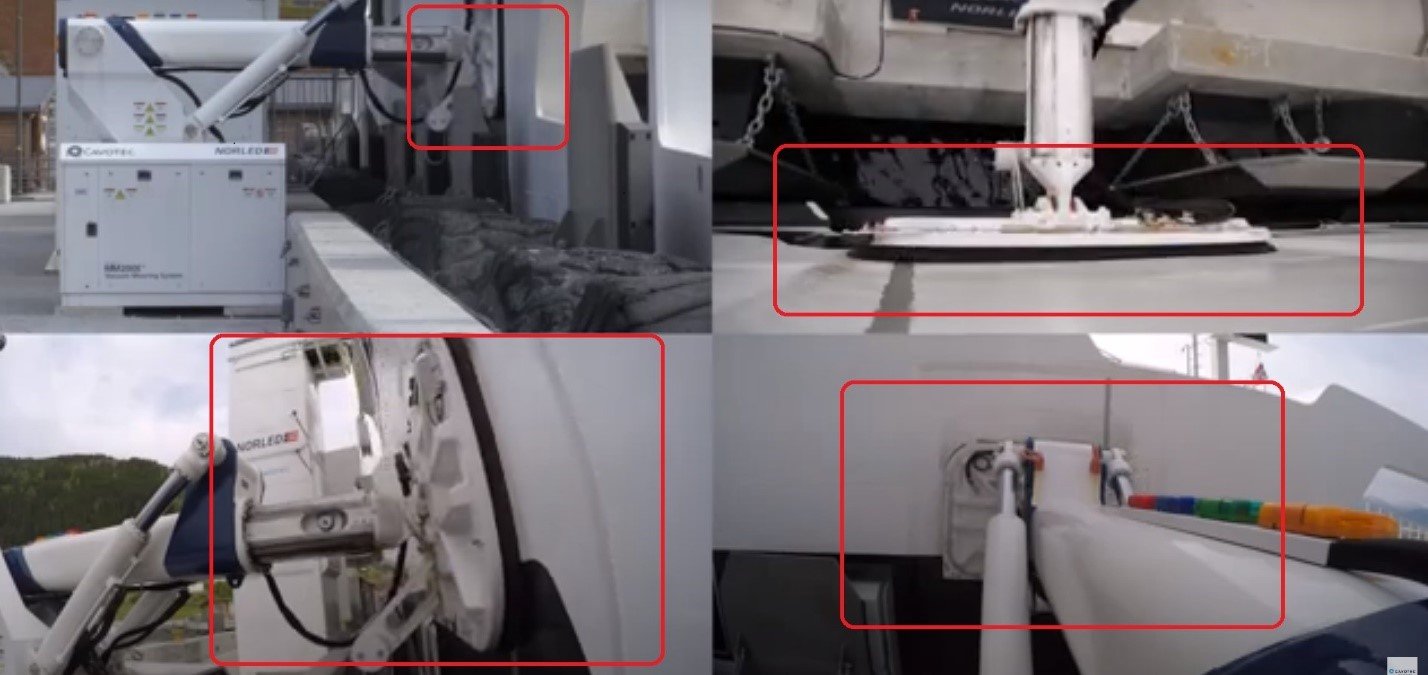
(d) The hull suitability requirements are:
- (i) Vessel hull must be free from all barnacles, marine growth, rust scale, flaking paint and salt build-up.
- (ii) Scuppers, tug push points and deck drains should not have a protruding lip surface.
- (iii) Welds and hull patch repairs must be no greater than 10mm in depth.
- (iv) Hull dents or deformations must be no greater than 20mm in depth and are not to exceed 1m of hull length.
(e) The vessel stability requirements during loading are:
- (i) Maximum vessel Bow / Stern trim + or – 5 metres.
- (ii) Maximum vessel Port / Starboard list no greater than 2 degrees.
- (iii) Vessel de-ballast systems are adequate to maintain efficient loading rates for the product being loaded.
(f) The requirements when the vessel is alongside are:
- (i) The Hatch covers are not to protrude beyond the vessel handrails at any time.
- (ii) The Razor wire or similar piracy boarding prevention devices must be removed before berthing.
- (iii) Vessel engines are not to be tested when alongside without a Pilot on-board.
- (iv) The Main engine immobilisation is not permitted when alongside such Berth.
(g) Additional a few mooring lines are deployed in such ports. They are called “Comfort Lines”.
(h) All the information must be completed during the Master-Pilot information exchange and additional precautions if required for the safe mooring must be adhered to.
(i) Additional restrictions may be stated by the port related to deballasting operations, berthing side, draft and trim during berthing which must be confirmed with the Port in advance.
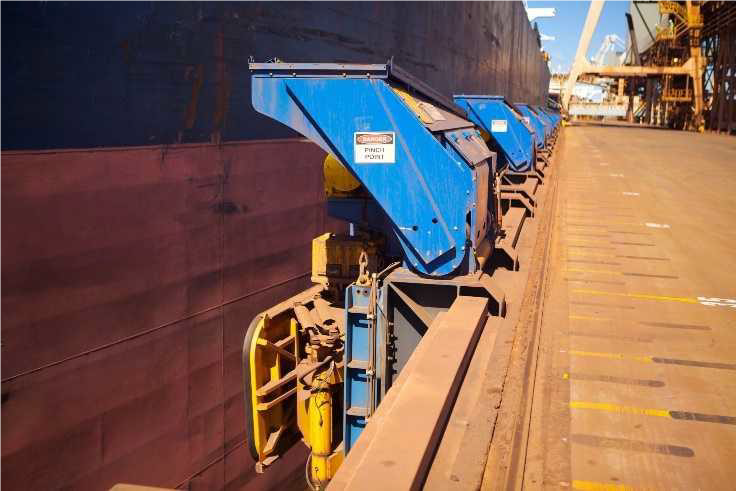
5.3.4 Tending Moorings
(a) When tending moorings that have become slack or too taut, an overall view of the mooring system should be taken so that the tightening or slackening of individual moorings does not allow the vessel to move or place undue stress onto other moorings.
(b) The vessel should maintain contact with the jetty fenders, and moorings should not be slackened if the vessel is lying off the fenders.
(c) The following should be considered when tending moorings;
- (i) Significant increase in wind speed or change in wind direction, particularly if the vessel is lightly laden;
- (ii) Swell conditions;
- (iii) Periods of maximum tidal flow;
- (iv) Low under Keel clearance;
- (v) The close passing of other ships.
(d) All ordinary precautions taken during berthing and cargo handling operations alongside a jetty also apply for a vessel at a buoy mooring.
Additionally, for Tankers only
a) While the tanker is at a multi buoy mooring, frequent and regular inspection is essential to ensure that mooring lines are kept taut and that movement of the vessel is kept to a minimum. Excessive movement may cause rupture of the cargo connections.
b) At single point moorings a watch keeper shall always be kept stationed at the forecastle to report any failure or imminent failure of moorings or leakage of oil. He should also report immediately if the tanker "rides up" to the buoy. He should be equipped with appropriate means to communicate with the OOW.
c) The Officer of Watch shall be contacted, and the position of the buoy and weight on the chafe chain shall be reported every 30 minutes. In case the buoy chain becomes too slack or coming to sharp angles in relation to the bow, same to be immediately reported to the CCR (Mooring Master) and appropriate actions to be taken. This information is usually discussed in the cargo meeting and pictorial lay is usually posted in CCR and on the forecastle.
d) Rigging of towing off wires while in port must be discussed in the pre-loading / discharging meeting. An entry of towing wires rigging shall be made in deck logbook if it is decided to rig the towing off wire. When alongside a jetty the wires should be over the offshore side, and for tankers at a buoy mooring they should be placed on the side opposite to the hose strings.
e) To provide enough wire paying out thus enabling the tugs to tow effectively, enough slack should be retained between bollard and chock and prevented from running out by a rope yarn or other easily broken means.