| FOM 5.5 |
Fleet Operations Manual FOM Wire Rope Integrity Management Plan |
Doc No.: FOM 5.5
Revision: 01 Date: 15 Oct 2024 Issued by: DPA Approved by: MD |
1. Introduction
This Wire Rope Integrity Management Plan (WRIMP) extends guidance to the vessel staff on board vessels managed by Company and the office staff for ensuring that load bearing steel wire ropes, used on various equipment and systems on board, are always maintained in safe condition.
The document covers essential information on how condition of steel wire ropes should be appropriately controlled at various stages of engagement on board. For this, advice is provided on following aspects in different chapters:
- Chapter 2: Documentation
- Chapter 3: Ordering / Procurement
- Chapter 4: Storage
- Chapter 5: Installation
- Chapter 6: Maintenance
- Chapter 7: Assessment & discard criteria
Note:
Implemented the plan results in the vessel having a Wire Rope Integrity Management System (WRIMS)
2. Documents
Note:
For robust management of wire rope integrity (ensuring sound condition of each wire rope for all applications), from selection to final discard, through-life documentation is essential.
2.1 Documents to be maintained on board
This includes standard guideline on following aspects with regards to wire ropes for different applications:
- Ordering
- Storage & preservation
- Installation
- Maintenance – inspection & lubrication
- Discarding / renewal
- Record keeping
2.1.1 Wire rope specification and inspection record (MR-02)
MR-02 Mooring equipment and wire rope tails inspection record should be filled to track the details of the wire rope in use or in storage.
The form is formulated to maintain following information:
- All duties where wire ropes are used, with specifications of each wire rope
- Details of PO no., date of procurement, date of renewal (date fitted), supplier, certificate no. etc
- Observations from inspection (monthly inspections as well as thorough examination) of wire ropes, with information on damages noted
Following should be noted regarding frequency of making entries into the MR-02 form 67M:
- When a wire rope is inducted into service, this document should be initiated.
- Updated periodically over the life of the wire rope (till it is discarded) with information from inspections
- When a wire rope is discarded, its record should be replaced with the information on new wire rope being installed
- Updated MR-02 form 67M should be sent to office monthly
2.1.2 Wire rope certificates
Copy of certificate of each wire rope (in use or in storage) should be filed
2.1.3 Wire rope delivery notes
Copies of the delivery notes of each wire rope (in use or in storage) should be filed
2.1.4 Vessel specific procedure for inspection of wire ropes
- A procedure for thorough examination of wire rope should be prepared and retained for each application
- This procedure should be revised, whenever a need is identified
- Guidelines for thorough examination are provided in the chapter “Maintenance” of Wire Rope Integrity Management Plan
2.2 Events involving documentation
2.2.1 Event: New Vessel in Management or WRIMS first implemented
Relevant documentation:
- WRIMP to be started
- MR-02 to be filled
- Certificates of each wire rope to be filed
- Delivery notes of each wire rope to be filed
- Wire rope thorough examination to be done and records to be maintained in MR-02
2.2.2 Event: A new wire rope is received on board
Relevant documentation:
- MR-02 to be updated
- Certificate of wire rope to be filed
- Delivery note of wire rope to be filed
2.2.3 Event: Wire rope is renewed
Relevant documentation:
- MR-02 should be filled up with record of first examination, to replace the record of the wire rope being discarded.
2.2.4 Event: Thorough investigation of wire rope condition - periodical or incidental
Relevant documentation:
- MR-02 form to be filled / updated
Note:
Inspection during installation should be carried out.
2.2.5 Event: A new equipment with wire rope installed or any modifications carried out to design of existing equipment
Relevant documentation:
- MR-02 form to be updated
- Certificate of wire rope (new / modified application) to be filed
- Delivery Note of wire rope (new / modified application) to be filed
3. Ordering and Payment
3.1 Requisition
Requisition for a wire rope must be raised by the vessel, at least 3 months prior the intended or expected date of renewal.
All design aspects of the requested wires, i.e. material, strength, construction etc., should conform to specifications in certificate of original wire rope / maker’s manual. Maximum information from the certificate should be included in the specifications under the requisition. Following should be indicated as a minimum in the specifications:
- Application
- Equipment details (Make, Model etc.)
- Material
- Nominal diameter
- Length
- Minimum breaking force
- Rope construction (No. of strands and no. of wires / strand)
- Rope core type
- Direction of lay
- Type of lay
- Wire rope termination (Should be in accordance with makers’ or regulatory specifications)
3.2 Procurement
Wire ropes should be procured from either of the following sources:
- Directly from equipment maker
- Authorised agents of the equipment maker
- Standard / reliable vendors identified by Purchasing Department of company Group
3.2.1 Additional guidance
- Certificate for the wire rope should be provided along with the supplied rope
- In case there are any doubts regarding the suitability of the offered or supplied wire rope, or in case the wire rope of exact specifications (as ordered) is not available, equipment maker should be consulted for confirming suitability of the available / offered rope, before confirmation of order
3.3 Receiving on board
On receipt of the new wire rope, following should be carried out:
- Delivered rope should be visually checked to conform to the specifications in the requisition
- Wire rope certificate should be checked to conform to order specifications
- In case of any discrepancies / defects, Vessel Manager and Purchaser should be informed
- Wire rope should be stored in a suitable location (refer to the chapter “Storage and Preservation”)
- Entry should be made into MR-02 form
- Copies of certificate and delivery note of the supplied wire rope should be filed
4. Storage
4.1 Storage & preservation guidelines
Storage is a vital part of preservation and the following should be ensured:
- Wire ropes to be stored in a clean, dry and well ventilated place
- Storage should be away from excessively high temperatures (which can dry the wire rope lubricant)
- Storage should be away from any effects of welding / fabrication activities, chemicals, chemical fumes, steam or other corrosives, that have potential to cause damage to the stored wire rope
- Where open storage is inevitable, a waterproof covering should be arranged, using a breathable fabric to avoid humidity/condensation problems. The covering should prevent water ingress but should allow an airflow around the wire rope
- If advised by manufacturers, suitable protective dressings (and compatible with the lubricant used) should be used for storage purpose
- Periodic outer layer checks should be conducted to establish that no significant deterioration has occurred
- Stock should be controlled to facilitate the use of the oldest wire rope first
- Details of location, period, preservation and conditions of storage should be recorded on the wire rope’s documentation and should be maintained until the wire rope has been retired from service
5. Installation
5.1 Preparation for wire rope installation
- Carry out thorough risk assessment
- Refer to manufacturer’s procedures to ensure that the wire rope is installed correctly and safely in all respects, without getting damaged
5.2 Checks on wire rope prior installation
- Check wire rope certificate to ensure that the rope is in accordance with that ordered
- After removing from storage, thoroughly examine wire rope to be free from defects
- Start MR-02 Form - record of inspection during installation to be entered as the first entry in the running record of wire rope inspection
- Thoroughly clean any protective coating (like wax coating) that is likely to obstruct effective lubrication of the wire rope
5.3 Cutting of wire rope
- If the wire rope has to be cut, apply secure servings to each side of the cut location (to prevent the rope from untwisting or distortion)
- Follow manufacturer’s instructions (if any) with regard to servings
- Apply the number of servings suitable for the type of wire rope - If the wire rope is rotation resistant or non-preformed, multi–layer or parallel closed type, at least two servings either side of the cut will be necessary
- Length of serving on each side should be minimum twice the nominal diameter
- High speed abrasive disc cutters or specialised wire rope cutters should be used. Flame cutting is not recommended unless the wire rope is being discarded
- Ensure proper safety precautions are followed:
- Secure the wire rope to cater for sudden movement by the two parts of the wire rope when cut
- Use appropriate PPE for protection against danger from sparks, disc break-up, dust, fumes (fumes from lubricants can be toxic) or heated lubricant that may emanate
- Ensure adequate ventilation to avoid build-up of fumes - Avoid cutting in confined spaces
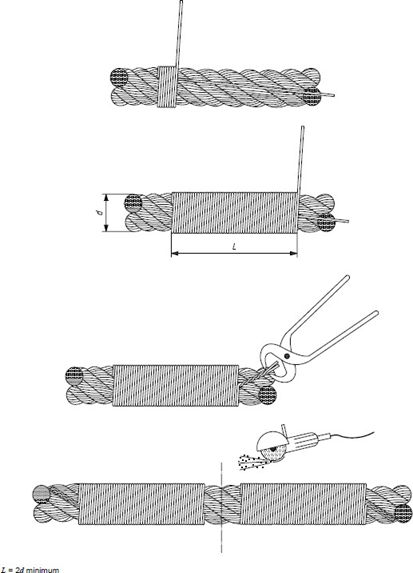
Figure 1. Application of servings prior cutting of wire rope

Figure 2. Wire Rope Cutter
5.4 Checks on crane / davit prior installation
- Examine the working drum for wear and damage
- Check suitability of the groove contour to ensure that the wire rope specified at order stage is appropriate. Any discrepancies should be immediately recorded and notified
- Inspect all sheaves and rollers to ensure good condition and ease of rotation
5.5 Terminations prior Reeving
- Secure the ends of the rope at the drum and outboard anchorages - Follow manufacturer's instructions for securing
- If the wire rope reeving operation requires to pull the wire rope through, with the use of another wire rope (messenger rope), take care about following points:
- Remove any turns / torsion inadvertently induced (by the messenger rope) in the new wire rope, before it is secured to the drum – This is highly probable if the old wire rope is used as the messenger rope
- Rotation of the messenger wire rope should be avoided. Rotation resistant wire rope or three-strand fibre ropes may be more suited to this task
- Confirm that the connection between the two wire ropes is adequately strong to withstand the induced forces and directional changes, e.g. while turning through the sheaves or bending around any rollers
- Confirm that the connection is correctly sized and shaped to pass through all the throats and other possible choke points in the system
- Wire rope socks (‘chinese fingers’/‘snakes’) can be used to connect wire ropes. Great care should be taken when any such attachment method is utilised
- Use of a swivel connection is not advisable as it may induce the wire rope to unwind. It is essential that the correct manufacturer’s instructions are followed at all times
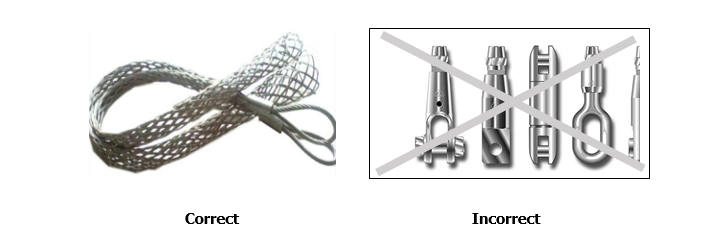
Figure 3. Means of connection between new wire rope and messenger rope (Incorrect)
5.6 Reeving operation during wire rope installation
- Thoroughly lubricate the wire rope
- Protect the rope from damages (rubbing against any part of the crane or hoist during installation)
- Ensure that wire rope is kept clean (clear of dirt and grit) during installation
- Prevent kinking and subsequent damage to the wire rope
- Spool the wire rope on to the drum in a controlled manner, constantly checking the condition, as it is spooled:
- Ensure that wire rope is paid out within specified fleet angles
- Apply appropriate back tension to maintain uniform reeling on to the drum
- The wire rope should travel from top of reel to top of drum or from bottom of reel to bottom of drum to avoid reverse bending and putting a twist in the wire rope
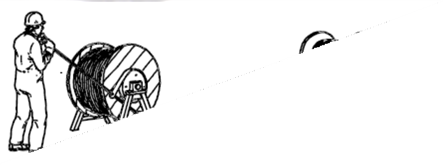
Figure 4. Example of transfer of wire rope from bottom of reel to bottom of drum with control of rope tension
- Ensure wire rope is not loose or unevenly wound while spooling on to the drum, else it will be subject to crushing and distortion.
- Ensure correct direction of coiling:
- From left or right side depending on the lay of the wire rope
- Under or over the barrel as per design / original construction
- On a multi-layer drum, ensure that the direction of coiling is reversed at every subsequent layer
5.7 Checks after installation
- After the wire rope is installed, before bringing the rope into full operation, check all alarms, cut outs and control & indicating devices associated with the operation of the equipment to ensure that these are correctly functioning
- Check for manufacturer’s instructions for precautions and procedure for operation after wire rope renewal. Comply accordingly
- Prior to use, run through equipment’s cycle under a load of approximately 10% of SWL (unless otherwise specified by the manufacturer) at least once to remove residual turns
During the post-installation period of a week, during which the wire rope is settling in, systematic inspection should be performed on a daily basis.

Figure 5. Post-installation inspection
6. Maintenance
6.1 Maintenance frequency
Maintenance of wire ropes should involve lubrication and inspection of wire ropes (and any required follow up action) at intervals / instances described in following sections (6.1.1 to 6.1.4).
6.1.1 Pre-use inspection
Depending on the frequency of usage of wire rope / equipment, operator to carry out visual check of wire rope to detect general deterioration and deformation.
- All visible parts of a wire rope, to be visually checked to the maximum extent possible
- If damage / deterioration is detected:
- A competent person should examine the wire rope
- Report the damage and update MR-02 Form
- Assess wire rope condition against discard criteria specified in chapter “Assessment / Guidance on Discard”
- Renew wire rope if damaged / deformed beyond acceptable limits
Note:
Chief Officer is the competent person to carry out inspection & maintenance of mooring equipment and fittings under the supervision of Master / Chief Engineer.
6.1.2 Monthly inspection and lubrication
A competent person should perform monthly inspection of wire rope condition
- Closely inspect all visible and accessible parts of the wire rope
- Apply recommended lubricant grade on all visible and accessible parts of wire rope - particularly on those lengths which pass through and around sheaves or enter and exit the drum or are used subsea
- If deterioration is detected
- Report the damage and update MR-02 form
- Assess wire rope condition against discard criteria specified in chapter “Assessment / guidance on discard”
- Renew wire rope if damaged / deformed beyond acceptable limits
6.1.3 Biannual inspection (thorough examination) and lubrication
A competent person should perform thorough examination of the wire rope, every six months. Vessel to prepare a ship specific procedure for this, for each application (each wire rope on all equipment), for ready reference.
- Appropriate risk assessments should be carried out prior proceeding
- Refer to relevant vessel specific procedure for thorough examination of wire rope
- Slacken wire rope to allow access to generally inaccessible parts (around the sheaves / blocks)
- Clean wire rope of all dust / sand / salt accumulations
- Carry out thorough examination and lubrication of at least the full working length plus three wraps of the wire rope (including hook end termination)
- Identify those areas of wire rope showing significant / maximum deterioration and assess for the severity of deterioration and follow up action (refer to the chapter “Assessment / guidance on discard”)
- Apply lubricant of recommended type by appropriate means (Refer to the section “Lubrication”)
6.1.4 Incidental inspection
An inspection should be carried out immediately after an overload or any incident which may have caused significant damage to a wire rope. The results of the inspection may identify the need for a thorough examination by a competent person
6.2 Review of inspection and lubrication intervals
Based on following considerations, the inspection intervals may be reduced (frequency of inspection increased) from those recommended above:
- Maker’s recommendations / guidelines
- Environmental conditions in which the equipment functions
- Frequency of usage / operating cycle
- Availability of access to entire wire rope length for effective inspection and lubrication – If difficulty in accessibility is preventing effective application of lubricant along entire wire rope length, frequency of visual inspections should be increased
- Results of previous inspections and thorough examinations
- Experience with previous wire ropes on the appliance or system
Note:
This guidance does not cover aspects of the maintenance of winch machinery, control systems, sheaves, swivels, and rollers or any other mechanical equipment or plant and other components of the wire rope system, but clearly their maintenance will affect the wire rope’s safety and service life. For such issues, maker’s guidelines or vessel’s PMS should be adhered to.
6.3 Lubrication
Besides carrying out lubrication along with the inspection routines, wire rope should be checked for lack of or unexpected deterioration of lubrication.
If any area shows such signs, it should be re-lubricated, and also subjected to investigation. Cause of deterioration should be determined, rectified and information recorded, along with all relevant details in MR-02 Form.
Frequency:
- Thorough greasing of the mooring wires every 3 monthly.
- Mooring wire ropes should be greased using high pressure greasing equipment at least once every six months.
Note:
Special attention to be paid over the outer 100 mtrs. of the wire, where the grease is lost during mooring operations or from being immersed in water.
Lubricant Grade
The rope dressing shall be compatible with the original lubricant applied by the rope manufacturer and shall have penetrating characteristics.
If the type of rope dressing is not identified in the equipment manual, guidance should be sought from the supplier of the rope or the wire rope manufacturer.
Lubrication method
Manufacturer’s recommendations regarding lubrication method should be referred to.
When pressure lubrication is not practicable or recommended, other methods should be used, such as spreading or brushing penetrating lubricant.
If pressure lubrication is the adopted means, it should be carried out with care, by operators trained in using the equipment.
Note:
During lubrication special attention to be given to the wire eye section which is under the mooring shackle.
6.4 Wire rope repair
6.4.1 Shortening
In certain cases of localised rope damage, it may be decided to continue using the wire rope after shortening and refitting of terminal fittings. However following conditions should be satisfied:
- Remaining rope length is in serviceable condition – The rope should be thoroughly examined after removal from the drum, and ascertained to be in acceptable condition (Refer to chapter “Assessment / Guidance on discard”)
- Remaining rope is of adequate length, i.e. deformation or damage (broken wires) are close to or at the termination, but the rope is unaffected elsewhere along its length. It should be ensured that the required minimum number of wraps would remain on the drum with the equipment at its most extreme operating limit
- Terminations (end splicing) can be retained in accordance with manufacturer’s recommendations (complying with regulatory requirements)
- If wire ropes are shortened or removed from drums for maintenance or testing purposes, while re-installation, all the relevant guidelines under the chapter “Installation” should be carefully followed. Thus, due attention should be paid to correct preparation, checks (prior, post and during installation), cutting, terminations and reeving as advised in the chapter “Installation”
6.4.2 Removal of protruding broken wire
- A broken wire may be removed if it protrudes excessively, overlies other wires and it can cause localised deterioration when that portion travels through a sheave
- It may be removed by gripping the protruding end(s) and bending the wire backwards and forwards (see Figure 7), until it eventually breaks in the valley position between the strands
- Number of removed broken wires should be recorded in the MR-02 form - along with other relevant information

Figure 7. Removal of protruding broken wire
6.4.3 Mooring Wire end to end changing and renewal of eye
- Wires to be turned end to end every 2.5 years
- Every docking (i.e. 5 yearly) on both ends of the mooring wire old eye to be cut off and new eye to be mechanically spliced.
7. Assessment / Guidance on Discard
7.1 Time based renewal
Renewal of wire ropes is recommended at following intervals, for respective applications:
| Application | Maximum renewal interval |
|---|---|
| Gangway / Accommodation Ladder | 12 months (1 year) |
| Davits for Life boats, Rescue Boats, Fast Rescue Boats and Life Rafts | 30 months (2.5 years) |
| Deck Cranes - Provision, Hose Handling, Cargo* | 30 months (2.5 years) |
| Engine Room Cranes | 60 months (5 years) |
| Mooring Wire Hawsers | 120 months (10 years) |
| Mooring Wire Tails | 18 months (1.5 years) |
*For cargo cranes, the renewal interval for wire ropes may be extended to a period in accordance with the maker’s guidelines.
For such an extension, the vessel should maintain appropriate supporting documents demonstrating following:
- A thorough examination is being carried out following maker’s guidelines or the sections 7.3 ‘Assessment criteria’, 7.4 ‘Evaluation process’ and 7.5 ‘Discard Guidance’ of this document (FOM 5.5 ‘Wire rope integrity management plan’)
- Periodicity of thorough inspection is followed in accordance with maker’s guidelines or the section 6.1 ‘Maintenance Frequency’ of this document (FOM 5.5 ‘Wire rope integrity management plan’)
Note:
Renewal interval should be shortened if manufacturer’s recommendations advise so.
Renewal should be carried out earlier, based on routine examination, if deterioration / damages are beyond acceptance criteria.
7.2 Purpose for periodic examination
Periodic inspections shall be carried out by a competent person, as advised under the chapter “Maintenance”.
The information gained from a periodic inspection is used to assist in deciding on following:
- Whether the wire rope can safely remain in service
- When wire rope shall undergo its next periodic inspection
- When wire rope should be discarded - whether immediately or within a specified timeframe
7.3 Assessment criteria
Common modes of deterioration for which a wire rope should be assessed and assessment methods to be used during a thorough examination are listed below:
| Mode of deterioration | Assessment method |
|---|---|
| Change in diameter (Area of X-section) | |
| Decrease in rope diameter | By measurement |
| Increase in rope diameter | By measurement |
| Breakage of wires / strands | |
| Number of visible broken wires | By counting |
| Fracture of strand(s) | Visual |
| Corrosion (external, internal and fretting) | |
| External corrosion | Visual |
| Internal corrosion | Visual |
| Fretting corrosion | Visual |
| Deformation | |
| Protrusion, Kinking, Flattening | Visual |
| Waviness | By measurement |
7.4 Evaluation Process
Following is the methodology recommended to be used by a competent person during a thorough examination:
- Identify those areas of wire rope showing significant / maximum deterioration on the criteria listed above
- For each identified location showing significant damage:
- Evaluate the condition w.r.t. each of the four main deterioration modes, and assign / estimate severity level for each mode as one of the six percentage levels aptly – 0%, 20%, 40%, 60%, 80% or 100%
- For each location, following four severity levels are thus obtained:
- Severity of Area of X-section / diameter change (Severity A)
- Severity of Breakage of wires / strands (Severity B)
- Severity of Corrosion (Severity C)
- Severity of Deformation (Severity D)
- Add severity level identified for each deterioration mode (for respective location) to obtain cumulative severity of the damages at that location:
Cumulative Severity = Severity A + Severity B + Severity C + Severity D
- From all the identified locations estimated for severity of deterioration, choose the one with maximum Cumulative Severity level for decision on discarding or revision of examination interval / frequency
- Enter the observations from thorough inspection into the MR-02 Form - for the concerned wire rope
7.5 Discard Guidance
Take following actions corresponding to the maximum Cumulative Severity level:
| Maximum Cumulative Severity of Deterioration | Action |
|---|---|
| 0%, 20%, 40% or 60% | Continue with existing time period (Bi-Annually) for thorough examination |
| 80% | Plan for renewal of wire rope at next suitable opportunity. Reduce time period for thorough examination from Bi-Annual to quarterly |
| 100% | Discard / renew wire rope immediately. |
8. Assessment Criterion – Change in Diameter
8.1 Measurement
Measure wire rope diameter using a calliper placed across the crest of the diametrically opposite strands, as shown in the figure below:
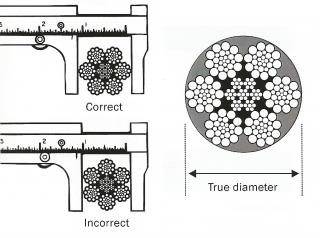
Figure 8. Correct method of measurement of wire rope diameter
8.2 Calculation of reduction in rope diameter
Actual uniform decrease in diameter expressed as a per cent of nominal diameter is calculated as follows:
Δd = [(dref − dm) / d] × 100 (%)
Where,
- dref (reference diameter) - measured diameter of a section of rope that is not subject to bending, taken directly after the rope has been broken in
- dm (measured diameter) - average of two measurements, taken at approximately at angles to one another at the time of inspection
- d (nominal diameter) - diameter by which the rope is designated
8.3 Severity of diameter reduction
Based on the percentage decrease in diameter, severity level to be assigned as specified below:
| Rope Type | Uniform decrease in diameter Δd% (expressed as % of nominal diameter) | Severity Rating % |
|---|---|---|
| Rope with Fibre Core | Δd < 6% | 0 |
| 6% ≤ Δd < 7% | 20 | |
| 7% ≤ Δd < 8% | 40 | |
| 8% ≤ Δd < 9% | 60 | |
| 9% ≤ Δd < 10% | 80 | |
| Δd ≥ 10% | 100 | |
| Rope with Steel Core | Δd < 3.5% | 0 |
| 3.5% ≤ Δd < 4.5% | 20 | |
| 4.5% ≤ Δd < 5.5% | 40 | |
| 5.5% ≤ Δd < 6.5% | 60 | |
| 6.5% ≤ Δd < 7.5% | 80 | |
| Δd ≥ 7.5% | 100 | |
| Rotation Resistant Rope | Δd < 1% | 0 |
| 1% ≤ Δd < 2% | 20 | |
| 2% ≤ Δd < 3% | 40 | |
| 3% ≤ Δd < 4% | 60 | |
| 4% ≤ Δd < 5% | 80 | |
| Δd ≥ 5% | 100 |
8.3.1 Reduction in diameter due to external wear
Assign severity level based on measurement of diameter
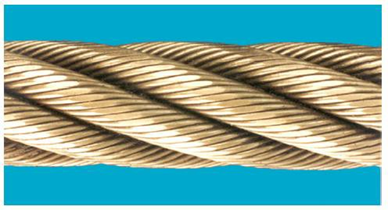
Figure 9. Reduction in diameter due to external wear
8.3.2 Local Reduction in diameter due to sunken strand / core deterioration
Discarded (assigned severity level 100%)

Figure 10. Local Reduction in diameter due to sunken strand / core deterioration
8.4 Severity of local increase in diameter
Rope diameter may also increase due to distortion, as represented in picture below.

Figure 11. Local increase in diameter due to distortion
The reason for this shall be investigated and severity ratings should be applied as follows:
| Rope Type | Local increase in diameter Δd% (expressed as % of nominal diameter) | Severity Rating % |
|---|---|---|
| Rope with Fibre Core | Δd < 6% | 0 |
| 6% ≤ Δd < 7% | 20 | |
| 7% ≤ Δd < 8% | 40 | |
| 8% ≤ Δd < 9% | 60 | |
| 9% ≤ Δd < 10% | 80 | |
| Δd ≥ 10% | 100 | |
| Rope with Steel Core | Δd < 1% | 0 |
| 1% ≤ Δd < 2% | 20 | |
| 2% ≤ Δd < 3% | 40 | |
| 3% ≤ Δd < 4% | 60 | |
| Δd ≥ 5% | 100 |
9. Assessment Criterion – Broken Wires
9.1 Identification
Wire breaks may occur in crown area or valley area as seen in pictures below:
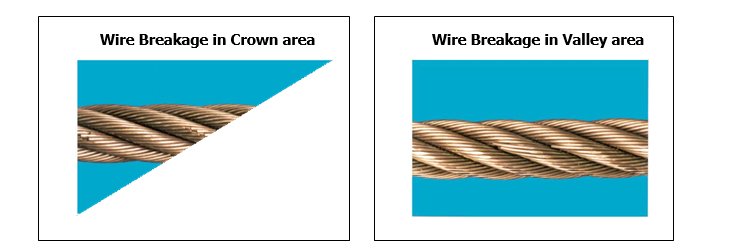
Figure 12. Wire breaks in crown area
9.2 Assigning severity level
Individual areas showing breakages of wires should be evaluated in following manner:
- Count number of broken wires existing over a length of 30 times the wire rope diameter, d.
- Calculate what percentage are these broken wires (counted over the length 30d) of the total number of load bearing wires in the outer layer of strands in the rope:
N% = (Nb30 / N) x 100 (%)
Where,
- Nb30 = Number of broken wires counted over a length of approximately 30d
- N = Total number of load bearing wires in the outer strands of the rope
- If certain areas are observed to have higher concentration of wire breakage, number of wires broken over a length of approximately 6 times the nominal diameter to be counted.
Based on section 7B.2, severity level to be assigned as specified below:
| Condition in relation to broken wires | Severity Rating % |
|---|---|
| Percentage of Load Bearing Wires broken over a length of 30 times the nominal rope diameter, N (%) | |
| N < 0.5% | 0 |
| 0.5% ≤ N < 1% | 20 |
| 1% ≤ N < 1.5% | 40 |
| 1.5% ≤ N < 2% | 60 |
| 2.5% ≤ N < 3% | 80 |
| N ≥ 3% | 100 |
| More than 12 wires broken over a length of 30 times the rope dia | 100 |
| Concentrated wire breaking More than 6 wires broken over a length of 6 times the rope dia |
100 |
| More than two wires broken at the termination | 100 |
10. Assessment Criterion – Corrosion
10.1 General
The rope sections undergoing inspection shall be wiped or brushed clean in order that oxidation of foreign particles on rope surface is not misjudged as wire rope corrosion.
The use of solvents for cleaning should be avoided.
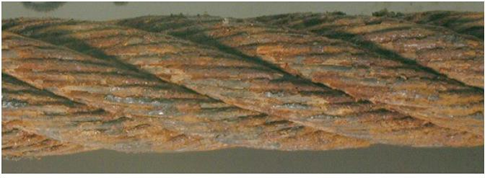
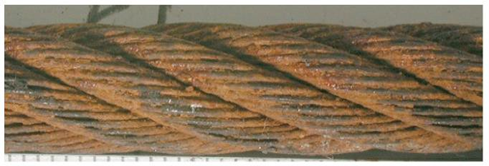
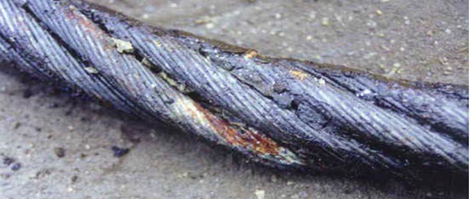
The discard criteria and intermediate severity ratings for corrosion are given in Table below.
| Condition | Severity Rating % |
|---|---|
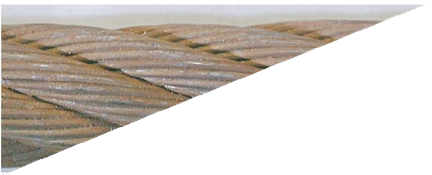
| External Corrosion Signs of surface oxidation, but can be wiped clean (superficial) |
0% |
 |
|
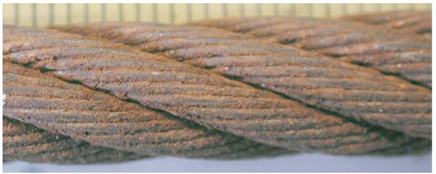
| External Corrosion Oxidation on wire surface. Surface rough to touch |
40% |
 |
|
| External Corrosion Surface greatly affected by Oxidation, starting to pit |
60% |
 |
|
| External Corrosion Surface heavily pitted and wires quite slack, gaps between wires |
100% |
 |
|
| Internal Corrosion Corrosion debris exuding from the valleys between outer strands |
100% |
 |
11. Assessment Criterion – Mechanical Deformation
11.1 General
Wire ropes should be checked for deformation for 4 major types of defects:
- Protrusion
- Flattening
- Kinking
- Waviness
11.2 Protrusion
Ropes with wires protruding in groups shall be immediately discarded – severity level 100%.
A single wire protruding from the core between the outer strands is not necessarily a reason for discard. If it does not interfere with other elements of the rope during operation, it can be removed, and noted as a broken wire in the inspection record (and severity level assigned aptly).
Following protrusion signs call for immediate discard (100% severity level):
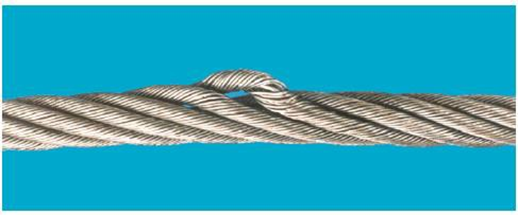
Figure 14. Protrusion of multiple wires
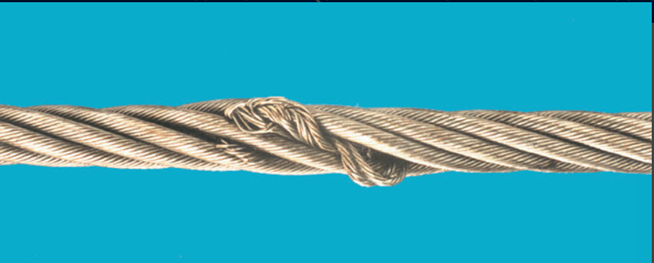
Figure 15. Core Protrusion
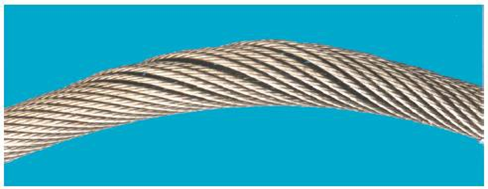
Figure 16. Basket Deformation
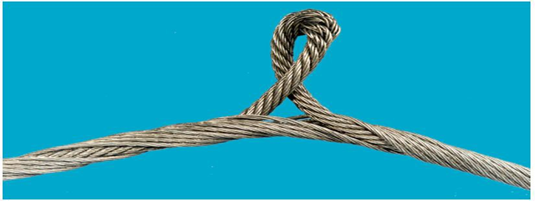
Figure 17. Protrusion of Inner Rope
11.3 Flattening
If flattening is observed, depending on the extent of flattening, and how quickly the condition is likely to deteriorate further, severity level should be assigned. Following considerations should be taken into account:
- Portions of rope which run through a sheave are likely to deteriorate more quickly and exhibit broken wires
- Flattened portions greater degree of corrosion when the outer strands open up and allow ingress of moisture
- Flattened portions of rope, which result from multi-layer spooling, may not have high severity, however these should be checked for number of broken wires and severity assigned accordingly
Figure below shows some examples of flattening:
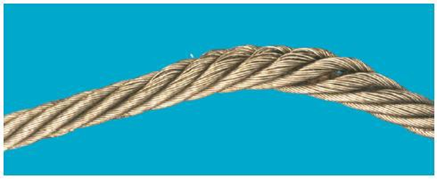
Figure 18. Flattening example 1

Figure 19. Flattening example 2
11.4 Kink or tightened loop
Ropes with a kink or tightened loop shall be immediately discarded (assigned severity level 100%).
Figures below shows some examples of kinking:
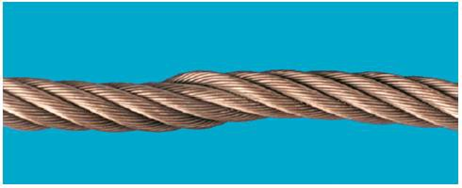
Figure 20. Kinking example 1
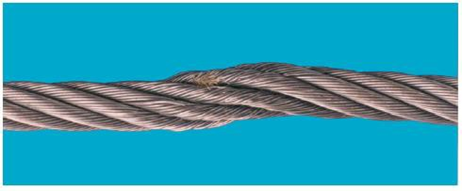
Figure 21. Kinking example 2
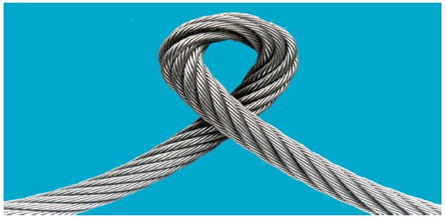
Figure 22. Kinking example 3
11.5 Mechanical deformation / waviness
Waviness is measured as follows:
- Place the rope on a straight edge
- Measure the gap (g) between the underside of the helix and the straight edge
- Express ‘g’ as a fraction of the nominal rope diameter ‘d’ (i.e. calculate g/d)
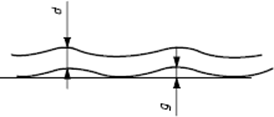
Figure 23. Measurement of waviness
Following is the discharge criteria:
| Description of location | Discard (Severity level 100%) |
|---|---|
| Straight portion that never runs through or around a sheave or spools on to the drum | If g/d > 1/3 |
| Portion of rope that runs through a sheave or spools on to the drum | If g/d > 1/10 |
Figure below depicts waviness of wire rope:
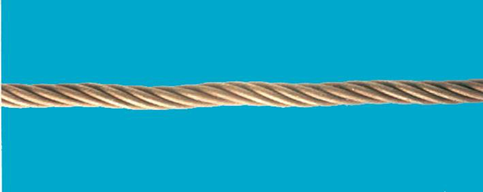
Figure 24. Waviness of wire rope